


What does it mean to be Taiwanese? Can the answer be found among the crumbling walls of a temple in Chiayi, or in the faded black-and-white photo of a family standing outside Kaohsiung Train Station?
The Fragmentized Illusion: An Exhibition of Taiwan Contemporary Photography (片段的幻:台灣當代攝影展) presents work by four of Taiwan’s top artists who examine this topic through mixed media and digital prints.
“The artists didn’t directly experience, for example, the Japanese colonial period or the early history of Taiwan,” said Siraya Pai (白斐嵐), a project administrator for Galerie Grand Ciecle. “But because they live on this land they want to examine and become part of its history.”
Mei Dean-E (梅丁衍), Wu Tien-chang (吳天章), Chen Shun-chu (陳順築) and Yao Jui-chung (姚瑞中) are all second-generation Mainlanders, or Taiwanese whose parents moved from China to Taiwan when it was occupied by the Chinese Nationalist Party (KMT) after World War II. They came of age during the upheavals of the
mid-1980s, a time of increased agitation for
freedom and democracy that culminated in the lifting of Martial Law in 1987.
“Up until that time, Taiwanese identity was repressed by the [KMT] government. They educated us to be Chinese, not Taiwanese. But during the 80s and 90s, people started to think about who we are,” Pai said.
Mei draws on images from the Japanese colonial period and early KMT occupation, such as anti-communist propaganda and show trials, to re-create fragment of Taiwan’s collective memory, while Chen examines the accuracy of his own memory through reproductions of black-and-white snapshots of his family taken in front of the Kaohsiung and Taipei train stations when he was a boy.
Wu adopts the so-called taike (台客) aesthetic using temple rituals and the faux neon glitz of betel nut girls in his digital images to examine a uniquely Taiwanese aesthetic. (Taike is a pejorative term once used by Mainlanders to belittle native-born Taiwanese that has been co-opted by Taiwanese youth seeking a uniquely Taiwanese identity). Yao’s brooding digital prints of deserted buildings, half-demolished factories and abandoned temples leave the viewer thinking that Taiwan’s economic miracle is a thing of the past.
Falling on the 60th anniversary of the KMT’s retreat to Taiwan from China, the exhibit — with its themes of Taiwanese identity and suggestion of decay — seems explicitly political. Was this the gallery’s intention?
“We didn’t set out to do a political exhibition ... but it is how it came out,” said Pai. She added that the artists who were active during the years immediately prior to and after the lifting of Martial Law thought they could use art and activism to create a better society. “But after 20 years of effort, [they] realize that much hasn’t changed,” she said.
The exhibition indirectly raises other questions: How will these artists, many of whom will probably live to see the centenary of the KMT’s occupation, be depicting Taiwan 40 years in the future. And will there be a nation called Taiwan to depict? Looking at the emerging generation of artists and the disenchantment of the artists represented in the exhibit, Pai is somewhat pessimistic.
“Earlier generations care more about this issue because they grew up at a time when it was trendy. But the younger generation of artists seem to care more about globalization,” Pai said.
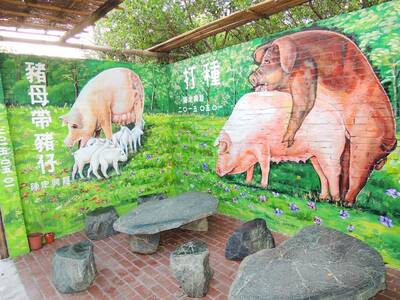
May 6 to May 12 Those who follow the Chinese-language news may have noticed the usage of the term zhuge (豬哥, literally ‘pig brother,’ a male pig raised for breeding purposes) in reports concerning the ongoing #Metoo scandal in the entertainment industry. The term’s modern connotations can range from womanizer or lecher to sexual predator, but it once referred to an important rural trade. Until the 1970s, it was a common sight to see a breeder herding a single “zhuge” down a rustic path with a bamboo whip, often traveling large distances over rugged terrain to service local families. Not only
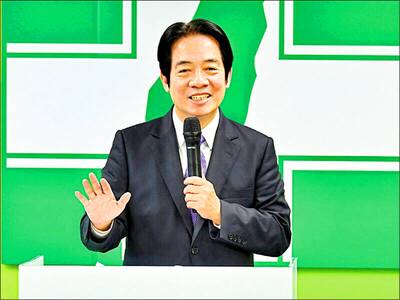
Ahead of incoming president William Lai’s (賴清德) inauguration on May 20 there appear to be signs that he is signaling to the Chinese Communist Party (CCP) and that the Chinese side is also signaling to the Taiwan side. This raises a lot of questions, including what is the CCP up to, who are they signaling to, what are they signaling, how with the various actors in Taiwan respond and where this could ultimately go. In the last column, published on May 2, we examined the curious case of Democratic Progressive Party (DPP) heavyweight Tseng Wen-tsan (鄭文燦) — currently vice premier
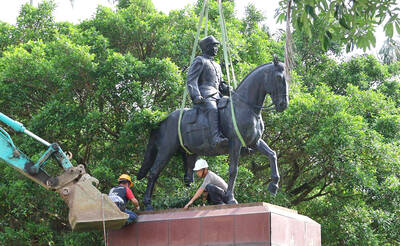
The last time Mrs Hsieh came to Cihu Park in Taoyuan was almost 50 years ago, on a school trip to the grave of Taiwan’s recently deceased dictator. Busloads of children were brought in to pay their respects to Chiang Kai-shek (蔣中正), known as Generalissimo, who had died at 87, after decades ruling Taiwan under brutal martial law. “There were a lot of buses, and there was a long queue,” Hsieh recalled. “It was a school rule. We had to bow, and then we went home.” Chiang’s body is still there, under guard in a mausoleum at the end of a path

Last week the Directorate-General of Budget, Accounting and Statistics (DGBAS) released a set of very strange numbers on Taiwan’s wealth distribution. Duly quoted in the Taipei Times, the report said that “The Gini coefficient for Taiwanese households… was 0.606 at the end of 2021, lower than Australia’s 0.611, the UK’s 0.620, Japan’s 0.678, France’s 0.676 and Germany’s 0.727, the agency said in a report.” The Gini coefficient is a measure of relative inequality, usually of wealth or income, though it can be used to evaluate other forms of inequality. However, for most nations it is a number from .25 to .50


 RSS
RSS