


The team of artists and designers who make up Islanders Studio (島民工作室) take the experience of living in an island nation and interpret it in everyday objects with a modern twist.
Whimsical but elegant lampshades and candleholders are shaped like animals native to Taiwan. Planters are inspired by the first island to disappear as a result of global warming, the agricultural history of Taiwan and the 921 Earthquake. Even a toilet brush in the shape of a stylized fish reminds users that anything they toss in their commode eventually ends up in the ocean.
Islanders Studio’s combination studio and store off Jinshan South Road (金山南路) near National Taiwan Normal University also hosts rotating exhibitions of emerging artists’ work.
“We hope to have exchanges with islands all over the world,” says executive director Hsiu-Ling Kuo (郭秀鈴). “‘Island’ is not necessarily just a geographic term. When we talk about the experience of islands and islanders, it includes the experiences of living in isolated areas all around the world.”
The environment is a repeating motif in many of Islanders Studio’s products, including the Lohachara Island flower planter. The center of the white ceramic planter has an opening shaped like the islet in India’s part of the Sundarban Delta, which researchers consider the first island to have been submerged by the effects of global warming. As plants grow, they turn into a miniature tribute to the lost island.
Another planter is square with a crack-shaped opening that leaves peep through as they grow. It pays homage to the process of rebuilding that Taiwan underwent after the 921 Earthquake. “You saw a lot of holes in the wall, but plants still grew through those cracks. For us, it symbolizes the dynamism of life on an island, despite all sorts of natural disasters,” says Kuo.
Other products highlight Taiwan’s ecology, including Islanders Studio’s best-selling series of paper lampshades, inspired by endangered species native to the country. Made from recycled materials, the lampshades are shaped like a Formosan black bear, sika deer, wild boar or scops owl. These animals also appear in candleholders that can be stacked on top of one another, creating a visual cross between the Bremen Town Musicians fairy tale and the allegorical tree of life.
Kuo says that the intent of the products is to allow people to enjoy the beauty of the animals without killing them. The lampshades are also sold in stores in England and the Netherlands.
“We hope by using these animals as a motif, we can make the world aware of different endangered species on this island. In terms of the environment, Taiwan hasn’t garnered very much international attention, but there are really a lot of precious indigenous species here,” says Kuo.
The studio’s downstairs exhibit space, Sugar Cube Gallery (白方糖畫廊), displays artwork that focuses on ideas relevant to Islanders Studio’s mission. The current show features pieces by Kuo Chiayun (郭家妘), a young artist who used ink and wash paintings of stray dogs to convey the feelings of isolation and homesickness she experienced when she moved from southern Taiwan to Taipei for university. In conjunction with the exhibit, Islanders Studio is hosting a series of talks that also explore the theme of displacement. The last talk in the series, by director and documentary filmmaker Hsueh Changhui (薛常慧), will take place on Aug. 29 at 2pm.
Hsiu-Ling Kuo spent 10 years in the UK and Germany studying and working and says that her time abroad influenced her decision to help found Islanders Studio. As a student, Kuo found that many of her classmates’ knowledge of Taiwan was limited to cross-strait relations.
“In terms of culture, people know very little. That was an important drive for me to come back to Taiwan to work, to try to know my country better and introduce it to the international community,” says Kuo.
The Islanders Studio team also wants “to help our fellow countrypeople appreciate our own culture more,” she adds. “Being abroad for so many years, I realized in Taiwan we really have a lot to contribute in terms of the natural environment. The minute you step outside of Taipei, you can really see that Taiwan is a beautiful island everywhere, in the east, the north and the south. It’s all very different.”

In late October of 1873 the government of Japan decided against sending a military expedition to Korea to force that nation to open trade relations. Across the government supporters of the expedition resigned immediately. The spectacle of revolt by disaffected samurai began to loom over Japanese politics. In January of 1874 disaffected samurai attacked a senior minister in Tokyo. A month later, a group of pro-Korea expedition and anti-foreign elements from Saga prefecture in Kyushu revolted, driven in part by high food prices stemming from poor harvests. Their leader, according to Edward Drea’s classic Japan’s Imperial Army, was a samurai

The following three paragraphs are just some of what the local Chinese-language press is reporting on breathlessly and following every twist and turn with the eagerness of a soap opera fan. For many English-language readers, it probably comes across as incomprehensibly opaque, so bear with me briefly dear reader: To the surprise of many, former pop singer and Democratic Progressive Party (DPP) ex-lawmaker Yu Tien (余天) of the Taiwan Normal Country Promotion Association (TNCPA) at the last minute dropped out of the running for committee chair of the DPP’s New Taipei City chapter, paving the way for DPP legislator Su
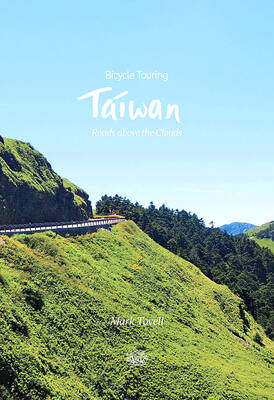
It’s hard to know where to begin with Mark Tovell’s Taiwan: Roads Above the Clouds. Having published a travelogue myself, as well as having contributed to several guidebooks, at first glance Tovell’s book appears to inhabit a middle ground — the kind of hard-to-sell nowheresville publishers detest. Leaf through the pages and you’ll find them suffuse with the purple prose best associated with travel literature: “When the sun is low on a warm, clear morning, and with the heat already rising, we stand at the riverside bike path leading south from Sanxia’s old cobble streets.” Hardly the stuff of your
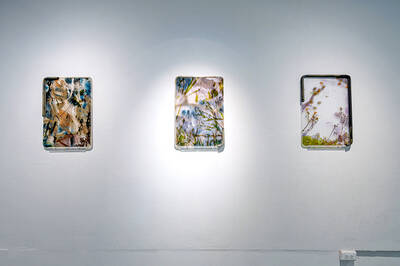
Located down a sideroad in old Wanhua District (萬華區), Waley Art (水谷藝術) has an established reputation for curating some of the more provocative indie art exhibitions in Taipei. And this month is no exception. Beyond the innocuous facade of a shophouse, the full three stories of the gallery space (including the basement) have been taken over by photographs, installation videos and abstract images courtesy of two creatives who hail from the opposite ends of the earth, Taiwan’s Hsu Yi-ting (許懿婷) and Germany’s Benjamin Janzen. “In 2019, I had an art residency in Europe,” Hsu says. “I met Benjamin in the lobby


 RSS
RSS