


Wang Ting-yu (王挺宇) admits that he deliberately conceals his true intentions from gallerygoers, who are likely to look upon his latest series of oil paintings as merely the pictorial embodiment of the artist’s personal dreams and fantasies.
One work depicts what looks like an ancient landscape in the middle of which a mysterious crystal rises like a stalagmite with the full moon floating above. Another shows a group of hunters posing happily with their dead quarry in a burned-out forest.
Explanatory notes purport to fill in the gaps concerning where and how these seemingly inexplicable events happened in a quasi-objective manner that mimics news reporting. Wang’s monochromatic, almost sepia, palette conveys a sense of photographic realism. But the complete absence of perspective constantly reminds visitors of his works’ fictional nature.
The interplay between the real and
non-real is underlined in the 28-year-old artist’s solo exhibition, The World Mystery (世界之謎), currently on display at Project Fulfill Art Space (就在藝術中心).
“I don’t see my works merely as oil paintings. My interest lies in images, and [for this particular series of works], how the media use images to construct a world,” Wang said.
Wang based the characters in his paintings on found images he culled from magazines and the Internet. For Fishing Miracle, Wang Googled “John fishing” and used photographs he found on the Web to paint a group of fishermen posing with their catch. For Sky Worried and Silent Fall, Wang flipped through issues of Next Magazine looking for snapshots of couples that he transformed into a scene of people standing by their cars amid a landscape rent by cracks and fissures that seem to have resulted from a natural catastrophe. The characters appear to be waiting for some sort of miracle to happen.
“When I put together all these people who had been photographed at different times and places a story begins to take shape. Some people seem to be looking up at the sky and some appear agitated. From their expressions and gestures I can imagine the kind of worlds they live in,” Wang explained.
The artist, however, leaves clues to his characters’ origins in the real world. Unlike their surroundings, which are fleshed out in several layers of paint, the figures themselves are sketched simply in a few brushstrokes. Only experienced gallerygoers notice the difference, Wang said.
For not-so-experienced visitors, it’s fun enough to be charmed by these imagined worlds, which feel mythical and yet oddly familiar. The backdrop in one painting looks like a site used for a ritual, another mimics a tourist destination, and a third recalls a disaster area. The unifying theme running through all of these works is that the characters in them seem drawn to these sites by some inexplicable force. Critics have noted that Wang’s paintings re-create the supernatural and mysterious sensations photography evoked when it first appeared. Wang, however, says the experience he aims to replicate is that of viewing a spectacle as presented through the lens of the mass media. In so doing he hopes to encourage viewers to question society’s obsession with these spectacles and how the way in which reality is represented in the media determines how they themselves view the world.
For Moo-vei Ricpoche’s Psychic Shoot ─ Final Scenery (目費仁波切靈視攝影—最後風景系列), a series of photographic works that won first place at last year’s Taipei Art Awards, Wang created a fictional Buddhist master, or Rinpoche, named Moo-vei who is able to photograph the last image people see before dying. The visions captured by the Rinpoche are in fact the final scenes of movies Wang photographed from a television screen. The names of the deceased and their death dates were randomly picked from The Internet Movie Database (www.imdb.com).
Wang noticed something interesting after he completed the series.
“I found that 80 percent of the movies I collected end with landscapes. The camera lingers [on the last scene] and gradually pulls away from it. It’s like the soul departing from the body and flying towards the sky,” he said.

In late October of 1873 the government of Japan decided against sending a military expedition to Korea to force that nation to open trade relations. Across the government supporters of the expedition resigned immediately. The spectacle of revolt by disaffected samurai began to loom over Japanese politics. In January of 1874 disaffected samurai attacked a senior minister in Tokyo. A month later, a group of pro-Korea expedition and anti-foreign elements from Saga prefecture in Kyushu revolted, driven in part by high food prices stemming from poor harvests. Their leader, according to Edward Drea’s classic Japan’s Imperial Army, was a samurai

The following three paragraphs are just some of what the local Chinese-language press is reporting on breathlessly and following every twist and turn with the eagerness of a soap opera fan. For many English-language readers, it probably comes across as incomprehensibly opaque, so bear with me briefly dear reader: To the surprise of many, former pop singer and Democratic Progressive Party (DPP) ex-lawmaker Yu Tien (余天) of the Taiwan Normal Country Promotion Association (TNCPA) at the last minute dropped out of the running for committee chair of the DPP’s New Taipei City chapter, paving the way for DPP legislator Su
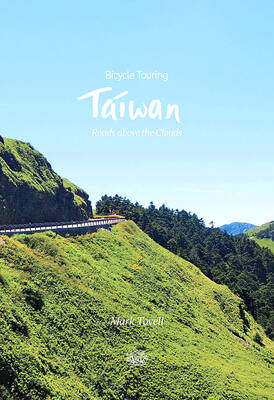
It’s hard to know where to begin with Mark Tovell’s Taiwan: Roads Above the Clouds. Having published a travelogue myself, as well as having contributed to several guidebooks, at first glance Tovell’s book appears to inhabit a middle ground — the kind of hard-to-sell nowheresville publishers detest. Leaf through the pages and you’ll find them suffuse with the purple prose best associated with travel literature: “When the sun is low on a warm, clear morning, and with the heat already rising, we stand at the riverside bike path leading south from Sanxia’s old cobble streets.” Hardly the stuff of your

Located down a sideroad in old Wanhua District (萬華區), Waley Art (水谷藝術) has an established reputation for curating some of the more provocative indie art exhibitions in Taipei. And this month is no exception. Beyond the innocuous facade of a shophouse, the full three stories of the gallery space (including the basement) have been taken over by photographs, installation videos and abstract images courtesy of two creatives who hail from the opposite ends of the earth, Taiwan’s Hsu Yi-ting (許懿婷) and Germany’s Benjamin Janzen. “In 2019, I had an art residency in Europe,” Hsu says. “I met Benjamin in the lobby


 RSS
RSS