


Building on the success of Terra-Cotta Army (兵馬俑) of Qin Shihuangdi (秦始皇帝) , an exhibit that attracted over 1.5 million visitors during the summer of 2007, the National Museum of History returns with a new exhibition of ancient Chinese funerary objects, The Smiling Kingdom: The Terra-Cotta Warriors of Han Yang Ling (微笑彩俑—漢景帝的地下王國), which displays figurines excavated from the mausoleum of the Emperor Jing of Han, dating from the early Han Dynasty (180BC to 141BC).
Though less than a century separates the figurines of the Han Dynasty exhibit and the preceding Qin Dynasty (221BC to 206BC) show, their style and stature differs significantly, with the latter favoring life-sized terra-cotta warriors and martial animals and the former miniature figures.
The Smiling Kingdom examines two aspects of the Emperor Jing’s imperial tomb to illustrate the concept that changes in society can be examined through funeral practices. The main part focuses on the clay figurines that were buried with the emperor, while a smaller section is devoted to the building materials that were employed to construct his mausoleum. Small replica burial sites, illustrations detailing the excavation area and a documentary of the archeological dig complement the 200 display objects, which include bronze utensils and jade decorations.
Two model excavation sites enable visitors to view the animal and human figurines as they were found in situ. The first, at the entrance, is approximately a 2m-by-10m glass case sunk 1m below ground and lined with rows of miniature terra-cotta dogs, pigs, goats and roosters, a display that would have been difficult to employ with the larger horses found in Qin Shihuang’s (秦始皇) mausoleum.
Immediately beyond this display is a replica burial mound strewn with armless, smiling and nude terra-cotta figures — all 60cm in height — with the originals located in an adjoining room displayed behind glass, accompanied by diagrams illustrating how they were created.
The figures were first modeled as nude bodies complete with male or female sexual organs (or none for eunuchs). The craftsmen then painted on hair and skin, fitted the torsos with movable wooden arms and hands and covered them with clothing. With the passage of time, however, the paint has faded and the arms and clothing have disintegrated. Several examples with limbs made of clay survived intact.
The building materials on display offer unique insights into the design of the emperor’s mausoleum: paving bricks inscribed with horizontal and vertical lines and roof tiles and bricks embossed with dragon designs show that the construction of the mausoleum’s buildings was as detailed and important as the figures inside.
Although not as wide ranging as Terra-Cotta Army of Qin Shihuangdi, the current exhibit of early Han Dynasty terra-cotta objects provides a solid introduction to the period and draws connections between societal changes and funeral practices.

In late October of 1873 the government of Japan decided against sending a military expedition to Korea to force that nation to open trade relations. Across the government supporters of the expedition resigned immediately. The spectacle of revolt by disaffected samurai began to loom over Japanese politics. In January of 1874 disaffected samurai attacked a senior minister in Tokyo. A month later, a group of pro-Korea expedition and anti-foreign elements from Saga prefecture in Kyushu revolted, driven in part by high food prices stemming from poor harvests. Their leader, according to Edward Drea’s classic Japan’s Imperial Army, was a samurai

The following three paragraphs are just some of what the local Chinese-language press is reporting on breathlessly and following every twist and turn with the eagerness of a soap opera fan. For many English-language readers, it probably comes across as incomprehensibly opaque, so bear with me briefly dear reader: To the surprise of many, former pop singer and Democratic Progressive Party (DPP) ex-lawmaker Yu Tien (余天) of the Taiwan Normal Country Promotion Association (TNCPA) at the last minute dropped out of the running for committee chair of the DPP’s New Taipei City chapter, paving the way for DPP legislator Su
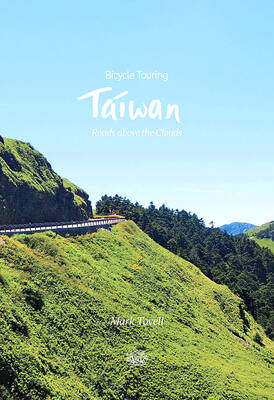
It’s hard to know where to begin with Mark Tovell’s Taiwan: Roads Above the Clouds. Having published a travelogue myself, as well as having contributed to several guidebooks, at first glance Tovell’s book appears to inhabit a middle ground — the kind of hard-to-sell nowheresville publishers detest. Leaf through the pages and you’ll find them suffuse with the purple prose best associated with travel literature: “When the sun is low on a warm, clear morning, and with the heat already rising, we stand at the riverside bike path leading south from Sanxia’s old cobble streets.” Hardly the stuff of your
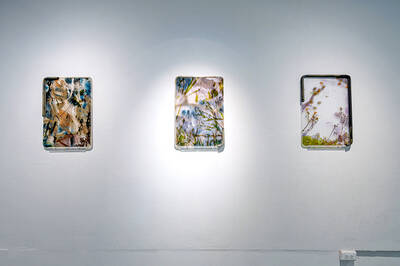
Located down a sideroad in old Wanhua District (萬華區), Waley Art (水谷藝術) has an established reputation for curating some of the more provocative indie art exhibitions in Taipei. And this month is no exception. Beyond the innocuous facade of a shophouse, the full three stories of the gallery space (including the basement) have been taken over by photographs, installation videos and abstract images courtesy of two creatives who hail from the opposite ends of the earth, Taiwan’s Hsu Yi-ting (許懿婷) and Germany’s Benjamin Janzen. “In 2019, I had an art residency in Europe,” Hsu says. “I met Benjamin in the lobby


 RSS
RSS