


Three ravishing young sisters sneak out of their family party at the Plaza Hotel. Struck with pity for an old carriage horse wearing a silly straw hat, they impulsively attempt a rescue. It swiftly ends in horror, sirens wailing, hand-sewn silk gowns soaked in blood.
So begins Alice Hoffman’s latest novel, The Story Sisters (Shaye Areheart). The oldest, Elv, creates a parallel fantasy world for herself and her siblings, but they all seem caught in a fairy-tale curse, their young lives ravaged by rape, drug addiction, fatal ailments and tragic accidents.
Hoffman wrote her first novel, Property Of, at 21, while studying creative writing at Stanford University. She has become the best-selling author of 25 books, and her work has been translated into over 20 languages.
We spoke at Bloomberg global headquarters in New York.
Zinta Lundborg: Is failed rescue one of the themes of your novel?
Alice Hoffman: I really don’t know what the theme of a book is when I’m writing it. I know what the story is, I know who the characters are, but the theme is something that really plays itself out in the writing.
I think it’s very much about wanting to be rescued, about wanting to rescue someone, and the final realization that you really can’t rescue anyone. You can only rescue yourself.
ZL: Why does the mother know so little of her children’s real lives?
AH: Annie is a typical mother. I think most mothers don’t have a clue as to the interior lives of their children. Those who do are very rare, and it often comes later in life. But during the time they’re adolescents and young adults, I don’t think we know the first thing about them.
They keep it secret from us. Partially, we don’t want to know, but, partially, they don’t want to tell us.
ZL: Why are the grandmothers so strong?
AH: I was very close to my grandmother. Children with grandparents are really lucky since you don’t have those issues you have with your parents, and it’s a freer, more loving relationship.
The two grandmother figures are like the fairy godmothers: they really understand the children and they try to set things right.
ZL: In your book, what are the limits of love?
AH: Love is all you have. There is nothing else, and that’s what the characters discover. But you can’t save someone from their own fate or their own destiny or their own willfulness or the traumas that happen to them. You can love them, but you can’t necessarily save them from living their lives.
ZL: The oldest sister creates a separate reality with its own language and myths and draws the other two in. Does this ultimately help or hurt them?
AH: Do stories help us work out reality, or is it a way to avoid reality? I tend to believe that stories help, and that making a narrative out of the real world is a way to understand it at a very deep level that is very hard to get to in our conscious waking lives. And that’s why people tell stories and always have: whoever tells the stories creates the society.
ZL: Why do you make animals so important in the sisters’ lives?
AH: There’s a depth and honesty of connection, and loyalty, that’s hard to find in the human world. For a lot of characters in the book, it’s a salvation. They are able to understand love and then move toward the human world.
ZL: You have pets, I gather?
AH: I’ve had lots of animals all my life, though at the moment I have only one, a Polish sheepdog, who’s anti-dog. He just wants to look out the window and be left alone.
ZL: What’s your reaction to being described as a “magical” writer?
AH: I like to write about real people in mythic ways because I see them that way. The tradition of literature is magic, whether it’s fairy tales or Kafka, Shakespeare or the Brontes, and the whole idea of realism is a new and not-so-interesting idea.
ZL: What’s the most memorable response you’ve gotten to your work?
AH: I received a beautiful letter from a woman whose son was in the second tower on 9/11, and she said reading my book allowed her to feel some of the feelings she was staying away from as too scary.
ZL: Nicole Kidman and Sandra Bullock starred in Practical Magic, one of your novels made into films, plus you’ve been a screenwriter. How has that affected your writing?
AH: Practical Magic wasn’t the book, but it’s a fun Hollywood movie with six great women in it. Screenplays taught me to cut away some of the excess and think about what’s really important. I collaborated with my husband since you got a lot more respect if you went in with a male partner.
ZL: How did you meet him?
AH: On a blind date. His car broke down, he wasn’t wearing a coat, he’d given it to a homeless guy, and he seemed somewhat interesting.

In late October of 1873 the government of Japan decided against sending a military expedition to Korea to force that nation to open trade relations. Across the government supporters of the expedition resigned immediately. The spectacle of revolt by disaffected samurai began to loom over Japanese politics. In January of 1874 disaffected samurai attacked a senior minister in Tokyo. A month later, a group of pro-Korea expedition and anti-foreign elements from Saga prefecture in Kyushu revolted, driven in part by high food prices stemming from poor harvests. Their leader, according to Edward Drea’s classic Japan’s Imperial Army, was a samurai

The following three paragraphs are just some of what the local Chinese-language press is reporting on breathlessly and following every twist and turn with the eagerness of a soap opera fan. For many English-language readers, it probably comes across as incomprehensibly opaque, so bear with me briefly dear reader: To the surprise of many, former pop singer and Democratic Progressive Party (DPP) ex-lawmaker Yu Tien (余天) of the Taiwan Normal Country Promotion Association (TNCPA) at the last minute dropped out of the running for committee chair of the DPP’s New Taipei City chapter, paving the way for DPP legislator Su
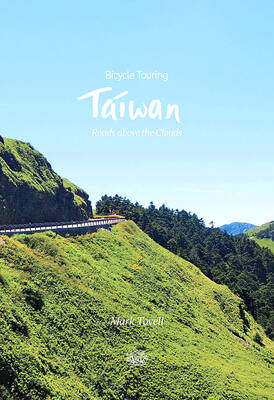
It’s hard to know where to begin with Mark Tovell’s Taiwan: Roads Above the Clouds. Having published a travelogue myself, as well as having contributed to several guidebooks, at first glance Tovell’s book appears to inhabit a middle ground — the kind of hard-to-sell nowheresville publishers detest. Leaf through the pages and you’ll find them suffuse with the purple prose best associated with travel literature: “When the sun is low on a warm, clear morning, and with the heat already rising, we stand at the riverside bike path leading south from Sanxia’s old cobble streets.” Hardly the stuff of your

Located down a sideroad in old Wanhua District (萬華區), Waley Art (水谷藝術) has an established reputation for curating some of the more provocative indie art exhibitions in Taipei. And this month is no exception. Beyond the innocuous facade of a shophouse, the full three stories of the gallery space (including the basement) have been taken over by photographs, installation videos and abstract images courtesy of two creatives who hail from the opposite ends of the earth, Taiwan’s Hsu Yi-ting (許懿婷) and Germany’s Benjamin Janzen. “In 2019, I had an art residency in Europe,” Hsu says. “I met Benjamin in the lobby


 RSS
RSS