


Come November, the number 2012 is likely to be on all cinema billboards advertising Roland Emmerich’s new take on apocalypse. The date 2012 is significant in a number of doomsday predictions and also marks the end of the 13th baktun cycle of the Mesoamerican Long Count calendar. While this in itself does not presage the end of the world, it does suggest, to all who want to believe in such things, a time of cataclysmic change.
The performance work 2012 by Mobius Strip Theater (莫比斯圓環創作公社) that starts Thursday should provide a rather more thoughtful reflection on the prospect of a new age compared to Emmerich’s star-studded end-of-the-world piece. Mobius Strip Theater, which was established in 2005 by a number of young performers including Faye Liang (梁菲倚) and Alex Cheung (張藝生), has a deep interest in exploring existential themes through theater and spiritual practices.
Liang and Cheung, former students at the Hong Kong Academy for Performing Arts (香港演藝學院) and former members of Taiwan’s U-Theater (優人神鼓), formed the group as a means of exploring new avenues of self-discovery and self-expression. One of the show’s three curators, Akash, is a dancer and yogi from Hong Kong with a deep interest in shamanism and spiritual healing.
Unsurprisingly, there is a strongly spiritual and New Age vibe to 2012, which is made up of seven sections, each a unique work created by an independent artist. The seven artists were brought together by curators Cheung and Akash.
“The date 2012 is significant in some spiritual beliefs, as well as in science. I wanted to explore this idea … We might not know exactly what may happen in 2012, but there is the idea that time is running out. That it is time that we start to grow up,” said Akash. “The idea of 2012, which is only three years away, is not a pressure, but a motivation, a reminder that certain things should be done before it is too late.”
Each of the seven pieces in 2012 is based on one of the seven chakras, or energy points, which, according to Hindu and Buddhist Tantric beliefs, exist in the human body. In the simplest terms, the opening of these chakras to allow the free flow of energy is fundamental to health and spiritual advancement. The production will progress through separate pieces that represent each of the chakras. According to Liang, the production is a mixture of ritual and theater in which the line of separation between performer and audience will at some points be deliberately blurred. It will end with a U-Theatre-like drumming session.
This is the second major production by Mobius Strip in Taiwan, and Liang said that they are still learning to negotiate the byzantine complexity of Taiwan’s arts funding organization. Given its inexperience, the fact that the group has been able to book the underused Jingmei Culture Park (景美文化園區) for 2012 show is a remarkable and fortuitous achievement. The park, a former detention center for political prisoners, has received little publicity since its conversion to an art space in the manner of Huashan Culture Park (華山文化園區), largely due to controversy over its political associations. Questions have been raised in the media over whether the site should, as a memorial to those who suffered for democracy, be open to art performances, and also over whether the park should be called the “Jingmei Human Rights Culture Park.”
For a production that looks closely at issues dealing with the search for personal liberation or some form of redemption in the run-up to the dawning of a new age, the venue seems remarkably appropriate. The guard towers, the razor wire and the stark concrete buildings that form the main features of the park strongly suggest the sense of imprisonment, often self-imposed, felt by individuals wandering through this world.
PERFORMANCE NOTES:
WHAT: 2012 by Mobius Strip Theater
WHEN: Thursday to June 28 at 7:30pm
WHERE: Jingmei Culture Park (景美文化園區), 131 Fusing Rd, Sindian City, Taipei County (台北縣新店市復興路131號)
TICKETS: NT$500, available through NTCH ticketing or online at www.artsticket.com.tw
On the Net: www.wretch.cc/blog/mstheatre

In late October of 1873 the government of Japan decided against sending a military expedition to Korea to force that nation to open trade relations. Across the government supporters of the expedition resigned immediately. The spectacle of revolt by disaffected samurai began to loom over Japanese politics. In January of 1874 disaffected samurai attacked a senior minister in Tokyo. A month later, a group of pro-Korea expedition and anti-foreign elements from Saga prefecture in Kyushu revolted, driven in part by high food prices stemming from poor harvests. Their leader, according to Edward Drea’s classic Japan’s Imperial Army, was a samurai

The following three paragraphs are just some of what the local Chinese-language press is reporting on breathlessly and following every twist and turn with the eagerness of a soap opera fan. For many English-language readers, it probably comes across as incomprehensibly opaque, so bear with me briefly dear reader: To the surprise of many, former pop singer and Democratic Progressive Party (DPP) ex-lawmaker Yu Tien (余天) of the Taiwan Normal Country Promotion Association (TNCPA) at the last minute dropped out of the running for committee chair of the DPP’s New Taipei City chapter, paving the way for DPP legislator Su
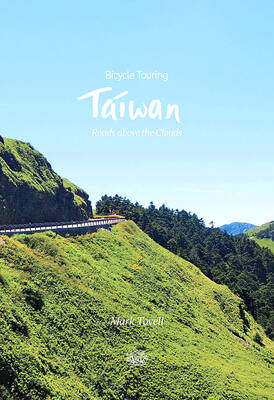
It’s hard to know where to begin with Mark Tovell’s Taiwan: Roads Above the Clouds. Having published a travelogue myself, as well as having contributed to several guidebooks, at first glance Tovell’s book appears to inhabit a middle ground — the kind of hard-to-sell nowheresville publishers detest. Leaf through the pages and you’ll find them suffuse with the purple prose best associated with travel literature: “When the sun is low on a warm, clear morning, and with the heat already rising, we stand at the riverside bike path leading south from Sanxia’s old cobble streets.” Hardly the stuff of your
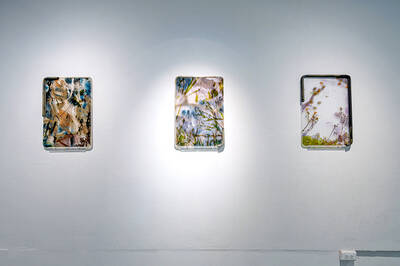
Located down a sideroad in old Wanhua District (萬華區), Waley Art (水谷藝術) has an established reputation for curating some of the more provocative indie art exhibitions in Taipei. And this month is no exception. Beyond the innocuous facade of a shophouse, the full three stories of the gallery space (including the basement) have been taken over by photographs, installation videos and abstract images courtesy of two creatives who hail from the opposite ends of the earth, Taiwan’s Hsu Yi-ting (許懿婷) and Germany’s Benjamin Janzen. “In 2019, I had an art residency in Europe,” Hsu says. “I met Benjamin in the lobby


 RSS
RSS