


When Chang Dai-chien (張大千) met Pablo Picasso in 1956, art critics hailed the confab as a summit between the world’s greatest living artists. Although Picasso and Chang worked in different genres, they were united by their artistic genius and the profound influence they exerted on their respective cultures. A photograph of the two artists forms part of a retrospective of Chang’s work that is currently on display at the National Museum of History.
Entitled Chang Dai-chien: Memorial Painting and Calligraphy Exhibition (張大千110 — 書畫紀念特展), the exhibit features 96 of Chang’s works as a means of illustrating his entire oeuvre — from his early calligraphy and ink paintings to the Buddhist fresco-inspired works of his middle period and the expressionist paintings of his late period.
Documentaries of the artist’s life and work, photos of Chang pictured with famous personalities and brief introductions — in English and Chinese — provide added depth.
Chang is unquestionably an artistic legend. Art historians generally agree that his faculty for emulating the styles and techniques found in the Chinese artistic tradition of ink painting and calligraphy dating as far back as the Tang Dynasty is unsurpassed. As such, the exhibit is as much a survey of the tradition of Chinese pictorial art over the past 1,000 years as it is an exhibition of one artist’s work.
The museum, to its credit, doesn’t skirt around Chang’s career as a copier and forger. Nor does it linger on those concerns — copying the great masters is presented as a necessary stage in Chang’s artistic development.
The 1929 Painting in the Style of Shih T’ao’s “Grass Hut by the Path in Autumn” (仿石濤秋徑草堂圖) illustrates Chang’s mastery of previous styles.
The lower half of the canvas, rendered in shades of dark green, blobs of black and pale brown, depicts an intellectual sitting outside a thatched hut that is partially obscured by thick foliage. Chang, following in a tradition developed by Shih T’ao, uses negative space as a means of showing perspective.
In 1939, Chang traveled to Dunhuang (敦煌), an ancient city along the Silk Road in the northwest of China, to study the Buddhist frescoes located in the Mogao Caves (莫高窟). The almost three years he spent there left an indelible mark on his painting technique.
Deity Descending to Earth (降聖圖) reveals the direction Chang was taking. The vibrant oranges, yellows, greens, blues and reds of this painting replicate the ornamental beauty of the Buddhist frescoes and contrasts the ink painting tradition that emphasizes line over color.
The influence of these Buddhist frescoes can be seen in the paintings of the following decade when vivid coloring appears in Chang’s pictures that depict more traditional subject matter. Seeking Inspiration (覓句圖) is an ink painting of an intellectual sitting at a desk under a tree and contemplating nature. The vibrant blue cap he wears on his head and the red flower on his table, as well as the green leaves growing on the tree, reveal that ornamental coloring had become an important part of Chang’s style.
There is another reason why this painting is important: the vase holding the flower is rendered in expressionist swaths of green, blue and red — a technique of painting and use of color that would come to characterize much of Chang’s later work.
Chang fled China after the civil war and made his home in the West for the next 25 years, mostly in the US and Brazil. During that time, he traveled extensively across Europe studying the modernist styles popular at that time.
Dawn Mist (煙雲曉靄) reflects the influence of expressionism. Swaths of burnt sienna, green and blue are washed across the canvas in a manner reminiscent of the coloring and splash-ink technique popularized during the Tang Dynasty. But it also combines expressionist and action painting styles that Chang picked up while living in the West.
The exhibit can be seen in the context of earlier shows put on by the National Museum of History in which work by artists who combine both Western and Eastern techniques to create art of profound originality were shown. This exhibit is worth visiting not only because it shows Chang’s mastery of many styles and his evolution as an artist, but also because the museum presents his oeuvre in easily digestible sections that can used as a starting point to approach each period in depth.

In late October of 1873 the government of Japan decided against sending a military expedition to Korea to force that nation to open trade relations. Across the government supporters of the expedition resigned immediately. The spectacle of revolt by disaffected samurai began to loom over Japanese politics. In January of 1874 disaffected samurai attacked a senior minister in Tokyo. A month later, a group of pro-Korea expedition and anti-foreign elements from Saga prefecture in Kyushu revolted, driven in part by high food prices stemming from poor harvests. Their leader, according to Edward Drea’s classic Japan’s Imperial Army, was a samurai

The following three paragraphs are just some of what the local Chinese-language press is reporting on breathlessly and following every twist and turn with the eagerness of a soap opera fan. For many English-language readers, it probably comes across as incomprehensibly opaque, so bear with me briefly dear reader: To the surprise of many, former pop singer and Democratic Progressive Party (DPP) ex-lawmaker Yu Tien (余天) of the Taiwan Normal Country Promotion Association (TNCPA) at the last minute dropped out of the running for committee chair of the DPP’s New Taipei City chapter, paving the way for DPP legislator Su
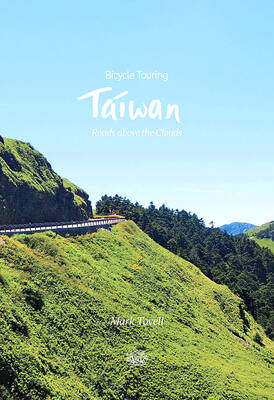
It’s hard to know where to begin with Mark Tovell’s Taiwan: Roads Above the Clouds. Having published a travelogue myself, as well as having contributed to several guidebooks, at first glance Tovell’s book appears to inhabit a middle ground — the kind of hard-to-sell nowheresville publishers detest. Leaf through the pages and you’ll find them suffuse with the purple prose best associated with travel literature: “When the sun is low on a warm, clear morning, and with the heat already rising, we stand at the riverside bike path leading south from Sanxia’s old cobble streets.” Hardly the stuff of your
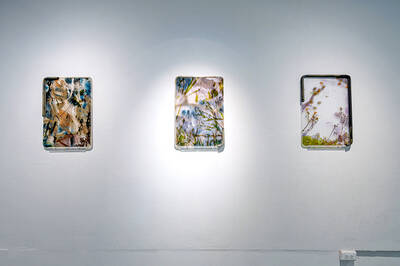
Located down a sideroad in old Wanhua District (萬華區), Waley Art (水谷藝術) has an established reputation for curating some of the more provocative indie art exhibitions in Taipei. And this month is no exception. Beyond the innocuous facade of a shophouse, the full three stories of the gallery space (including the basement) have been taken over by photographs, installation videos and abstract images courtesy of two creatives who hail from the opposite ends of the earth, Taiwan’s Hsu Yi-ting (許懿婷) and Germany’s Benjamin Janzen. “In 2019, I had an art residency in Europe,” Hsu says. “I met Benjamin in the lobby


 RSS
RSS