


Kaohsiung hosts the World Games in July, a huge gathering featuring sports not included in the Olympics. And just in time for the arrival of the world’s sports journalists and camera crews, Taiwan’s second city has completed its vast new World Games Stadium, which is capable of seating 40,000 and boasts 8,844 solar panels.
The Opening Ceremony of the games (on July 16) will be much like an Olympic opening ceremony. But the Inaugural Concert that opens the stadium on Wednesday will be an all-classical affair. It features the Pittsburgh Symphony Orchestra, the Vienna State Opera Choir and Taiwan’s National Experimental Chorus (國立實驗合唱團) performing Beethoven’s Seventh and Ninth symphonies and Tchaikovsky’s 1812 Overture, which ends with the firing of guns.
But why should an ultra-modern, eco-friendly building, constructed in Asia, celebrate its inauguration with acoustic music written 200 years ago in distant Europe? Why not a massive pop concert with some of the region’s top bands? Or, if classical music is to be favored, why not something contemporary featuring living composers, including Taiwan’s composers?
There are arguments on both sides, of course. This, I imagine, might be the case for the prosecution: In Asia, classical music is often associated with status. Well-heeled audiences arrive in large cars and pay handsomely to watch famous names. Classical music represents affluence, and it’s not surprising that Kaohsiung’s city fathers should pick it to open their extremely expensive new building.
They’ve predictably opted for tried and tested items with a guaranteed social cachet. Beethoven seems about right — his Ninth Symphony, after all, ends with a massive, if strident, vocal number with four roaring soloists and a chorus that can be as big as you want. (It’s routinely performed in Taipei’s Sun Yat-sen Memorial Hall (國父紀念館) with seven hundred or eight hundred singers).
In addition, because foreign things are often thought in Taiwan to be better than their local equivalents, no one will be surprised to see an American orchestra and a European chorus. Both will have been flown in and housed at immense cost, but then conspicuous consumption, especially in these difficult times, is very much the name of the game.
Finally, why choose labor-intensive old-style acoustic music when it will have to be electronically amplified (using those solar panels) to fill such a vast space anyway?
So, what is the case for the defense?
Essentially, that this aging foreign music has world standing. The last movement of Beethoven’s Ninth Symphony, the celebrated (if sometimes decried) Ode to Joy, is, after all, the EU’s transnational anthem, and was also closely associated with the tearing down of the Berlin Wall. In that context it was a hymn to liberty too, and Kaohsiung may also be making a veiled point in selecting it.
Then there is the consideration that Taiwan is preeminent in Asia in all aspects of classical music performance. But, this being the case, why not employ all Taiwanese musicians? This is an argument that will be kept carefully hidden by the defense attorneys.
So, let the party begin. It would certainly have been a more riotous one with other kinds of music. But it will be a great day for Taiwan anyway, and the less musically inclined, plus those for whom Beethoven and Tchaikovsky would never have been first choice, will simply have to sit back and endure.
The Main Stadium Inauguration Concert — The World Games Concert 2009 (2009迎接世運之夜 — 世運主場館落成音樂會) is at the World Games Main Stadium, Kaohsiung (高雄世運主場館) located at the junction of Jhunghai and Junsiao roads (中海路與軍校路口), beginning on Wednesday at 7:30pm. Tickets are NT$290 to NT$3,000, available through ERA ticketing or online at www.ticket.com.tw.

In late October of 1873 the government of Japan decided against sending a military expedition to Korea to force that nation to open trade relations. Across the government supporters of the expedition resigned immediately. The spectacle of revolt by disaffected samurai began to loom over Japanese politics. In January of 1874 disaffected samurai attacked a senior minister in Tokyo. A month later, a group of pro-Korea expedition and anti-foreign elements from Saga prefecture in Kyushu revolted, driven in part by high food prices stemming from poor harvests. Their leader, according to Edward Drea’s classic Japan’s Imperial Army, was a samurai

The following three paragraphs are just some of what the local Chinese-language press is reporting on breathlessly and following every twist and turn with the eagerness of a soap opera fan. For many English-language readers, it probably comes across as incomprehensibly opaque, so bear with me briefly dear reader: To the surprise of many, former pop singer and Democratic Progressive Party (DPP) ex-lawmaker Yu Tien (余天) of the Taiwan Normal Country Promotion Association (TNCPA) at the last minute dropped out of the running for committee chair of the DPP’s New Taipei City chapter, paving the way for DPP legislator Su
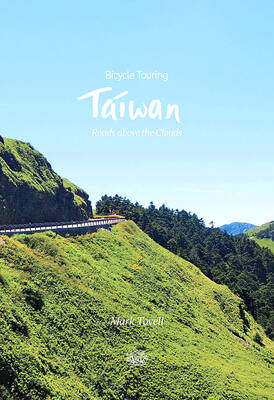
It’s hard to know where to begin with Mark Tovell’s Taiwan: Roads Above the Clouds. Having published a travelogue myself, as well as having contributed to several guidebooks, at first glance Tovell’s book appears to inhabit a middle ground — the kind of hard-to-sell nowheresville publishers detest. Leaf through the pages and you’ll find them suffuse with the purple prose best associated with travel literature: “When the sun is low on a warm, clear morning, and with the heat already rising, we stand at the riverside bike path leading south from Sanxia’s old cobble streets.” Hardly the stuff of your
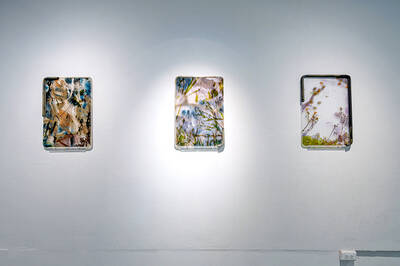
Located down a sideroad in old Wanhua District (萬華區), Waley Art (水谷藝術) has an established reputation for curating some of the more provocative indie art exhibitions in Taipei. And this month is no exception. Beyond the innocuous facade of a shophouse, the full three stories of the gallery space (including the basement) have been taken over by photographs, installation videos and abstract images courtesy of two creatives who hail from the opposite ends of the earth, Taiwan’s Hsu Yi-ting (許懿婷) and Germany’s Benjamin Janzen. “In 2019, I had an art residency in Europe,” Hsu says. “I met Benjamin in the lobby


 RSS
RSS