


It’s a crisp Andean morning, and South America’s prettiest colonial capital is coming to life with people, pigeons and sunshine. “Papas! Aguita! Papitas!” A street vendor in a bowler and with a child strapped to her back carries a stack of golden crisps. City clerks in sharp suits scan today’s paper, while shoe-shiners get to work on their shoes. Schoolgirls in tartan skirts swap gossip and chewing gum. And watching over us all from her Panecillo hilltop is Quito’s famous Virgin.
While the city awakens, I sip coca-leaf tea at the window of the new Hotel Plaza Grande. Actually, it’s quite venerable, but like much of the old town has recently been restored to its former belle epoque splendor. The porters wear top hats and white gloves, and there are inkwells and gold-tipped quills in the rooms.
Here at the leafy Plaza Grande, the belle and the less belle epochs of the city converge. It is an historic hot spot that boasts the presidential palace and a baroque cathedral. And it was here that the first expeditions into the Amazon started, and where the lives of at least one president and one bishop ended rather messily. With an irony that is pitch-perfect, the bishop’s palace now houses a restaurant called Mea Culpa.
Vendors like the crisps seller are rare these days. Most of them have been given stalls in the new markets as part of a regeneration project. Well-groomed parks dot the seven sacred Inca hills, and Quito is now the continent’s greenest capital. Brightly colored facades jazz up the streets and derelict buildings have been turned into attractive homes for the wealthy.
Once a seedy backwater, the old town is becoming a trendy place to live and visit. True, it was exciting before, but now you are much less likely to be relieved of your wallet. Two years ago, it wasn’t safe to stay in the old town; today it would be madness not to. The nightlife used to consist of pickpockets and prostitutes, but now the cobbled Barrio la Ronda is the trendiest place to hang out.
You can watch the street from the new upstairs restaurant Los Geranios, while savoring yaguarlocro, a black pudding soup with a bloody history. If you’re lucky, you might hear the pasillo, Ecuador’s equivalent of Portuguese fado, sung in one of La Ronda’s bars. What delights me is that there are no scheduled tourist-pleasing events. Just turn up and stick around.
By day, La Ronda’s main street is lined with workshops, galleries and craft shops. An orphan mission run by Italian nuns has opened as a cafe. In the courtyard of Misioneras de la Ninez you can enjoy freshly-baked pastries and Ecuadorian hot chocolate. Two years ago, you couldn’t buy a bar of Ecuadorian chocolate because it was all exported. Now there are single-origin varieties for discerning chocoholics.
Shopping has also arrived in the old town. My head is encased in a Panama hat from Ecuador’s oldest hat-maker, Homero Ortega, who has a new shop in Plaza San Francisco. The gallery-shop Sinchisancha at San Francisco has top-notch Amazonian crafts, and the Corporacion Metropolitana has opened a shop in Plaza Grande, where you can buy Ecuadorian cigars and coffee.
Quito is still a relatively shy star, but new boutique hotels in old colonial mansions are already competing for the increasing flow of visitors. I spent a few days at the Patio Andaluz, a Moorish mansion whose courtyard restaurant serves Ecuadorian lunches. The staff wear red Andean capes, an extravagance that somehow stops short of being kitsch. This is the thing about the new, old Quito: it is made of such durable stuff.
And to make sure that it never falls prey to falsehood, a new generation of artists is being created at the Escuela Taller de Quito I, an artisanal school for underprivileged teenagers. Together, apprentices and masters have restored a colonial maternity hospital into the most charming school I’ve ever seen. You can visit between 8am and 4pm and meet tomorrow’s stone carvers, carpenters and restorers, all trained in yesterday’s crafts. Already they are making altar pieces and carved columns so eye-wateringly beautiful that they could easily slip into Quito’s emblematic monastery San Francisco and pass as the real thing.
These kids are the latest graduates of the Quiteno style, the colonial offspring of the gunshot wedding between Spanish Catholicism and indigenous aesthetics. Everywhere you look, you see cupolas, spires, baroque follies, life-like Virgins and Inca suns.
The San Diego cemetery, perched above the town, is a thing of beauty, with its mausoleums and melancholy angels. Inside the spooky 16th-century San Diego convent next door, where nuns scurry in the shadows, I spot the most extreme Christ in a country where gory crucifixions adorn every church and even the odd restaurant. “This is how you love,” says a note that someone has pinned to his feet.
The mystic 17th-century Quiteno artist Miguel de Santiago allegedly killed one of his students to make his shocking sculpture of the dead Christ, and today you can still wonder at it in the San Augustin Monastery, where monks live in seclusion.
But the greatest marvel at the heart of the old town is San Fransisco, the continent’s most extravagant religious center. It has miraculously survived countless earthquakes and volcanic eruptions, and only now is it under restoration for the first time.
I climb the scaffolding with the head architect to get baroque vertigo near the gilded, Arab-influenced ceilings and grinning cherubs. “This is the biggest restoration project Quito has seen,” Senor Cheka tells me. “This place was built on the remains of the palace of Atahualpa, and nobody has touched it since. We are digging up skeletons under the church floor. Who knows what else we’ll dig up before we open to the public.” Atahualpa was the last Inca chief, and there is a legend about the gold he left to his protege, Cantuna.
Most likely, the gold is nowhere to be found, because it was used to build San Francisco, just like all the gold the Spaniards found. In return, they gave the indigenous people the promise of salvation, and mirrors that supposedly contained their souls.
This summer, Quito is putting on a big fiesta to celebrate 200 years since South America’s first independence uprising. It ended with bloodshed, but freedom followed. The Spaniards have been long subsumed into the indigenous pool. Old Quito hums with new energies, and the future belongs to the children of Atahualpa.
Quito Bicentenary celebrations are from Aug. 8 to Aug. 10. For more information, visit Corporacion de Tourismo de Quito’s Web site at quito.com.ec.

In late October of 1873 the government of Japan decided against sending a military expedition to Korea to force that nation to open trade relations. Across the government supporters of the expedition resigned immediately. The spectacle of revolt by disaffected samurai began to loom over Japanese politics. In January of 1874 disaffected samurai attacked a senior minister in Tokyo. A month later, a group of pro-Korea expedition and anti-foreign elements from Saga prefecture in Kyushu revolted, driven in part by high food prices stemming from poor harvests. Their leader, according to Edward Drea’s classic Japan’s Imperial Army, was a samurai

The following three paragraphs are just some of what the local Chinese-language press is reporting on breathlessly and following every twist and turn with the eagerness of a soap opera fan. For many English-language readers, it probably comes across as incomprehensibly opaque, so bear with me briefly dear reader: To the surprise of many, former pop singer and Democratic Progressive Party (DPP) ex-lawmaker Yu Tien (余天) of the Taiwan Normal Country Promotion Association (TNCPA) at the last minute dropped out of the running for committee chair of the DPP’s New Taipei City chapter, paving the way for DPP legislator Su
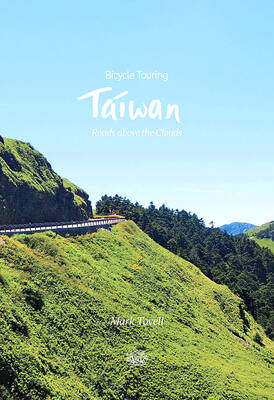
It’s hard to know where to begin with Mark Tovell’s Taiwan: Roads Above the Clouds. Having published a travelogue myself, as well as having contributed to several guidebooks, at first glance Tovell’s book appears to inhabit a middle ground — the kind of hard-to-sell nowheresville publishers detest. Leaf through the pages and you’ll find them suffuse with the purple prose best associated with travel literature: “When the sun is low on a warm, clear morning, and with the heat already rising, we stand at the riverside bike path leading south from Sanxia’s old cobble streets.” Hardly the stuff of your
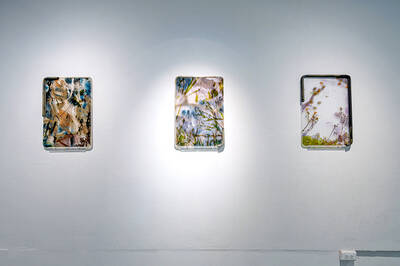
Located down a sideroad in old Wanhua District (萬華區), Waley Art (水谷藝術) has an established reputation for curating some of the more provocative indie art exhibitions in Taipei. And this month is no exception. Beyond the innocuous facade of a shophouse, the full three stories of the gallery space (including the basement) have been taken over by photographs, installation videos and abstract images courtesy of two creatives who hail from the opposite ends of the earth, Taiwan’s Hsu Yi-ting (許懿婷) and Germany’s Benjamin Janzen. “In 2019, I had an art residency in Europe,” Hsu says. “I met Benjamin in the lobby


 RSS
RSS