


A History of Pain? I had to laugh when I saw this title. It reminded me of Heaven: A History, another absurdly impossible project, seemingly, that nonetheless proved eye-catching. But looking into this new book I see that it actually refers to China’s — and Taiwan’s — history over the past 150 years or so, a period that was painful, and also of course fatal, to many, with much of the suffering, according to the author, self-inflicted.
In fact, there was a previous Chinese book with a name that translates as A History of Pain — a novel written about the bloody transition from the Song to Yuan dynasties by late-Qing Dynasty author Wu Jianren (吳趼人, 1866-1910). Atrocities proliferate in it, including the massacre of an entire city. Translator and professor Michael Berry discusses this book, and it clearly gave him the idea for his own quirky title.
What Berry’s own book,
published last month, actually deals with are artistic representations of six crucial events — Taiwan’s 228 Incident and its earlier Musha
Incident (of 1930), plus four traumatic crises in China: the Nanjing Massacre of 1937; the Cultural Revolution as it occurred in Yunnan Province; the Tiananmen Square Massacre of 1989; and (rather surprisingly, but more of that later) the handover of Hong Kong in 1997.
Taiwan’s Musha Incident, known in Mandarin as the Wushe Incident (霧社事件), was the occasion when approximately 300 Atayal Aborigines attacked Japanese officials at an elementary school sports meeting in Nantou County, killing 134 of them, many by decapitation. The event, and especially its leader Mona Rudao, has been endlessly mythologized in Taiwan, and Berry cites comic strips, poems, films that illustrate this. The problem, however, is that this was an entirely Aboriginal attack that the Chinese-descended Taiwanese also wanted to commandeer into the history of their anti-colonial struggle.
It’s interesting to remember that a year after coming to power in 2000, the DPP administration minted NT$20 coins depicting the head of Mona Rudao. These are no longer in circulation, but the exercise was an indication, according to Berry, of the way different groups in modern Taiwan continue to vie for “possession” of that murderous event.
Far and away the most interesting — and radical — response to it, Berry argues, was the 1999 novel Remains of Life (餘生) by the Tainan-born writer Wu He (舞鶴). This 210-page stream-of-consciousness narrative, that contains only 20 sentence breaks, not only mostly deals with the area of the massacre as it is today but also indulges in elaborate sexual fantasies and, in a manner virtually unheard-of in the Taiwan context, questions the morality of the killings in themselves. The book awaits an English translator, though a section of it can be read in English in Taiwan Literature: English Translation Series No. 13 (July 2003).
Wu has also written about the events of 228, notably in a widely anthologized story Investigation: A Narrative (調查;敍述) where he again refuses any simple, “patriotic” approach and instead espouses an interweaving complexity that suggests that the truth about most things is unknowable, and that all you can be certain of is “pain,” a word echoed and re-echoed in the story by a pet mynah bird.
There’s much else about 228 in this book because, as the author states, there was remarkably little in English on the trauma’s cultural repercussions, especially in fiction, until Sylvia Li-chun Lin’s Representing Atrocity in Taiwan: The 2/28 Incident and White Terror in Fiction and Film [reviewed in the Taipei Times on March 30, 2008.
Quite why the author opts to concentrate on the agony caused by the Cultural Revolution in Yunnan rather than anywhere else is unclear. Obviously an event lasting 10 years and spawning many different kinds of writing in China — “scar literature,” “search-for-roots literature” and so on — couldn’t be treated complete. Yunnan had the advantage of being the location for Dai Sijie’s (戴思杰) novel and subsequent film Balzac and the Little Chinese Seamstress (小裁縫) and Chen Kaige’s (陳凱歌) film King of the Children (孩子王). This is probably the least rewarding chapter in the book, but then the Cultural Revolution can hardly be said to have received inadequate coverage elsewhere.
The inclusion of Hong Kong’s handover appears problematic, but the author is well aware of this. What he points out is that it was an example of an event widely predicted as likely to be apocalyptic that turned out, on the surface anyway, as nothing of the sort. China’s experience of pain, in other words, which had almost become routine, led to vividly imagined expectations of a recurrence. It didn’t happen as anticipated, but the books and films were written and made in advance nonetheless.
Berry calls this phenomenon “anticipatory trauma,” but does point out that the emigration from the territory that took place before 1997 was real enough. This was representative of the mass movements of people that have often accompanied China’s recent convolutions — emigration, and student applications for asylum in the countries where they found themselves, after the Tiananmen Square events of 1989 being another example.
One of the characteristics of these traumatic events, Berry argues, is that they are disputed. Beijing disputes Tiananmen and Tokyo disputes the numerically far more terrible massacre of Nanjing. This is, of course, part and parcel of social groups wanting to control the representation of past events — how they are seen, how they are remembered and, particularly, how they are understood.
“Modern China’s trajectory has been one of discontinuity, displacement, social unrest, and historical trauma,” writes Berry. Taiwan has certainly been fortunate by comparison, though not without its own awesomely dark interludes. Despite the heady, bloodless early days of the French and Russian revolutions, happiness can be said to abide in times where almost nothing important (in a political sense) actually happens.

In late October of 1873 the government of Japan decided against sending a military expedition to Korea to force that nation to open trade relations. Across the government supporters of the expedition resigned immediately. The spectacle of revolt by disaffected samurai began to loom over Japanese politics. In January of 1874 disaffected samurai attacked a senior minister in Tokyo. A month later, a group of pro-Korea expedition and anti-foreign elements from Saga prefecture in Kyushu revolted, driven in part by high food prices stemming from poor harvests. Their leader, according to Edward Drea’s classic Japan’s Imperial Army, was a samurai

The following three paragraphs are just some of what the local Chinese-language press is reporting on breathlessly and following every twist and turn with the eagerness of a soap opera fan. For many English-language readers, it probably comes across as incomprehensibly opaque, so bear with me briefly dear reader: To the surprise of many, former pop singer and Democratic Progressive Party (DPP) ex-lawmaker Yu Tien (余天) of the Taiwan Normal Country Promotion Association (TNCPA) at the last minute dropped out of the running for committee chair of the DPP’s New Taipei City chapter, paving the way for DPP legislator Su
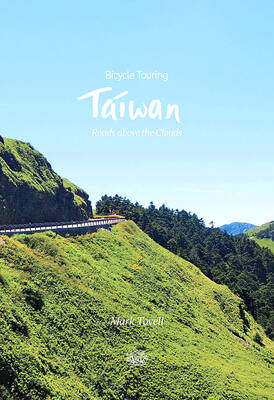
It’s hard to know where to begin with Mark Tovell’s Taiwan: Roads Above the Clouds. Having published a travelogue myself, as well as having contributed to several guidebooks, at first glance Tovell’s book appears to inhabit a middle ground — the kind of hard-to-sell nowheresville publishers detest. Leaf through the pages and you’ll find them suffuse with the purple prose best associated with travel literature: “When the sun is low on a warm, clear morning, and with the heat already rising, we stand at the riverside bike path leading south from Sanxia’s old cobble streets.” Hardly the stuff of your
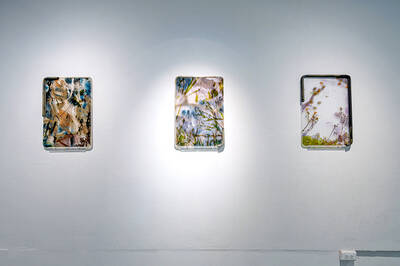
Located down a sideroad in old Wanhua District (萬華區), Waley Art (水谷藝術) has an established reputation for curating some of the more provocative indie art exhibitions in Taipei. And this month is no exception. Beyond the innocuous facade of a shophouse, the full three stories of the gallery space (including the basement) have been taken over by photographs, installation videos and abstract images courtesy of two creatives who hail from the opposite ends of the earth, Taiwan’s Hsu Yi-ting (許懿婷) and Germany’s Benjamin Janzen. “In 2019, I had an art residency in Europe,” Hsu says. “I met Benjamin in the lobby


 RSS
RSS