


Tate Modern, the museum converted from a London riverside power station, filled its vast entrance hall starting on Monday with a futuristic shelter containing colossal sculptures and 200 bunk beds strewn with books.
TH.2058 is the ninth installation in the Turbine Hall from a series sponsored by Unilever. Artist Dominique Gonzalez- Foerster imagines a place 50 years from now where Londoners seek refuge from continuous rain, surrounded by books, sculptures, and a giant screen projecting science-fiction film clips, Tate said in the exhibition’s press release.
“It rains incessantly in London,” Gonzalez-Foerster wrote in an essay dated October 2058 handed out to reporters. “Not a day, not an hour without rain, a deluge that has now lasted for years and changed the way people travel, their clothes, leisure activities, imagination and desires.”
The work depicts an ecological apocalypse. Viewers slip through colored plastic curtains into a stark shelter where steel, mattress-less bunk beds are lined up. Each has a book on it with a catastrophe-related theme: The Drowned World by J.G. Ballard, or Fahrenheit 451 by Ray Bradbury, or Hiroshima Mon Amour, by Marguerite Duras.
The books are refugees from the torrential rain, which beats down in a haunting sound track beamed through loudspeakers. The odd droplet of water falls on the viewer’s skin.
TURBULENCE AHEAD
“Turbulence — fasten your seat belts,” advised Gonzalez- Foerster at the Tate press briefing, evoking her broadly themed work, and dismissing reporters’ repeated efforts to connect it to the current global financial meltdown. The French artist, born in 1965, dressed youthfully in a striped sailor’s top and blue jeans, her long stringy hair loosened to the waist.
The bunk beds are placed at the feet of monumental sculptures — larger-than-life replicas of Louise Bourgeois’ giant spider (Maman, 1999) and Calder’s Flamingo (1973), among others. The sculptures have been brought inside the shelter to stop them from growing bigger and bigger in the tropical rain.
On the back-wall screen are edited clips of futuristically themed films: from The Man Who Fell to Earth (Nicolas Roeg) to Planet of the Apes (Franklin J. Schaffner) to Repulsion (Roman Polanski).
Gonzalez-Foerster said there were many possible “doors” into her work, and levels on which it could be read. She was drawn to participatory art after working as a museum security guard and being “so shocked to see how little time people spent looking at the works.”
“I’ve always been obsessed to keep the viewer longer,” she explained.
Visitors to the Turbine Hall, where TH.2058 will be shown through April next year, can lie on a bunk bed and read a book, peering through the steel grid of the bed above at the belly of Bourgeois’ spider.
Flashbacks to World War II and Blitz-era London are not accidental. Gonzalez-Foerster says she clearly remembers a wartime photograph of a reader browsing a book beneath the bombed-out ceiling of the British Library.
She herself is a by-product of World War II: Her father did his military service in Germany, where he met her mother. Without the war, “I would never have been born,” she said.
Previous participants in the Unilever series include Doris Salcedo, who, through April this year, showed Shibboleth, a 167m crack in the concrete floor of the hall; and Carsten Hoeller, who installed slides between October 2006 and April 2007 that visitors could slip down.
Unilever announced today that it is extending its support for the Turbine Hall installations until 2012, at a cost of US$3.75 million.

In late October of 1873 the government of Japan decided against sending a military expedition to Korea to force that nation to open trade relations. Across the government supporters of the expedition resigned immediately. The spectacle of revolt by disaffected samurai began to loom over Japanese politics. In January of 1874 disaffected samurai attacked a senior minister in Tokyo. A month later, a group of pro-Korea expedition and anti-foreign elements from Saga prefecture in Kyushu revolted, driven in part by high food prices stemming from poor harvests. Their leader, according to Edward Drea’s classic Japan’s Imperial Army, was a samurai

The following three paragraphs are just some of what the local Chinese-language press is reporting on breathlessly and following every twist and turn with the eagerness of a soap opera fan. For many English-language readers, it probably comes across as incomprehensibly opaque, so bear with me briefly dear reader: To the surprise of many, former pop singer and Democratic Progressive Party (DPP) ex-lawmaker Yu Tien (余天) of the Taiwan Normal Country Promotion Association (TNCPA) at the last minute dropped out of the running for committee chair of the DPP’s New Taipei City chapter, paving the way for DPP legislator Su
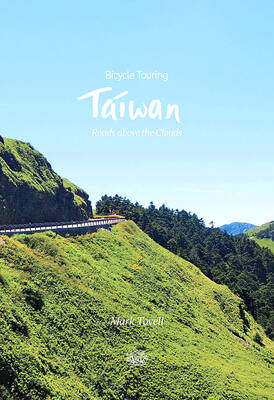
It’s hard to know where to begin with Mark Tovell’s Taiwan: Roads Above the Clouds. Having published a travelogue myself, as well as having contributed to several guidebooks, at first glance Tovell’s book appears to inhabit a middle ground — the kind of hard-to-sell nowheresville publishers detest. Leaf through the pages and you’ll find them suffuse with the purple prose best associated with travel literature: “When the sun is low on a warm, clear morning, and with the heat already rising, we stand at the riverside bike path leading south from Sanxia’s old cobble streets.” Hardly the stuff of your
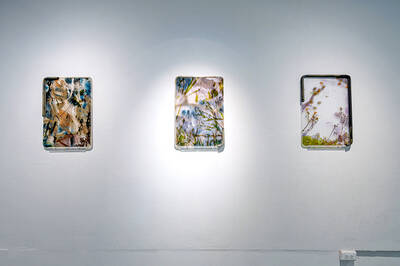
Located down a sideroad in old Wanhua District (萬華區), Waley Art (水谷藝術) has an established reputation for curating some of the more provocative indie art exhibitions in Taipei. And this month is no exception. Beyond the innocuous facade of a shophouse, the full three stories of the gallery space (including the basement) have been taken over by photographs, installation videos and abstract images courtesy of two creatives who hail from the opposite ends of the earth, Taiwan’s Hsu Yi-ting (許懿婷) and Germany’s Benjamin Janzen. “In 2019, I had an art residency in Europe,” Hsu says. “I met Benjamin in the lobby


 RSS
RSS