


IN her mission statement about the online magazine she launched this week, Tina Brown says she decided to call it The Daily Beast because that is “the name of the newspaper in Scoop, Evelyn Waugh’s hilarious satire of Fleet Street, which happens to be my favorite novel of all time.” To which one can only reply: Up to a point, Lord Copper.
The spoof newspaper in Waugh’s novel is in fact called The Beast. If you had a mind to turn it into an acronym (Waugh didn’t) it would be TB, sharing her initials, which would be fitting given her own reputation for ruthless perfectionism.
For almost 30 years Brown has been shaking up the world of magazine journalism, spreading fear and awe in equal measure. Now she has turned her hand to the web, a medium renowned for shaking up editors rather than vice versa, and medialand is agog as to how she will fare. For some the answer is quite simple. “She will be great as a Web editor, because she is a great editor,” is how Maer Roshan, editor of the pop culture magazine Radar and a long-time friend, sees it.
He recalls a discussion with her at her last, ill-fated, start-up, Talk magazine, soon after the Sept. 11 attacks on New York.
“Someone suggested we find out about the Taliban, and Tina leapt at the idea. ‘Who have we got to infiltrate the Taliban?’ she said.”
Such ambition has been a hallmark of Brown’s career and style of editing since she took over the helm of the society magazine Tatler in 1979 at the age of 26. By then her reputation was already established — she was making waves while still at Oxford University, wrote a column for Punch magazine and struck up a relationship with her editor at the Sunday Times, Harold Evans, who she went on to marry in 1981.
She took the Tatler, swept aside its staid, debutante air, and turned it into an organ that people talked about.
She repeated the trick in 1982 in New York where she gave Vanity Fair an extreme makeover, remolding it into the mix of highbrow writing and lowbrow celebrity gossip and true crime reporting that to a large extent it remains. Her cover of the nude and heavily pregnant Demi Moore was a sensation.
It was at the New Yorker, still only 38, that she cemented her fame, or notoriety, depending on conflicting views of her impact on the august journal. Many people thought she took a rather boring publication and made it readable; many others were horrified by the first use of photographs, and profiles of celebrities. Alexander Chancellor, who was signed up by Brown to oversee the Talk of the Town section, remembers being assailed by two blue-rinse, elderly women in the New York library. “You tell that Miss Brown we don’t need a contents list. We are not stupid!” they screeched.
What stands out for Chancellor was Brown’s instinct for controversy and rigorous standards. “She’s a tremendous perfectionist. She frets if things aren’t as good as they should be, which is an advantage but also creates an element of anxiety.”
Editing the most famous magazine in the world would have satisfied the ambitions of most journalists. Not Brown, who after six years quit in 1998 to pursue her desire to become a media mogul in her own right. It was perhaps a case of pride coming before a fall. Her experiment with a new magazine tied to book publishing and movie rights, Talk, was a massively expensive flop, brought down partly by the economic chill after Sept. 11 and partly by its own hype and overreach.
Despite the commercial success of her bestselling book on the Princess of Wales, the Diana Chronicles, the Talk debacle still hangs over her and adds an edginess to this week’s launch of her Internet magazine. Forget the mistitle — will the Daily Beast prove as costly a mistake for its backer, Barry Diller of IAC, as Talk did for Miramax?
In the first two days she has demonstrated she has lost none of her talent for creating a stir. The Web was buzzing — to use her own favorite phrase — with chatter about a spiky profile of Jennifer Lopez that alleged she had suffered a form of nervous breakdown. Elle had turned the article down for being too unflattering. Brown snapped it up instead.
The site seeks to help readers through the clutter and cacophony of the Web with its own digest of the best reads of the day, supplemented by its own commissions from writers, politicians and household names. Jeremy Gilbert, a Web designer who teaches at the Medill School of Journalism, thinks she will have a steep learning curve as an Internet publisher. “I’m not alone in being a little unsure about what the Daily Beast is trying to do. It doesn’t have the political slant of the Huffington Post and it doesn’t make many concessions to the online format.”
So the jury is out on the Beast and its celebrity editor. She clearly relishes the challenge, though only time will tell whether the medium matches or overwhelms the scale of her ambitions.

In late October of 1873 the government of Japan decided against sending a military expedition to Korea to force that nation to open trade relations. Across the government supporters of the expedition resigned immediately. The spectacle of revolt by disaffected samurai began to loom over Japanese politics. In January of 1874 disaffected samurai attacked a senior minister in Tokyo. A month later, a group of pro-Korea expedition and anti-foreign elements from Saga prefecture in Kyushu revolted, driven in part by high food prices stemming from poor harvests. Their leader, according to Edward Drea’s classic Japan’s Imperial Army, was a samurai

The following three paragraphs are just some of what the local Chinese-language press is reporting on breathlessly and following every twist and turn with the eagerness of a soap opera fan. For many English-language readers, it probably comes across as incomprehensibly opaque, so bear with me briefly dear reader: To the surprise of many, former pop singer and Democratic Progressive Party (DPP) ex-lawmaker Yu Tien (余天) of the Taiwan Normal Country Promotion Association (TNCPA) at the last minute dropped out of the running for committee chair of the DPP’s New Taipei City chapter, paving the way for DPP legislator Su
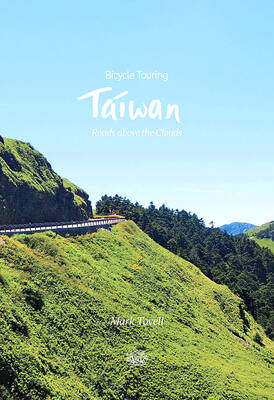
It’s hard to know where to begin with Mark Tovell’s Taiwan: Roads Above the Clouds. Having published a travelogue myself, as well as having contributed to several guidebooks, at first glance Tovell’s book appears to inhabit a middle ground — the kind of hard-to-sell nowheresville publishers detest. Leaf through the pages and you’ll find them suffuse with the purple prose best associated with travel literature: “When the sun is low on a warm, clear morning, and with the heat already rising, we stand at the riverside bike path leading south from Sanxia’s old cobble streets.” Hardly the stuff of your
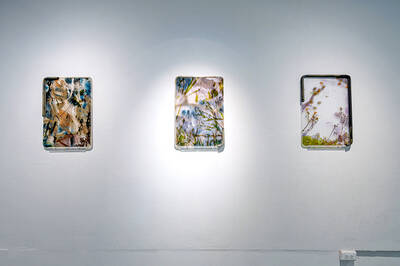
Located down a sideroad in old Wanhua District (萬華區), Waley Art (水谷藝術) has an established reputation for curating some of the more provocative indie art exhibitions in Taipei. And this month is no exception. Beyond the innocuous facade of a shophouse, the full three stories of the gallery space (including the basement) have been taken over by photographs, installation videos and abstract images courtesy of two creatives who hail from the opposite ends of the earth, Taiwan’s Hsu Yi-ting (許懿婷) and Germany’s Benjamin Janzen. “In 2019, I had an art residency in Europe,” Hsu says. “I met Benjamin in the lobby


 RSS
RSS