


Chou Kung-shin (周功鑫), who took over from Lin Mun-lee (林曼麗) as director of the National Palace Museum in May this year, is hardly a newcomer to the institution, having begun her career at the museum back in 1972. Her long association with the museum and familiarity with the institution has allowed Chou to pursue many innovations commenced under her predecessors, as well as make some bold initiatives of her own.
New and old meet in the events being held to celebrate the museum’s 83rd anniversary with two important exhibitions that show off the museum’s collection in traditionally scholarly style, and musical concerts, a relatively new innovation, aimed at drawing a wider and more diverse crowd.
Chou, who received her doctorate in art history and archaeology at the University of Paris-Sorbonne, served as secretary to two of the museum’s directors and headed its Exhibition Department for 16 years, during which time she organized numerous international exhibitions, including groundbreaking shows such as Monet and other Impressionists: Collections from Musee Marmottan Monet Paris (1993), Western Landscape in Paintings from the Sixteenth to Nineteenth Centuries (from the collection of Musee du Louvre in 1995) and The World of Picasso (from the collection of the Musee de Picasso in 1998).
In 1999, Chou left the National Palace Museum to join Fu Jen Catholic University (輔仁大學), where she subsequently became the founding director of its Graduate Institute of Museum Studies (博物館學研究所). She returned to the museum with a brief to develop it from being simply a great repository of ancient art into an institution that more effectively serves the local community and to raise the level of cultural appreciation among all levels of society.
In the past, the museum’s mandate was simply to preserve a priceless collection of art — everything else was secondary. Chou said that the scope of the museum’s activities has gradually been broadened, first to include education, and now as an increasingly engaged member of the wider cultural scene.
“Now museum’s have moved to a new level, a broader aspect, as part of a cultural industry. We have to look for ways to make the collection more valuable, so that more people can get inspiration from it. The functions of the museum have broadened,” Chou said. “The National Palace Museum has to follow this trend and that is the main reason I have returned.”
Chou’s main challenge is finding a balance between her efforts to expand the appeal of the museum while retaining its core expertise in historical research and the technical branches of conservation and restoration. After all, it is the latter that has made the museum the internationally respected institution it is today.
Major projects include the opening of a center to promote “cultural industry creation” and train young designers. This will be built on a 5.4-hectare site opposite the museum and includes, Chou said, a range of recreational facilities such as restaurants, tea houses, classical Chinese gardens and so on.
“We want this complex to be a demonstration of the idea of cultural creation. When people visit, they will be able to see the traditional over here (the main museum), and the modern over there,” Chou said.
More ambitious still are the projects surrounding the yet-to-open southern branch of the National Palace Museum. “Because the branch is located in Chiayi, we must find ways of attracting international tourists to this location with some special characteristics. We are considering creating a theme park based on the story of the Monkey King. We’ll invite people like Ang Lee (李安) and other film producers and directors to join this project,” Chou said.
The idea of using the Monkey King story — also known as Journey to the West — is that it links Chinese culture with the rest of the world through the medium of Buddhism. The money for this project would come from private sector investment. “Basically this will be done on a BOT (build-operate-transfer) model. Many people are interested, so the budget is no problem,” said Chou, adding that work on this project should begin in three or four years.
The recent completion of a new restaurant, Silks Palace (故宮晶華), managed by the Grand Formosa Regent group, has already added to the appeal of the museum as a destination and is helping to create a synergy between arts and fine dining. The museum has extended its opening hours on Saturdays to 8:30pm, when it sometimes holds concerts. The final concerts in the current series, performed by the National Chinese Orchestra (台灣國家國樂團), will take place at 6pm on Saturday and 4.30pm on Sunday at the National Palace Museum auditorium (admission is free).
At 83, the National Palace Museum is looking younger than ever. It’s all a brave new world, and success or failure will depend on whether Chou is able to find the right balance between maintaining the museum’s international reputation and making it a commercially successful cultural playground.
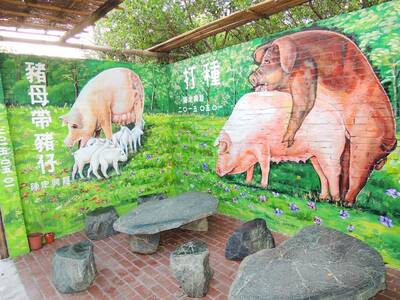
May 6 to May 12 Those who follow the Chinese-language news may have noticed the usage of the term zhuge (豬哥, literally ‘pig brother,’ a male pig raised for breeding purposes) in reports concerning the ongoing #Metoo scandal in the entertainment industry. The term’s modern connotations can range from womanizer or lecher to sexual predator, but it once referred to an important rural trade. Until the 1970s, it was a common sight to see a breeder herding a single “zhuge” down a rustic path with a bamboo whip, often traveling large distances over rugged terrain to service local families. Not only
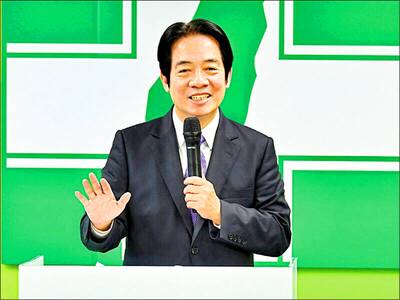
Ahead of incoming president William Lai’s (賴清德) inauguration on May 20 there appear to be signs that he is signaling to the Chinese Communist Party (CCP) and that the Chinese side is also signaling to the Taiwan side. This raises a lot of questions, including what is the CCP up to, who are they signaling to, what are they signaling, how with the various actors in Taiwan respond and where this could ultimately go. In the last column, published on May 2, we examined the curious case of Democratic Progressive Party (DPP) heavyweight Tseng Wen-tsan (鄭文燦) — currently vice premier
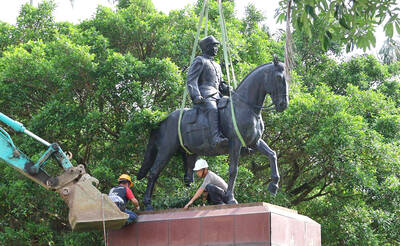
The last time Mrs Hsieh came to Cihu Park in Taoyuan was almost 50 years ago, on a school trip to the grave of Taiwan’s recently deceased dictator. Busloads of children were brought in to pay their respects to Chiang Kai-shek (蔣中正), known as Generalissimo, who had died at 87, after decades ruling Taiwan under brutal martial law. “There were a lot of buses, and there was a long queue,” Hsieh recalled. “It was a school rule. We had to bow, and then we went home.” Chiang’s body is still there, under guard in a mausoleum at the end of a path

Last week the Directorate-General of Budget, Accounting and Statistics (DGBAS) released a set of very strange numbers on Taiwan’s wealth distribution. Duly quoted in the Taipei Times, the report said that “The Gini coefficient for Taiwanese households… was 0.606 at the end of 2021, lower than Australia’s 0.611, the UK’s 0.620, Japan’s 0.678, France’s 0.676 and Germany’s 0.727, the agency said in a report.” The Gini coefficient is a measure of relative inequality, usually of wealth or income, though it can be used to evaluate other forms of inequality. However, for most nations it is a number from .25 to .50


 RSS
RSS