


For an island nation where oyster omelets (蚵仔煎) were once voted the exemplar of Taiwanese xiao chi (小吃), or snacks, Taipei suffers from a curious — and tragic — dearth of raw oyster bars. Yaya’s Oyster Bar (Yaya’s生蠔酒館) strives to fill that gap. Located on Changan East Road near a strip of seafood joints, the large sculpture of an oyster on a half shell mounted next to the restaurant’s door makes it hard to miss.
In all honesty, if you are the type of oyster aficionado who can tell the difference between the sweet finish of a Kumamoto oyster harvested from the cool waters off the north of Japan or a Long Island blue point, and who caresses each plump, quivering mass with your tongue like a sip of fine pinot noir before sliding it down your throat, then Yaya’s will probably leave you underwhelmed. But if all you are looking for is a plate of reasonably priced bivalves to slurp down with a mug of Coors Light or Corona (NT$150), then you should leave satisfied.
The interior of Yaya’s is cozy and grotto-like, with low ceilings, wooden floors, wall murals and an entertainingly large and detailed poster of cheerful, mostly nude sunbathers on Wreck Beach, a clothing-optional beach near Vancouver. We ordered Set A for two people (NT$1,400), which comes with Boston clam chowder, four raw oysters, four baked oysters, salad, and spaghetti or a rice dish. We also ordered an additional plate of six raw oysters (生蠔拼盤, NT$720 for small oysters, NT$780 for larger ones; sets of three oysters with different toppings are available for NT$360 or NT$390 each).
The oysters are firm, fresh and reasonably flavorful — as far as we could tell. It was difficult to gauge the shellfish’s natural aroma because each one was served with a heavy, overwhelming dollop of topping, including salsa, cocktail sauce, fish roe or miso paste. The latter left a particularly indelible impression and not in a good way — the saltiness of the miso coated my taste buds for the rest of the meal, a situation that no amount of house wine (NT$150 per glass) could rectify. The oyster flesh practically screamed for freedom and we obliged by scrapping off half of each topping (except for the fish roe, which was a suitably light complement) before tipping it into our mouths. The flavors in the baked oysters, which were topped with melted cheese, were better balanced.
The clams in the chowder were generously apportioned and tender, but we wished the texture of the soup itself had been a bit thicker and heartier, with more brininess to balance the rich cream base. The al dente texture of the spaghetti was pleasingly toothsome, while the marinara sauce was unexpectedly spicy.
If you want to avoid overeating, order from the restaurant’s a la carte menu. Most of the dishes have an Italian or French twist. Entrees include garlic prawns (義大利蒜蝦, NT$250), escargot (法式田螺, NT$240), plate ribs (鐵板牛小排, NT$350) and meatball pizza (貢丸比薩餅, NT$200). Pasta and rice dishes are available for NT$200 to NT$350, while carb-shy diners can order salads for NT$180 to NT$300.

Taiwan’s English education system is being pulled apart by three opposing forces. Bilingual Nation 2030 pulls students toward English and global communication. Artificial Intelligence (AI) readiness pulls them toward digital judgment, verification and AI-mediated work. But Taiwan’s old exam culture pulls them back toward memorization, grammar drills, timed reading and correct answers. If the education system keeps using old exams to define success, it risks producing graduates who are neither genuinely bilingual nor genuinely AI-ready, but trained for tasks machines can already perform. The first force is Bilingual Nation 2030. Launched in 2018, the policy aimed to “help Taiwan’s workforce connect
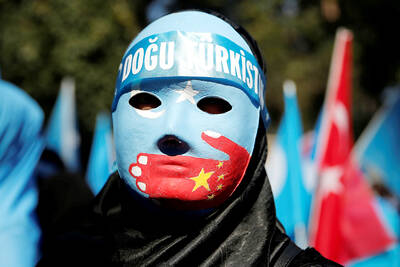
It seems every few days one bumps into one of those “real man” comments in which Taiwan is urged to “face reality” or similar, and “make a deal,” with the speaker implying that soon it will be too late. “Deal” advocates always present themselves as having a superior grip on reality, and the manly ability to make the “hard choice.” Their testosterone-laden language often echoes that of Taiwan sellout advocates. Note that such commentary always specifies a process (“make a deal, work with, make progress”), never the end state of what occupation by a violent authoritarian colonialist state will entail. In
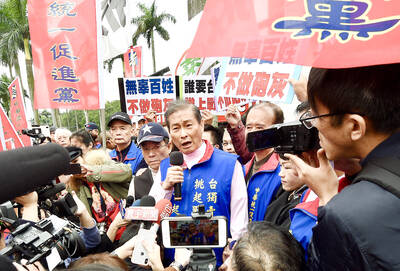
There are shadowy cabals plotting to sell out Taiwan to be annexed by China, by invasion if necessary. Fortunately, they are buffoons. In 2019, former Bamboo Union gangster and founder of the China Unification Promotion Party (CUPP), Chang An-le (張安樂, colorfully known as “White Wolf”), led a protest at the Legislative Yuan against comments made by then-premier Su Tseng-chang (蘇貞昌) that in the event of an attack by China, he would never surrender, but would protect the nation by fighting to the end, even if he only had a broom. Chang had party members bring a wooden casket that they
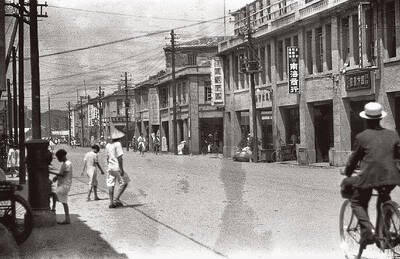
June 1 to June 7 "If all Taiwanese were as afraid of dying as you, then what would happen?” Physician Shih Chiang-nan (施江南) reportedly said this to his wife Chen Chiao-tung (陳焦桐) after she urged him to stop intervening on behalf of Taiwanese soldiers stranded overseas after serving in the Japanese Army during World War II. Shih had clashed with high-ranking officials over the issue, engaged in several heated arguments with Taiwan governor-general Chen Yi (陳儀) and allegedly shouted at general Ko Yuan-fen (柯遠芬), chief of staff of the Taiwan Garrison Command, over


 RSS
RSS