


Listen to this album and you’ll think there is hope for Mando-pop after all. Not that Tainan-native Crowd Lu (盧廣仲) aspires to be the next Jay Chou (周杰倫) or Wang Lee-hom (王力宏), at least for now. Lu’s debut album is chock-full of sunshine pop, beautifully conceived and executed, yet down-to-earth and full of surprises.
Aside from impressive songwriting skills and instrumental talent, the 23-year-old Lu sports a come-from-behind narrative that fuels his fire: while recovering in the hospital from a serious car accident, he resolved to learn the guitar. From there, he won a handful of college contests; his geek-chic charm and vocal skills earned him a following and at one point made him a YouTube star.
With the uplifting Good Morning, Beautiful Morning, replete with a bouncy rhythm and bright vocal harmonies, Lu ropes you in and doesn’t let up. He sounds like the nice brother helping his kid sister get ready for school when he utters in Taiwanese-accented Mandarin “Hey, get-up for breakfast — hurry up.” Pop hooks then hit you left and right, making the song’s cutesiness endearing instead of annoying. The song’s deceptively simple chorus, “Dui-a, Dui-a” (對啊, 對啊), looks silly on paper, but is infectious and fun to hear. Lu then throws in a wicked, lyrical guitar solo, and by the tempo change at the bridge, you’re almost sad the song is about to end.
The album keeps you engaged with variety: there’s pop, funk, rock and even a 20-second thrash metal interlude. And for all the indie attitude, Lu doesn’t shy from straightforward ballads. On the album’s title track, he cruises comfortably from a husky alto to a falsetto; his voice soars but he makes it seem effortless.
Lu keeps it real by driving most of the songs with guitar, which makes his feel-good pop sensibilities easier to swallow. But there is also a sense of honesty that comes through in his songs, something sorely lacking among Mando-pop artists today.
— David Chen
Matthew Lien made his name in Taiwan as an “eco-musician,” and the island continues to serve as his main source of artistic inspiration. With Adventures in the Hakka Heartland, Lien turns his attention to Hakka folk music in Taiwan.
The album was born out of a program on Hakka TV that Lien co-hosted with singer-songwriter Hsieh Yu-wei (謝宇威). The two spent six months traveling to Hakka communities in the countryside to meet and record singers and musicians who performed traditional music. In between location visits, Lien took the field recordings and returned to his studio to add backing instrumentation to the performances.
The result is a time-lapsed collaboration: you’ll hear folk artist performances, mostly vocal, but with editing, backing instrumentation and studio polish from Lien. Many of the songs are medleys that combine performances from one location that “tells the story” of a community. The Four Mountain Kings is based on Lien’s trip to Chutung (竹東) in Hsinchu County, a site renowned for its Hakka Mountain Song singing competition. The song features two different generations of singers — a group of four elderly men and a class of elementary school students.
Within each track, the mood often changes as new performers appear. Ambient synthesizers and a Native American flute solemnly introduce a solitary voice in Among Rows of Tea, which grows into a chorus of Hakka and Atayal singers from a village in Ilan County. The sound becomes more sentimental with a vocal performance from a Hakka tea farmer.
Overall, the songs connect seamlessly with the feel of a musical or movie soundtrack. Lien’s seasoned studio skills clearly come into play here, and the finished product reflects his musical ethos of clean, pristine production and slick pop arrangements. Lien intends the album to serve as a celebration of Hakka music, but it won’t resonate with folk music enthusiasts looking for authenticity. Instead this album will probably appeal to listeners who, like Lien, prefer to connect with a subject through imagination and romance.
— David Chen
PunkGod are two musicians from China’s Jiangxi Province who were forced to go into exile after declaring their support for Taiwan independence at a Taipei concert in 2004. They received political asylum in Sweden, where they recorded their latest album, Youth (少年), recently released through a Taipei-based label.
The band shows its dissident street cred in songs like Soul of Taiwan (台灣魂) and the title track, with lyrics like “Youth is dead/It’s been killed by the Communist Party.” But beyond their political musings, PunkGod has made an album with some interesting musical ideas.
Their sound is full of punk angst propped by sparse instrumentation, which is used to great effect on songs like Help the Revolution, Get a Revolution (求革命得革命). The band overdrives the piezo pickups on their acoustic guitars, which hits a distortion as satisfying as any electric guitar amp cranked up to eleven.
The punked-out acoustic guitars sound like angry marching on I Won’t Play Again for a Cow (不再對牛彈琴), a song with eerie hypnotic rhythms that reminds one of Tom Waits’ more recent music. The tune’s lyrics are delivered with a gruff growl, and it’s hard to tell if they’re trying to be profound or silly: “I once played for a cow, but I won’t do it anymore/I decided it was a waste of time, I’ve decided to eat beef and nibble on the bone.”
On Revenge for the People (為人民報仇), the vocals slide from yells to high-pitched whines to near-uncontrollable howls on the words “bao chou” (報仇), and pause with perfect timing. In between, the singer’s gutteral utterances sound like Mongolian throat-singing.
PunkGod also dabbles with electronic beats, which ground the furious chorus of Dream of the Red Chamber(紅樓夢) and provide a tonic for the desolate Bury You With the Dead (陪葬).
— David Chen
Gaga is the first full-length release of 54-year-old Atayal (泰雅) singer Inka Mbing (雲力思) and includes traditional Aboriginal songs as well as original works. What all the tracks share is an intensity and commitment to the music as part of a way of life and of deeply felt experience. One gets the feeling that Inka is reaching out to create a musical portrait of a people, one that takes in the children’s playground as much as the vast prospects of the mountains which many Atayal call home. The effort is not entirely successful, with traditional tunes like Quas mtglaw (Gathering Song) and Sinramat na rimuy (Rimuy Tune), with their simple and catchy harmonies well suited to cheerful singalongs, sitting somewhat uncomfortably against the rich musical texture and tragic cadences of Inka’s original works like Linnigisan na rgyax (Call of the Mountain), which opens the album. In this first song, traditional melodies are enriched by the use of cello, by IO Chen (陳主惠); guitar, by Ken Ohtake; and tarka flute, by Sangpuy Kataepan; and is led by Inka’s own incomparably evocative voice. As with the best of world music, such tracks transcend their source, generating an appeal that is not directly bound to the community that inspired them. The album comes with detailed liner notes that include the lyrics as sung, with translations into Chinese. It is of momentary interest to discover the meaning of the text, but this can quickly be put aside as you give yourself over to the mood of the music.— Ian Bartholomew

As mega K-pop group BTS returns to the stage after a hiatus of more than three years, one major market is conspicuously missing from its 12-month world tour: China. The omission of one of the group’s biggest fan bases comes as no surprise. In fact, just the opposite would have been huge news. China has blocked most South Korean entertainment since 2016 under an unofficial ban that also restricts movies and the country’s popular TV dramas. For some Chinese, that means flying to Seoul to see their favorite groups perform — as many were expected to do for three shows opening

A recent report from the Environmental Management Administration of the Ministry of Environment highlights a perennial problem: illegal dumping of construction waste. In Taoyuan’s Yangmei District (楊梅) and Hsinchu’s Longtan District (龍潭) criminals leased 10,000 square meters of farmland, saying they were going to engage in horticulture. They then accepted between 40,000 and 50,000 cubic meters of construction waste from sites in northern Taiwan, charging less than the going rate for disposal, and dumped the waste concrete, tile, metal and glass onto the leased land. Taoyuan District prosecutors charged 33 individuals from seven companies with numerous violations of the law. This
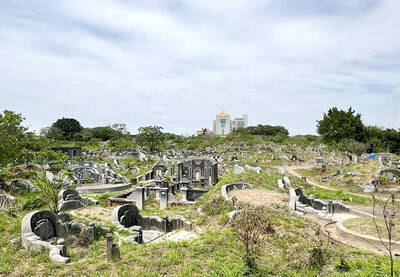
Apr. 13 to Apr. 19 From 17th-century royalty and Presbyterian missionaries to White Terror victims, cultural figures and industrialists, Nanshan Public Cemetery (南山公墓) sprawls across 95 hectares, guarding four centuries of Taiwan’s history. Current estimates show more than 60,000 graves, the earliest dating to 1642. Besides individual tombs, there are also hundreds of family plots, one of which is said to contain around 1,000 remains. As the cemetery occupies valuable land in the heart of Tainan, the government in 2018 began asking families to relocate the graves to make way for development. That

Taiwan’s semiconductor industry consumes electricity at rates that would strain most national grids. Taiwan Semiconductor Manufacturing Co (TSMC) alone accounted for more than 9 percent, or 2,590 megawatts (MW), of the nation’s power demand last year. The factories that produce chips for the world’s phones and servers run around the clock. They cannot tolerate blackouts. Yet Taiwan imports 97 percent of its energy, with liquefied natural gas reserves measured in days. Underground, Taiwan has options. Studies from National Taiwan University estimate recoverable geothermal resources at more than 33,000 MW. Current installed capacity stands below 10 MW. OBSTACLES Despite Taiwan’s significant geothermal potential, the


 RSS
RSS