


What constitutes a classic? And how do you recognize one? Current orthodoxy holds that there’s no such thing, only works that contemporary society feels a need for — economic, ideological and so forth. But there’s another view, namely that certain human creations do stand out by reason of their intrinsic qualities, and that these works retain their eminence over the years irrespective of our passing fashions.
Even so, the second of my initial questions remains easier to answer than the first. Some of the key characteristics to watch out for might be breadth of vision and technical sophistication, plus a refusal to buckle under to the demands of easy reading. But it’s not necessarily a characteristic of the finest works that they make no concessions at all to the reader — many of the greatest books go out of their way to lure and trap us with their magic and charisma.
Wang Anyi’s (王安憶) The Song of Everlasting Sorrow (長恨歌) aims unambiguously for the status of literature from the very beginning, where the spirit of Shanghai is summoned up over some 20 headily evocative pages. This extended eulogy deserves to be printed as a prose-poem in its own right. Surely she can’t keep this up any longer, you think, as one passionate, rapturous groundswell mixing memory and desire follows another. But she can, and does, and on and on she goes, to cumulatively marvelous effect.
Published in Chinese to huge acclaim in 1995, this fine masterpiece has now arrived in an English version. It tells the story of heroine Wang Qiyao (王琦瑤), one embodiment at least of the city’s recent history. She progresses through a series of lovers but fails to establish a permanent relationship with any of them.
First she’s taken up by a photographer, Mr Cheng, and through him wins third place in a beauty contest in 1946. She then becomes the concubine of a powerful entrepreneur called Director Li. After he’s killed in an air crash she moves briefly into the countryside where she meets a poetic but impressionable youth, Deuce. She quickly returns to the big city, however, and, realizing her beauty will one day fade, trains as a nurse.
Next to fall under her spell is Sasha who, with his Russian mother, is “a half-breed child of the revolution.” Then comes Kang Mingxun, the son of a rich factory-owner. By now it’s 1960 and, though famine stalks the land elsewhere in China, Shanghai continues to revel in its egg custard, deep-fried twisted dough sticks and salted pork, and even its filet mignon and pork-chops with onions.
Wang gives birth to a daughter, Weiwei, and the story then jumps 15 years to Weiwei’s adolescence. By now Wang has become a symbol of the Shanghai of old, and is appropriately enough courted by a young fogy called Old Color who, though still in his 20s, is an addict of retro fashion of all kinds. Also onto the scene comes one Long Legs, a kind of aristocratic bohemian with a taste for currency exchange on the black market. As disco begins to dominate the dancehalls, life starts to darken for Wang Qiyao until a final encounter with Long Legs proves more than even she had bargained for.
This is no moralizing tale of the downward progress of a sex-addict, but instead the representation of a kind of modern Everywoman. We are none of us permanent residents in this world, the author implies, but instead are “ephemeral but recurring.” And a life of this kind illustrates that fact far better than a tale of a happy and faithful wife ever could.
The treatment of China’s history is curiously muted, with political developments merely alluded to, and the evolution of everyday life — notably clothes, food and disease — placed center-stage instead. Politics continue to happen, of course, and Mr Cheng commits suicide as a result of the Cultural Revolution and a school friend of Wang’s becomes a cadre. But Shanghai is presented as sailing its own course in spite of everything — not exactly serenely, perhaps, but certainly with a strong sense of its own special qualities and distinction.
The translators, Michael Berry and Susan Chan Egan, refer to “the power and beauty of [Wang’s] literary world,” and this readily comes over in their excellent translation. Weatherhead Books is a part of Columbia University Press, but this novel deserves far more than an academic readership.
Shanghai is presented as a city where people without money or power have little place, where every day is like Christmas and the partying rarely stops. But as Wang Qiyao tells one of her daughter’s friends, “They may all be clamoring for you today, but in a blink of an eye they’ll be running like startled animals. Women have only so much time to settle down. Those who miss the boat are mostly smart, beautiful girls like you.”
This is a long book, an overview of a huge swathe of social history (from the 1940s to the 1980s) that nonetheless refuses to give up on detail. It consequently has the richness of texture of some of the great 19th century novels, with which it implicitly invites comparison. Everything is marshaled into the one imposing edifice — the historical research, the visits to the locations described, the dispositions of the various characters, and so on. Very hard work combines with unflagging high-spirits, just as a sober view of the consequences of people’s actions manages to hold its own with a genuine sympathy for the author’s many creations.
And this, you’re finally convinced, really is a genuine classic, whatever that disputed term may be taken to mean..

In late October of 1873 the government of Japan decided against sending a military expedition to Korea to force that nation to open trade relations. Across the government supporters of the expedition resigned immediately. The spectacle of revolt by disaffected samurai began to loom over Japanese politics. In January of 1874 disaffected samurai attacked a senior minister in Tokyo. A month later, a group of pro-Korea expedition and anti-foreign elements from Saga prefecture in Kyushu revolted, driven in part by high food prices stemming from poor harvests. Their leader, according to Edward Drea’s classic Japan’s Imperial Army, was a samurai

The following three paragraphs are just some of what the local Chinese-language press is reporting on breathlessly and following every twist and turn with the eagerness of a soap opera fan. For many English-language readers, it probably comes across as incomprehensibly opaque, so bear with me briefly dear reader: To the surprise of many, former pop singer and Democratic Progressive Party (DPP) ex-lawmaker Yu Tien (余天) of the Taiwan Normal Country Promotion Association (TNCPA) at the last minute dropped out of the running for committee chair of the DPP’s New Taipei City chapter, paving the way for DPP legislator Su
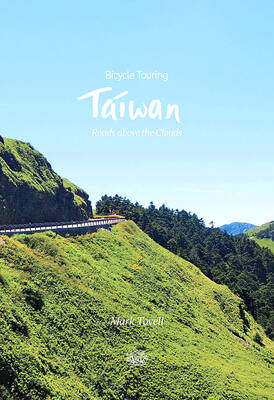
It’s hard to know where to begin with Mark Tovell’s Taiwan: Roads Above the Clouds. Having published a travelogue myself, as well as having contributed to several guidebooks, at first glance Tovell’s book appears to inhabit a middle ground — the kind of hard-to-sell nowheresville publishers detest. Leaf through the pages and you’ll find them suffuse with the purple prose best associated with travel literature: “When the sun is low on a warm, clear morning, and with the heat already rising, we stand at the riverside bike path leading south from Sanxia’s old cobble streets.” Hardly the stuff of your
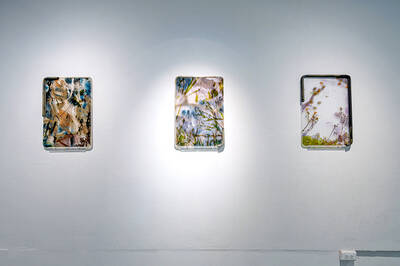
Located down a sideroad in old Wanhua District (萬華區), Waley Art (水谷藝術) has an established reputation for curating some of the more provocative indie art exhibitions in Taipei. And this month is no exception. Beyond the innocuous facade of a shophouse, the full three stories of the gallery space (including the basement) have been taken over by photographs, installation videos and abstract images courtesy of two creatives who hail from the opposite ends of the earth, Taiwan’s Hsu Yi-ting (許懿婷) and Germany’s Benjamin Janzen. “In 2019, I had an art residency in Europe,” Hsu says. “I met Benjamin in the lobby


 RSS
RSS