


Ask any Taiwanese born after the 1970s about the White Terror, 228 or the Kaohsiung Incident, and chances are the answers will be less than satisfactory. Ask them what role, if any, their parents played in the dangwai — or, conversely, in the repressive Chinese Nationalist Party (KMT) apparatus that existed at the time — and more often than not the response will be “I don’t know; we don’t discuss these things with our parents.” Such collective amnesia cannot but have implications for Taiwan. As historian E.H. Carr wrote in What is History?, “A society which has lost belief in its capacity to progress in the future will quickly cease to concern itself with its progress in the past.”
For that period, a defining part of Taiwan’s history, is all about progress, with opposition movements slowly beginning to defy, then breaking apart, the system of fear over which dictator Chiang Kai-shek (蔣介石) and later his son, Chiang Ching-kuo (蔣經國), presided. Before the regime collapsed, so pervasive had been the repression of the state against its people that no one would dare discuss the KMT regime’s massacre of thousands of Taiwanese on Feb. 28, 1947, lest informants inform the authorities. As a result, a seminal event in the relationship between Taiwanese and their occupiers was long held in oblivion as part of a denial of history.
Spared the threat of disappearance, imprisonment, torture and execution, many foreigners who came to live and work in Taiwan felt it was their responsibility to do something to help right what they saw as a grave injustice being perpetrated against Taiwanese in the name of “democracy,” all made possible by US support for the Chiang regime. However, at the height of the Cold War, it was rather unfashionable for rights activists to criticize allies of Washington involved in combating communism, and the odds against them were formidable, from a struggle to gain the media’s ear to accusations of being communist sympathizers. Still, for many students, academics, missionaries, journalists and otherwise unemployed activists, the horrors of the KMT and the plight of a people had to be exposed.
A Borrowed Voice is their story. Through narratives, historical documents and analyses from many participants, the book provides a composite picture of the state apparatus, the resistance, and those, like Linda Gail Arrigo and Lynn Miles, who tried to help by bringing that story to the world, all under the watchful eye of the police state and its allies abroad.
The result has a little of a spy novel feel to it, with daring dashes in the night as Arrigo and her husband, dangwai leader Shih Ming-teh (施明德), are purchased by police after the Kaohsiung Incident in 1979; underground dissident meetings; proscribed publications and the ever-present fear as one passes through immigration at the airport. The state security apparatus is omnipresent, with the CIA always in the background.
In their struggle to make a difference, activists are sucked into a world of paranoia and self-doubt. It is a world where neighbors spy on neighbors, where one dares not even discuss 228 in a solitary park and where an advocate may just as well be in the pay of the Ministry of Information — or worse, one of the many intelligence agencies that maintained a tight grip on society. As Wendell Karsen, a teacher in Taiwan at the time, writes, the many Garrison Command encampments that peppered the local communities were meant to intimidate Taiwanese first, and defend the nation second.
As many of the authors who contributed to this project argue, the worse consequences for them being caught paled in comparison with the treatment reserved prisoners of conscience and fugitives such as Chen Yu-hsi (陳玉璽), Reverend Kao Chun-ming (高俊明), Chen Chu (陳菊), author Li Ao (李敖), Peng Ming-min (彭明敏), Shih and many, many others. At worst, exposure meant immediate expulsion, or failure to get a visa renewed, as well as the financial consequences of losing one’s job. Others, like Miles, became so involved with the cause that their marriages suffered. Missionaries from the Presbyterian Church — which was among the first institutions to advocate Taiwanese independence — were also targeted by the authorities and treated to “tea chats” with security officials, with intimidation the ostensible goal.
Two question weave themselves throughout the narratives: Was it worth it, when the blunders of amateurs playing spy could lead to the detention, torture or even execution of the very Taiwanese the expatriates were trying to help — and did it make a difference? The answer to both is almost certainly yes, although as the writers themselves acknowledge, it was Taiwanese themselves, not some foreign power, who in the end dismantled the oppressive regime and cultivated democracy.
Still, the many Americans, Japanese and others who chose not to remain indifferent to the abuse they witnessed in Taiwan share some of the credit, as their exposure of the Chiang regime’s rottenness — especially after US President Jimmy Carter switched recognition to Beijing and put human rights at the core of his foreign policy, at least rhetorically — resulted in pressure on Taipei and the American Institute in Taiwan, which played a role in propping up the regime and whose officials, with some notable exceptions, chose to look the other way when evidence showed that their ally in the battle against communism was repressing an entire people and, by rebound, sullying the US’ reputation.
It was Chiang Ching-kuo’s fear of abandonment following Carter’s recognition of the People’s Republic of China that ultimately compelled him to gradually open up the political sphere to opposition parties, which eventually coalesced into the Democratic Progressive Party. Aside from Carter’s policy, it was foreign activists who effectively brought the message home: Open up, or else. It is a message one would hope activists today are bringing to the undemocratic and repressive regimes the US is once again propping up in the name of a cause.
If we believe in the progress of the human race, we cannot afford to forget the past, and A Borrowed Voice gives a voice to the many unsung heroes, Taiwanese and foreign, who did their part during a defining period in Taiwan’s history. With its successful transition from a police state to a democracy, Taiwan did not, as one author once put it, reach the end of history. The fight to keep democracy alive is just as hard, just as important, and history is our best guide. A Borrowed Voice is part of that history.
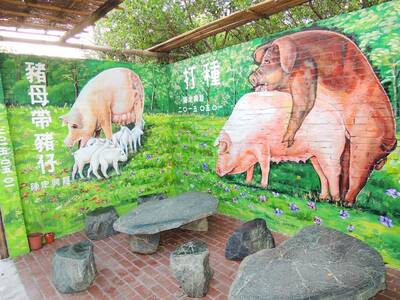
May 6 to May 12 Those who follow the Chinese-language news may have noticed the usage of the term zhuge (豬哥, literally ‘pig brother,’ a male pig raised for breeding purposes) in reports concerning the ongoing #Metoo scandal in the entertainment industry. The term’s modern connotations can range from womanizer or lecher to sexual predator, but it once referred to an important rural trade. Until the 1970s, it was a common sight to see a breeder herding a single “zhuge” down a rustic path with a bamboo whip, often traveling large distances over rugged terrain to service local families. Not only
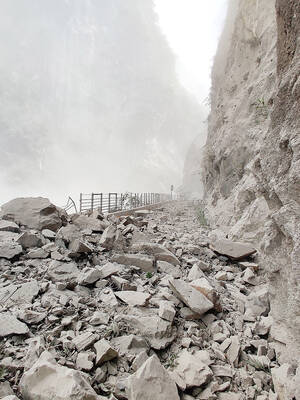
Moritz Mieg, 22, lay face down in the rubble, the ground shaking violently beneath him. Boulders crashed down around him, some stones hitting his back. “I just hoped that it would be one big hit and over, because I did not want to be hit nearly to death and then have to slowly die,” the student from Germany tells Taipei Times. MORNING WALK Early on April 3, Mieg set out on a scenic hike through Taroko Gorge in Hualien County (花蓮). It was a fine day for it. Little did he know that the complex intersection of tectonic plates Taiwan sits
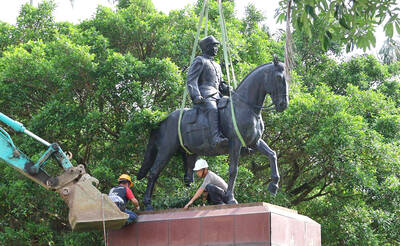
The last time Mrs Hsieh came to Cihu Park in Taoyuan was almost 50 years ago, on a school trip to the grave of Taiwan’s recently deceased dictator. Busloads of children were brought in to pay their respects to Chiang Kai-shek (蔣中正), known as Generalissimo, who had died at 87, after decades ruling Taiwan under brutal martial law. “There were a lot of buses, and there was a long queue,” Hsieh recalled. “It was a school rule. We had to bow, and then we went home.” Chiang’s body is still there, under guard in a mausoleum at the end of a path

Last week the Directorate-General of Budget, Accounting and Statistics (DGBAS) released a set of very strange numbers on Taiwan’s wealth distribution. Duly quoted in the Taipei Times, the report said that “The Gini coefficient for Taiwanese households… was 0.606 at the end of 2021, lower than Australia’s 0.611, the UK’s 0.620, Japan’s 0.678, France’s 0.676 and Germany’s 0.727, the agency said in a report.” The Gini coefficient is a measure of relative inequality, usually of wealth or income, though it can be used to evaluate other forms of inequality. However, for most nations it is a number from .25 to .50


 RSS
RSS