


Gary Hill surfs, speaks backwards and snickers at the appellation most often used to describe him. While to many art fans he’s the biggest pioneer of “video art” after Nam June Paik, the 55-year-old Hill is on a different wavelength.
“I don’t think terms are what it’s about really,” he said in a recent phone interview from Seattle. “I’m probably more of a language artist than a video artist. That gives you an idea of the a gap between what I do and what whoever makes terms up thinks that I do.”
What Hill did do was establish himself as one of the progenitors of what has come to be known — to “whoever makes terms up” — as “new media art.” He helped define an art, still growing in popularity, in which technology replaces traditional materials like stone, metal and pigment.
Hill has no shortage of fans and followers in Taiwan’s tech-heavy art scene, which — along with a well-received solo exhibition at the Museum of Contemporary Art Taipei in 2003 — helps explain why he has been invited to speak at Taipei’s World Trade Center on Saturday as part of Art Taipei 2008, the country’s biggest art fair.
Hill will give a “kind of open-ended talk” called Language Beyond Its Own Limits with poet George Quasha. The pair have just finished a book titled The Art of Limina.
Art Taipei will include a gallery showing Remembering Paralinguay (2000), one of Hill’s “single-channel” works (the art world’s term for a straight-up video). In the piece a woman “struggles across an unknown gap or space until her face fills the screen,” a description provided by the artist reads, and then shrieks “in extreme falsetto.”
While some of Hill’s work has been criticized for being inscrutable, the artist himself is anything but. Cerebral, perhaps, but the Santa Monica, California-born surfer describes his work in a lucid, refreshingly straightforward manner. West-coast I means, you knows, uhs and frequent chuckles have been omitted from quotes above and below.
“If it’s challenging to the viewer, it’s challenging to myself,” Hill says. “I have to think, ‘Does this make sense? Is this insane? Is this nonsense? Is there something here that makes me think, even though I don’t know what it is?’ I’m going through the same questions that, perhaps, the viewer goes through.”
“It may be difficult, it may be ‘What does this mean?’ but for the most part I try to have everything available,” he says. “Even if it’s difficult, it’s available.”
Hill started making videos in 1973 on what was at the time a revolutionary device. The Sony Portapak camcorder, while unwieldy by today’s standards, put video in the hands of the people. Trained as a sculptor, Hill was living in Woodstock, New York, and had already begun incorporating sound recordings into works made with metal bars. Video art had been making ripples in the art scene when Woodstock Community Video opened, and Hill stopped by “to check it out.”
“It was somewhat by happenstance that it occurred, but I was ready for it.”
To viewers not familiar with this kind of work, some of the pieces that followed haven’t aged well. The 2003 MOCA show included pieces with overly digitized images, grainy color separations and repetitious, drawn-out takes that resembled the results of someone tinkering with the “effects” buttons on today’s cameras.
Other works in the show were friendlier to the casual museumgoer. For Wall Piece (2000), Hill repeatedly threw himself against a wall and uttered sometimes incoherent words. Each time he hit the wall, the pitch-dark gallery was illuminated by a split-second image of the artist, sometimes coinciding with the moment of impact, sometimes not. The effect was humorous and engaging.
One of the reasons even the newest media art can appear dated is that its techniques often overlap those used in cinema, television and music video. Commercial producers typically have more at their disposal than artists, and can therefore provide cleaner results.
“I really move back and forth, sometimes … delving in technology, but typically not super high-end technology,” he says. “I generally look for some sort of fallibility, some kind of crack in technology.”
Hill laughs when asked to compare his work and music videos. His pieces “may have to do with opening up time, which is significantly different than most music videos, which are sort of trying to make things happen as quickly as possible. This isn’t talking about apples and oranges; it’s like talking about fruit and meat.”
Commercial interests seem below Hill, making his appearance at Art Taipei all the more interesting. This afternoon at the Taipei Fine Arts Museum auditorium, the 2008 Asia Art Economy Forum includes a talk titled Chinese Focus: Development and Trend of Auction Markets in the Chinese World. On Sunday a speaker will tell listeners How to Collect Young Artists.
“The art market has destroyed artists as far as I’m concerned,” Hill says. “I think that the prices are completely and totally inflated, all misrepresentational and bad for long-term creativity and reality people.”
“When things sell for millions and millions of dollars and it’s just because people have the wool pulled over their eyes, it creates a false idea of value.”
While averse to terms like “video art,” Hill isn’t above coining a word or two himself. “Paralinguay” in the title of the work to be shown at Art Taipei is an anagram of the first names “Gary” and “Paulina” — from longtime collaborator Paulina Wallenberg-Olson, the woman who appears in the piece.
It seemed natural to ask an American artist famous for experimenting with language if he spoke anything other than English. A bit of French, he answered, and a little Japanese when he lived there for a year in the 1980s.
“And I can speak backwards. I learned it for some of my works.”
Then he said something, followed by a quick chuckle, that I still can’t understand, despite repeatedly listening to a recording of our conversation.
“It’s not a very used language,” he said.
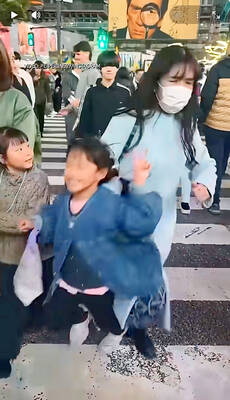
It starts out as a heartwarming clip. A young girl, clearly delighted to be in Tokyo, beams as she makes a peace sign to the camera. Seconds later, she is shoved to the ground from behind by a woman wearing a surgical mask. The assailant doesn’t skip a beat, striding out of shot of the clip filmed by the girl’s mother. This was no accidental clash of shoulders in a crowded place, but one of the most visible examples of a spate of butsukari otoko — “bumping man” — shoving incidents in Japan that experts attribute to a combination of gender

The race for New Taipei City mayor is being keenly watched, and now with the nomination of former deputy mayor of Taipei Hammer Lee (李四川) as the Chinese Nationalist Party’s (KMT) candidate, the battle lines are drawn. All polling data on the tight race mentioned in this column is from the March 12 Formosa poll. On Christmas Day 2010, Taipei County merged into one mega-metropolis of four million people, making it the nation’s largest city. The same day, the winner of the mayoral race, Eric Chu (朱立倫) of the Chinese Nationalist Party (KMT), took office and insisted on the current

Last week the government announced that by year’s end Taiwan will have the highest density of anti-ship missiles in the world. Its inventory could exceed 1,400, or enough for the opening two hours of an invasion from the People’s Republic of China (PRC). Snark aside, it sounds impressive. But an important piece is missing. Lost in all the “dialogues” and “debates” and “discussions” whose sole purpose is simply to dawdle and delay is what the Chinese Nationalist Party (KMT) alternative special defense budget proposal means for the defense of Taiwan. It is a betrayal of both Taiwan and the US. IT’S
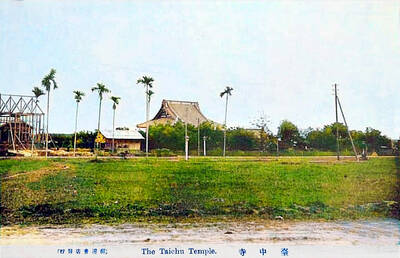
March 16 to March 22 Hidden for decades behind junk-filled metal shacks, trees and overgrowth, a small domed structure bearing a Buddhist swastika resurfaced last June in a Taichung alley. It was soon identified as a remnant of the 122-year-old Gokokuzan Taichuu-ji (Taichung Temple, 護國山台中寺), which was thought to have been demolished in the 1980s. In addition, a stone stele dedicated to monk Hoshu Ono, who served as abbot from 1914 to 1930, was discovered in the detritus. The temple was established in 1903 as the local center for the Soto school


 RSS
RSS