


Sitting by a window at a cafe in Ximending (西門町), Zero Chou (周美玲) appeared surprisingly patient and agreeable as she sat through a weekend afternoon of interviews prior to the theatrical release of her third feature film, Drifting Flowers, (漂浪青春) last Friday.
With a youthful appearance and an unpretentious way of speaking, Taiwan’s foremost lesbian director looked more like a college student than a seasoned filmmaker with a clutch of award-winning films under her belt, the most recent being Spider Lilies (刺青), the winner of last year’s Berlinale Teddy Award for Best Feature Film. Even more surprising was the disarming candor and earnestness that the 39-year-old director displayed throughout our interview, which made the conversation seem like one between old acquaintances catching up on lost time.
Chou spoke openly of her childhood memories of Keelung’s red-light district, her early success as a documentary filmmaker, and her desire to tell the history of homosexuality in Taiwan using a language that can be understood by everyone.
Taipei Times: Your first job after graduating from National Chengchi University (國立政治大學) was working as a reporter at the then-tangwai (黨外, outside the KMT) television network known as Chuan Min (全民) and later at a local newspaper in Kinmen. What motivated you? Social and political awareness?
Zero Chou: That, and just me being young and curious, wanting to experience and experiment. Back then [in early 1990s] cable television stations were mushrooming. There were around 200 of them, 100 of which were the “underground” tangwai cable channels that formed the Chuan Min network. I got to spend lots of time with legislators back when the Legislative Yuan was quite a boisterous scene.
When I was working there, Kinmen was still under martial law [which was lifted in 1992], so it was a place young people thought was cool to visit and hang out at.
TT: Were you also aspiring to become a film director?
ZC: No. Even now I think I would be a lot happier being, say, an assistant art designer. There is an immediate sense of satisfaction from a job well done. The director says [he or she wants] a white plate, you give [him or her] a white plate.
But, unfortunately, I realized how much I loved making films after I started making them. The original motive behind any creative act is always as innocent as a child. But once you try to execute it, you run into complexities and problems that make you wonder how the world has become as messed up as it is now.
TT: Like many local filmmakers, you started off making documentaries. Was this partially for economic reasons?
ZC: At first, yes. It’s a lot easier to get funding for documentary making. I could live on grants of NT$10,000 for three months and make plans for my projects. But I quickly grew fond of this form of filmmaking because it satisfied my appetite for making friends with all kinds of people from different backgrounds and social stratums. I made documentaries about prostitutes, the visually-impaired, homosexuals, hand-puppet artists and nakasi (那卡西) performers [a type of music associated with red-light districts]. They all became material for my feature films. The characters I create [now] feel real and rooted in life because I had seen [so many different] lives.
(In 1999, Chou initiated the ambitious project Floating Islands (流離島影) with 11 other filmmakers. The series documented life on 12 islands separate from the Taiwanese mainland. It is considered a milestone in the history of Taiwanese film because of its scale and its experimental approach to documentary making. Chou then went on to make the award-winning Corner’s (私角落) and Poles Extremity (極端寶島), films about the homosexual community and lower classes, respectively.)
TT: Your trio of feature films [Splendid Float (豔光四射歌舞團), Spider Lilies and Drifting Flowers, the first three films in the ongoing Rainbow Colors project, which comprises six films about homosexuality] shows Taiwan’s homosexual community in a traditional context. Is your interest in traditional Taiwanese culture also related to your childhood?
ZC: Yeah. I’m from Keelung, and my obsession with this seemingly tawdry and neon-lit lowbrow culture started when I was growing up in what was then the country’s biggest port, some 30 years ago. We kids didn’t speak a word of English, but we all knew the word “bar.” The street [in the port’s red-light district] was all lit up at night by neon signs that pictured naked women in wine glasses.
We had a red-light district called Railway Street (鐵道路). When night fell, the red light bulbs hanging in front [of the brothels] glowed in clusters. Women would come out to sit on stools, combing their hair and sprucing themselves up.
The family of one of my best friends in elementary school ran one of these establishments. We loved doing our homework in their living room cum bar. The beautiful “older sisters” and “aunties” would kiss us, pinch our cheeks and fix us things to eat and drink. These are warm, sweet-scented memories to me.
TT: Is this also the reason why you choose to tell stories in the form of melodramas?
ZC: Yeah. I come from a blue-collar background and have lived with members of the so-called underclass. Why should I speak in a language that they don’t understand?
TT: You made your first feature short A Film About the Body (身體影片) in 1996, about cross-dressers. Eight years later you made your feature debut, Splendid Float, which is also about a group of drag queens. Were you aware from the beginning that the themes of the body and sexual identity were recurring motifs in your art?
ZC: No, actually. I’m a slow person. [Laughing, Chou confesses that she didn’t know she was gay until she was 29 years old]. I wasn’t aware of my own sexuality or the reasons why I was attracted to what is usually deemed vulgar and gaudy. I made films and then, much later, I looked back and suddenly realized, “Oh, so that’s where it came from.”
TT: You once said that homosexuality to you is as much of an identity as it is an aesthetic. Would you care to elaborate on this point?
ZC: Taiwan’s homosexuals have a special affinity for the colorful, bling-bling look and spirit. To me, this shares a common language with the flashy visuals Taiwanese culture uses to express and represent itself. I want to find a way for the two to coexist in harmony, at least in my films. If the two split, it would mean I am split, and I don’t want that.
TT: So you have made it a point to show this aspect of Taiwan’s homosexual community?
ZC: The best way is being truthful. Since Drifting Flowers I’ve been getting the same question from lots of people, who ask why I didn’t portray gays as contemporary and urban. This is exactly the kind of thinking that upsets me, because being urban and modern is equivalent to being cut off from history. I don’t need to fill in the blanks if someone else already has. But it seems that no one is interested in articulating the history of homosexuals in Taiwan except us [gay filmmakers].
TT: So you aimed to do Ts justice in Drifting Flowers? [“T” is a term used in the Taiwanese gay community for a tomboy, or butch lesbian.]
ZC: Yes! I simply wanted to tell a good story about Ts. Half of all Ts in Taiwan bind their breasts. But no films talk about this.
TT: You once said your films are always inspired by your friends’ experiences. What parts of Drifting Flowers are based your life or your friends’ lives?
ZC: Well, my film crew said I am the old Lily [an Alzheimer’s sufferer] because I always forget things and can easily disconnect myself from the outside world to live in a world of fantasies.
I made the second segment about the AIDS patient hoping that it would comfort a friend of mine who has AIDS and has attempted suicide several times.
TT: Is it true that you will take a break from your Rainbow Project after Drifting Flowers?
ZC: There’s no rush to make all six films about homosexuality all at once. I’ll work with completely different material and find new nourishment and inspiration for my next Rainbow Project. My next feature film will be a film-noir epic about the Aboriginal tradition of headhunting. These were sacred killings through which the warriors communicated with god. It was through the sacrifice of human heads that Aborigines created some of the most sublime, amazing sounds we have the privilege of hearing today.
TT: What are your thoughts on the Taiwanese film industry?
ZC: We always say that whoever controls the venue controls the market. In the film business, the venue is the movie theater. In Taiwan, theaters only show Hollywood films. The local film business was among the first to be given away during Taiwan’s bid to enter the WTO. After that, there has been no stopping the Hollywood invasion.
When local films don’t sell, people say, “Oh, it’s because they’re not entertaining and commercial enough.” But in recent years we have seen some very entertaining films. It is just that they die prematurely before they can reach most audiences.
I think it’s rather impossible to see [Taiwan’s] film industry taking off again, as long as no changes are made to correct this structural problem.

In late October of 1873 the government of Japan decided against sending a military expedition to Korea to force that nation to open trade relations. Across the government supporters of the expedition resigned immediately. The spectacle of revolt by disaffected samurai began to loom over Japanese politics. In January of 1874 disaffected samurai attacked a senior minister in Tokyo. A month later, a group of pro-Korea expedition and anti-foreign elements from Saga prefecture in Kyushu revolted, driven in part by high food prices stemming from poor harvests. Their leader, according to Edward Drea’s classic Japan’s Imperial Army, was a samurai

The following three paragraphs are just some of what the local Chinese-language press is reporting on breathlessly and following every twist and turn with the eagerness of a soap opera fan. For many English-language readers, it probably comes across as incomprehensibly opaque, so bear with me briefly dear reader: To the surprise of many, former pop singer and Democratic Progressive Party (DPP) ex-lawmaker Yu Tien (余天) of the Taiwan Normal Country Promotion Association (TNCPA) at the last minute dropped out of the running for committee chair of the DPP’s New Taipei City chapter, paving the way for DPP legislator Su
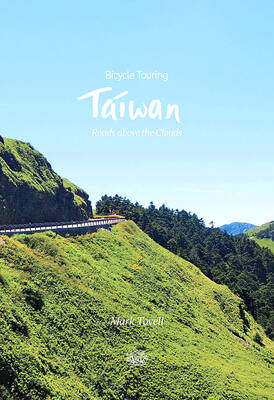
It’s hard to know where to begin with Mark Tovell’s Taiwan: Roads Above the Clouds. Having published a travelogue myself, as well as having contributed to several guidebooks, at first glance Tovell’s book appears to inhabit a middle ground — the kind of hard-to-sell nowheresville publishers detest. Leaf through the pages and you’ll find them suffuse with the purple prose best associated with travel literature: “When the sun is low on a warm, clear morning, and with the heat already rising, we stand at the riverside bike path leading south from Sanxia’s old cobble streets.” Hardly the stuff of your

Located down a sideroad in old Wanhua District (萬華區), Waley Art (水谷藝術) has an established reputation for curating some of the more provocative indie art exhibitions in Taipei. And this month is no exception. Beyond the innocuous facade of a shophouse, the full three stories of the gallery space (including the basement) have been taken over by photographs, installation videos and abstract images courtesy of two creatives who hail from the opposite ends of the earth, Taiwan’s Hsu Yi-ting (許懿婷) and Germany’s Benjamin Janzen. “In 2019, I had an art residency in Europe,” Hsu says. “I met Benjamin in the lobby


 RSS
RSS