


I'm driving down a narrow cement road nearing the northwest coast of Jibei (吉貝) Islet, one of Penghu County's northernmost islands. The rocky beach to the left slants down to a crystalline sea dotted a little ways out with small fishing boats and a lighthouse on the horizon. Black-naped terns emerge from the scrub to my right and dive-bomb passing motorists. This part of the island is still largely in the hands of nature, but this is something that, judging from all the guesthouses under construction, will soon change.
Reaching Jibei’s northernmost tip, a smaller rocky islet juts out of the sea 100m offshore. It’s 10am and the temperature is already above 30°C. The shallow turquoise water separating the two shores here is an ideal spot for snorkeling and a good place to return to in the early evening, when the dipping sun will provide better conditions for exploring.
Although the county government’s glossy brochures promote high-end hotels and adventurous water sports, from parasailing to surfing to jet skiing, locals say that for those with a limited amount of time, the best way to get a feel for Penghu’s lifestyle is to rent a scooter and hit the road. Forget the highways, guide maps and developed infrastructure: it’s off the beaten path where Penghu’s charms are to be found.
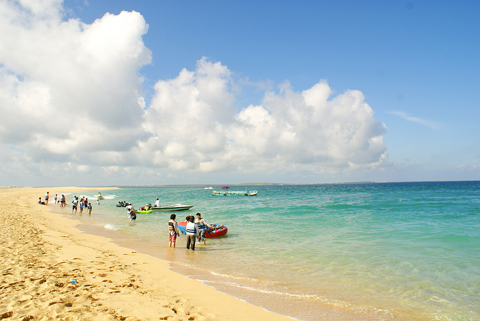
PHOTO: NOAH BUCHAN, TAIPEI TIMES
Jibei’s topography differs little from that of the roughly 20 inhabited islands in the Penghu Archipelago (澎湖群島) and is a microcosm of what the county has to offer. All are mainly flat and largely treeless, with basalt terrain that gives way to sandy beaches perfect for sunbathing and swimming, interspersed with craggy shoals ideal for scuba diving or snorkeling. Intertidal zones make for fascinating ocean-side exploration.
The islet’s southwestern beaches contrast remarkably with those on the northern tip, where barnacle-and-seaweed-encrusted terrain leads to a horn of fine blanched sand that stretches 1.5km out to the ocean. Noisy beach bums and the distant growl of motorboats replace the menacing song of the terns and the relative silence of partially unspoiled nature. The west side of the spit is reserved for water sports, while the east side’s glassy-blue waters tempt waders and swimmers.
Some 317 bird species, 723 species of fish and, depending on the time of year, sea turtles and dolphins can be found around Penghu, according to the The Beauties of Penghu tourist brochure, which is available at the Penghu Tourist Service Center, a 10-minute drive from Makung Airport on Highway 204. The waters surrounding Penghu are also home to an abundance of shellfish and crustaceans, which can be seen up close in the large glass tanks that line the many seafood restaurants found in Makung City (馬公市), the county capital.
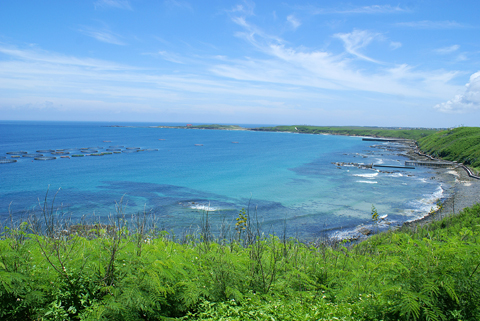
PHOTO: NOAH BUCHAN, TAIPEI TIMES
The three main islands of Makung (馬公), Baisha (白沙) and Siyu (西嶼) are linked by bridges and have five numbered highways. The islands are also a gateway to all the other accessible islands, which can be reached by boat or plane. To get to Jibei, for example, you board a boat (NT$300 per person) at the North Sea Tourist Service Center on the northeast coast of Baisha.
The island’s tourism industry began to develop in earnest more than a decade ago. Since then, the county government has restored and maintained historic sites and marked and maintained highways to make touring, on scooter or bicycle, easy.
Riding around is also an ideal way to interact with locals. Two people arriving at a small village and getting off a motorcycle are a curiosity; 20 people getting off a tour bus are dollar signs. The locals don’t mind visitors snapping a few pictures of them engaged in their traditional subsistence lifestyle, whether it be drying fish beside the sea or cultivating a garden on top of an ochre-tipped bluff.
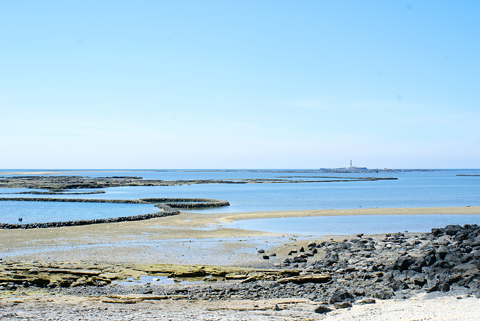
PHOTO: NOAH BUCHAN, TAIPEI TIMES
Although the county government maps are not precise, this should not stop the inquisitive from wandering off the beaten track. Many excursions down a small road or lane revealed a boatyard here or a spectacular vista there. And don’t worry about getting lost: the beauty of Penghu is that no matter how lost you become, if you keep driving, you’ll always find the ocean.
One detour near the town of Chihma (赤馬) on the southern west coast of Siyu leads down a small wall-lined lane, past century-old stone houses, and eventually opens on to a field, on the other side of which is a small conifer forest that ends at a secluded beach with azure water.
Another village back street in the small fishing hamlet of Siaomen (小門) on the north coast of Siyu leads to a tile pathway that snakes up a small hill to enclosed gardens of gourd and corn, laid out symmetrically and separated by large rock walls to protect the soil from the powerful winds that arrive each October and blow through Penghu for the following seven months. Reaching the tip of what turned out to be a basalt cliff with stairs down to the sea, an expansive view of Penghu’s famous heart-shaped weirs, a spectacular shipwreck and islands in the distance were the rewards for this short trek.
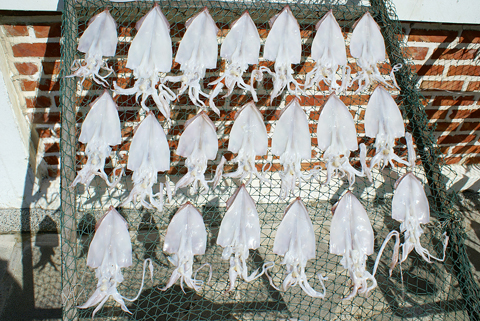
PHOTO: NOAH BUCHAN, TAIPEI TIMES
With the receding tide came ocean-side scavengers, elderly men and women wandering among the rocks in search of their dinner, the women dressed so that only their eyes were exposed.
For the less adventurous or those wanting to save a few bucks on motorcycle rentals and gas, there is still plenty to do and see on Penghu’s many islands.
Makung has some of the best and most easily accessible beaches. For those wanting to enjoy a day at the beach, Shanshui (山水) Beach on the southwest coast is highly recommended. Like all beaches on Penghu, it is clean and the surf relatively safe. There are also a couple of restaurants, a surf shop and minsu (民宿), or guesthouses, along the small main drag.
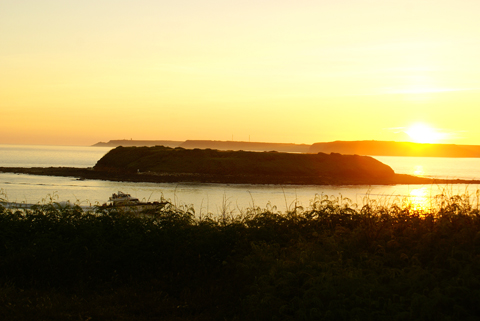
PHOTO: NOAH BUCHAN, TAIPEI TIMES
Further west is Shili ( 裡) Beach, equally as beautiful as Shanshui and ideal for those wanting to avoid the crowds. A 10-minute drive west of Shili Beach are Fongguei Cave (風櫃) and Shetou Hill (蛇頭山) Recreational Area — the latter a romantic place to watch the sun set into the sea.
Siying Rainbow (彩虹) Bridge in front of the Kuanyin Pavilion (觀音亭) in the western part of Makung City is another favored place to watch the sun set. After the sun sinks below the horizon, follow the smell a few minutes north along Mingtsu (民族) Road to an outdoor Taiwanese-style all-you-can-eat barbeque (NT$249) that overlooks the sea. Or head into the city for a seafood dinner.
Unfortunately, time didn’t permit exploration of the eastern half of Makung (called Husi (湖西) Township), which is said to offer exquisite sunrises. Also absent from this short journey was Chimei (七美), along with the other islands south of Makung. No matter. It simply means that my next journey to Penghu will take me south, rather than north.
IF YOU GO
GETTING THERE:
» Daily flights leave Taipei’s Songshan Airport on Uni Air, Mandarin Airlines, TransAsia Airways and Far Eastern Air Transport. One-way tickets run between NT$1,700 and NT$2,400.
SCOOTER AND BICYCLE RENTAL:
» There are many shops in Makung City offering scooters and bicycles for rent. A 125cc scooter rents for NT$400 per day. Two helmets are provided but tourists must pay to fill the gas tank themselves. In Jibei, scooters are cheaper and this is reflected in the quality of the ride. NT$250 will give you a scooter for a day with a tank full of gas.
ISLAND INFORMATION AND TOURS:
» The South Sea Tourist Service Center in Makung City provides information and tickets for tours of the many islands south of Makung. The North Seas Tourist Service Center at the northeast tip of Baisha Island provides information and tickets for tours of Jibei and Mutou islands. Penghu Walker is a well-illustrated map that includes some of the more popular tourist attractions and destinations. The Beauties of Penghu is a detailed brochure explaining Penghu’s culture and environment. There are Chinese and English versions of each.
WHERE TO STAY:
» Camping is possible on most public property. Just pitch your tent or unroll your sleeping bag. A complete list of hotels and homestays on all of Penghu’s main islands can be found at: tour.penghu.gov.tw.
» Chenhai Guesthouse: Upmarket and a 15-minute drive along Highway 203 from Makung City.(www.chenhai-bay.com)
» Beach Castle Villa: Upmarket, located on Shanshui beach.(www.beachcastle.com.tw)
» Mahalo: Surfer style on Shanshui beach.(www.mahalosurfing.com)
» Gibei Sunshine: Mid-level guesthouse located on the beach in Jibei.(www.gibay-sunshine.com)
WHAT TO BRING:
» SPF30 sunscreen and mosquito repellent. If you plan to ride a scooter or a bike around any of the islands, be sure to wear a long-sleeved shirt to prevent sunburn.

In late October of 1873 the government of Japan decided against sending a military expedition to Korea to force that nation to open trade relations. Across the government supporters of the expedition resigned immediately. The spectacle of revolt by disaffected samurai began to loom over Japanese politics. In January of 1874 disaffected samurai attacked a senior minister in Tokyo. A month later, a group of pro-Korea expedition and anti-foreign elements from Saga prefecture in Kyushu revolted, driven in part by high food prices stemming from poor harvests. Their leader, according to Edward Drea’s classic Japan’s Imperial Army, was a samurai

The following three paragraphs are just some of what the local Chinese-language press is reporting on breathlessly and following every twist and turn with the eagerness of a soap opera fan. For many English-language readers, it probably comes across as incomprehensibly opaque, so bear with me briefly dear reader: To the surprise of many, former pop singer and Democratic Progressive Party (DPP) ex-lawmaker Yu Tien (余天) of the Taiwan Normal Country Promotion Association (TNCPA) at the last minute dropped out of the running for committee chair of the DPP’s New Taipei City chapter, paving the way for DPP legislator Su
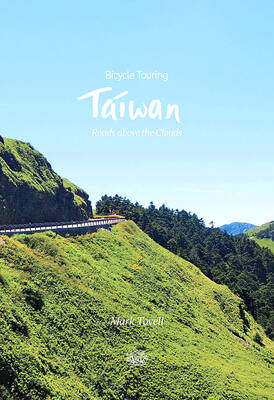
It’s hard to know where to begin with Mark Tovell’s Taiwan: Roads Above the Clouds. Having published a travelogue myself, as well as having contributed to several guidebooks, at first glance Tovell’s book appears to inhabit a middle ground — the kind of hard-to-sell nowheresville publishers detest. Leaf through the pages and you’ll find them suffuse with the purple prose best associated with travel literature: “When the sun is low on a warm, clear morning, and with the heat already rising, we stand at the riverside bike path leading south from Sanxia’s old cobble streets.” Hardly the stuff of your
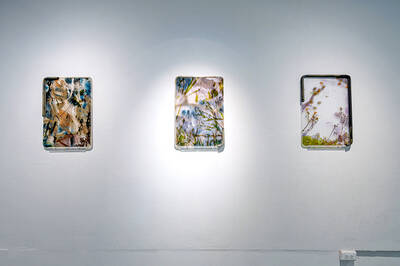
Located down a sideroad in old Wanhua District (萬華區), Waley Art (水谷藝術) has an established reputation for curating some of the more provocative indie art exhibitions in Taipei. And this month is no exception. Beyond the innocuous facade of a shophouse, the full three stories of the gallery space (including the basement) have been taken over by photographs, installation videos and abstract images courtesy of two creatives who hail from the opposite ends of the earth, Taiwan’s Hsu Yi-ting (許懿婷) and Germany’s Benjamin Janzen. “In 2019, I had an art residency in Europe,” Hsu says. “I met Benjamin in the lobby


 RSS
RSS