


The pitch: Eight weeks in Antarctica. Groundbreaking research into the climate before the Ice Age. Glaciers. Volcanoes. Adorable penguins.
The details: Camping on the sea ice in unheated tents, in minus 20oC temperatures. Blinding whiteouts. The bathroom? A toilet seat over a hole in the ice.
Stephen Pekar, a geology professor from Queens College, was selling Shakira Brown, a 29-year-old Harlem middle school science teacher, on his expedition.
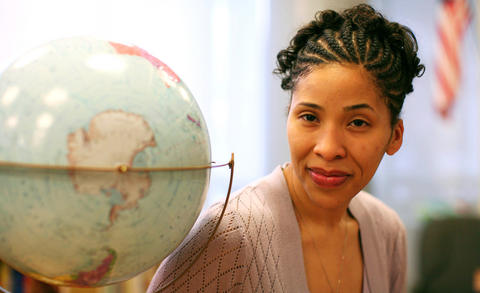
PHOTOS: NY TIMES NEWS SERVICE
Her response: I'm in.
Pekar had found just the person for his Antarctica team: a talented, intrepid African-American teacher to be a role model for minority science students.
"I'm tired of having a bunch of white people running around doing science," said Pekar, who is white. "When it comes to Antarctica, it isn't just the landscape that's white."
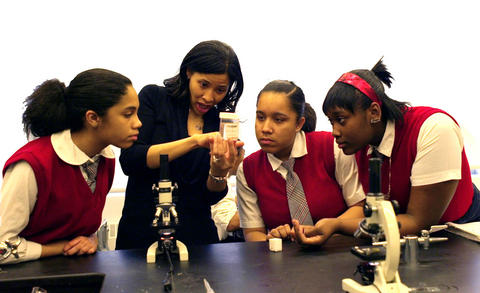
PHOTOS: NY TIMES NEWS SERVICE
Pekar and other scientists want to get more urban minority students excited about science, pointing to studies that show teenagers across the US lagging in math and science scores behind their peers in other industrialized countries.
"These kids don't have the role models, or the environment, that shows them what the possibilities are," he said. "I want Shakira Brown's students to be able to live this experience through her. I want them to be thinking like scientists - like lovers of life."
The trip is sponsored by the National Science Foundation, which sends about 300 scientists to Antarctica each year. Tom Wagner, director of earth sciences for the program, estimates that perhaps three or four African-Americans have joined that research effort.
Relatively few African-Americans, Hispanics and American Indians work in the earth sciences, Wagner said, adding that the foundation was working to bring greater diversity to the field.
Brown, Pekar and three of his students leave in October. They and 11 other team members will meet at McMurdo Station in Antarctica for survival training, including learning how to build an emergency igloo.
At Promise Academy, the charter school where Brown teaches, the students are bursting with questions. Will their teacher catch her own food? (No - Pekar is bringing a chef.) What if Brown falls through the ice? (Unlikely, Pekar says, though their teacher will learn how to avoid cracks.) Will she see polar bears? (No, bears don't live in Antarctica.)
Will her fiance let her make the trip?
"What do you mean, 'Is he going to let me go?' " Brown has told her students. "Of course he's going to let me go. I'm independent. It's the chance of a lifetime."
Eva Ramos, 13, who is in Brown's eighth-grade class, approves. "Ms Brown is a very smart woman," she said. "The trip is going to be hard. But it's for the good of science."
Pekar's search for a teacher began at Harlem Children's Zone, a nonprofit organization that runs Promise Academy. Brown - who gets her students excited about science by having them look at cells under microscopes, ask lots of questions and dream up their own experiments instead of just memorizing facts for state standardized tests - was at the top of everyone's list as the ideal Antarctica explorer-educator.
Brown makes science both understandable and cool, Eva said. "When I was younger, I hated science," she said. "The teachers talked too much. After they talk a lot, you get bored. Brown gives us examples from real life. When she teaches us something, I learn it in a snap."
Brown plans to teach her students - along with dozens of others through the Urban Science Corps, a NASA-affiliated, nationwide after-school program she is helping to develop - with lessons live from Antarctica, via video conferencing and blogging.
At Promise Academy, the Antarctica studies have already begun. On a recent outing to the American Museum of Natural History, Brown's students got to touch penguin feathers. They were enthralled by Pekar's slides of his last trip to Antarctica.
"I want to get them to visualize it, to envision themselves there," Brown said in a recent interview. "You hear about Antarctica in the fourth grade when they're doing all the continents of the world, but it's not a place you consider tangible. You can picture Virginia: Your grandmother lives in Virginia. But who lives in Antarctica?"
Brown grew up in Irvington, New Jersey, just outside Newark, one of five children raised by a single mother who is a social worker. Sophomore biology at Irvington High School - and an inspiring teacher named Miss Jordan - hooked her on science. She went to Hofstra University intending to become a doctor.
But during a stint as a substitute teacher in a Newark middle school - she was working her way through college - she felt called to teaching, she said.
"I prayed over it, and that's where I was led," she said. "When you pay attention to where you're supposed to be, when you operate inside your gift, it just becomes easy. I found my gift; my gift found me."
"I'm a young African-American teacher who came from a public school education, from an urban environment," she went on. "My mom made less than US$30,000 a year, and she raised me and four brothers. Now I'm in a position to empower all these people to have the same path that I was on."
She tells her students they should not be afraid to go anywhere - to Japan (where she went on a fellowship during college), or Africa, or India, or Antarctica. "They ask me, 'If they send you to the moon, will you go?'" she said. "I say: 'Absolutely. You have to go everywhere. Life is bigger than Harlem.'"
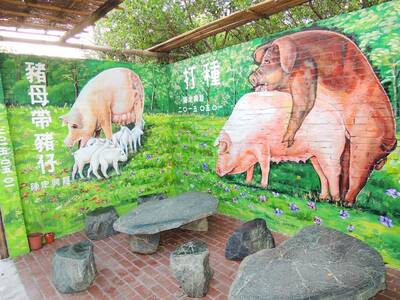
May 6 to May 12 Those who follow the Chinese-language news may have noticed the usage of the term zhuge (豬哥, literally ‘pig brother,’ a male pig raised for breeding purposes) in reports concerning the ongoing #Metoo scandal in the entertainment industry. The term’s modern connotations can range from womanizer or lecher to sexual predator, but it once referred to an important rural trade. Until the 1970s, it was a common sight to see a breeder herding a single “zhuge” down a rustic path with a bamboo whip, often traveling large distances over rugged terrain to service local families. Not only
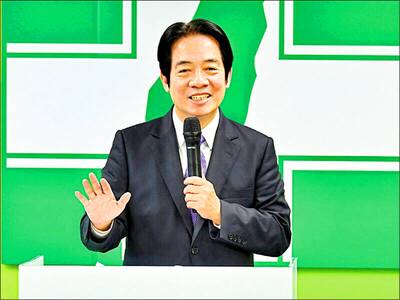
Ahead of incoming president William Lai’s (賴清德) inauguration on May 20 there appear to be signs that he is signaling to the Chinese Communist Party (CCP) and that the Chinese side is also signaling to the Taiwan side. This raises a lot of questions, including what is the CCP up to, who are they signaling to, what are they signaling, how with the various actors in Taiwan respond and where this could ultimately go. In the last column, published on May 2, we examined the curious case of Democratic Progressive Party (DPP) heavyweight Tseng Wen-tsan (鄭文燦) — currently vice premier
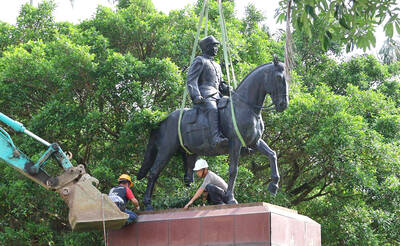
The last time Mrs Hsieh came to Cihu Park in Taoyuan was almost 50 years ago, on a school trip to the grave of Taiwan’s recently deceased dictator. Busloads of children were brought in to pay their respects to Chiang Kai-shek (蔣中正), known as Generalissimo, who had died at 87, after decades ruling Taiwan under brutal martial law. “There were a lot of buses, and there was a long queue,” Hsieh recalled. “It was a school rule. We had to bow, and then we went home.” Chiang’s body is still there, under guard in a mausoleum at the end of a path

Last week the Directorate-General of Budget, Accounting and Statistics (DGBAS) released a set of very strange numbers on Taiwan’s wealth distribution. Duly quoted in the Taipei Times, the report said that “The Gini coefficient for Taiwanese households… was 0.606 at the end of 2021, lower than Australia’s 0.611, the UK’s 0.620, Japan’s 0.678, France’s 0.676 and Germany’s 0.727, the agency said in a report.” The Gini coefficient is a measure of relative inequality, usually of wealth or income, though it can be used to evaluate other forms of inequality. However, for most nations it is a number from .25 to .50


 RSS
RSS