


Wang Gungwu (王赓武), a prolific historian and scholar, has written extensively on China and Chinese migration. He was recently in Taipei, where he gave a lecture at the Lung Ying-tai Cultural Foundation (龍應台文化基金會) called What Kind of Chinese? Southeast Variations. Before the lecture, he sat down with the Taipei Times to discuss Taiwan's recent history and identity, local politics and his impressions of China's leadership and their concerns over Taiwan.
Taipei Times: What influence does history have on ideas of local identity and independence?
Wang Gungwu: I think there is an understandable desire on the part of many people here to reexamine their history and rewrite it. And I think that is happening. And understandably because, for a long time, when the Nationalists [Chinese Nationalist Party, KMT] were in power under Chiang Kai-shek (蔣介石) … history was all about China with very little reference to Taiwan - maybe a footnote here and there - and I think that caused a lot of resentment. So, the idea of putting Taiwan into the history books is certainly understandable. But of course the politics of independence is a different issue altogether. That is not always about history, it's about the future; you want a certain future and then you reinterpret the past to help you get to the future. That has got very little to do with history writing per se. That's politics, ideology, face … But using the past for that is very common everywhere, but that's not history.
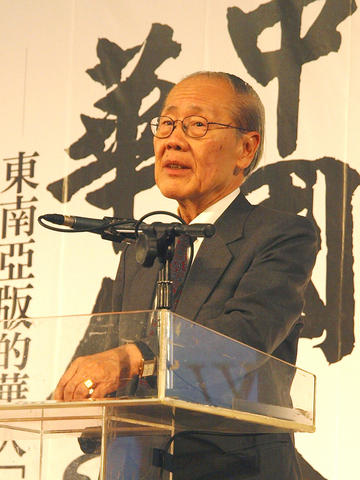
PHOTO: COURTESY OF THE LUNG YING-TAI CULTURAL FOUNDATION
TT: How can a balance be struck in Taiwan between the writing of history and politics?
WGW: Some of the politicians involved are not interested in striking a balance. They want to make a case for their own needs and history can be useful: The history that helps their cause they will bring out, and that which doesn't help they will ignore. It's not really about history. It's really about creating in their minds a new nation, and that is a different cause altogether. I mean scholars, we historians, are interested in what happened in the past even though we might not get it right, but we want to know what happened in the past and know it for its own sake. We have no agenda - our agenda is to get as close to the reality as possible. So we don't always come up with the answers politicians want. If we don't, we know that they will ignore us. But if we do, our findings will be used.
TT: In your opinion, are the current ethnic tensions a reaction to KMT policies of the 1980s?
PHOTO: COURTESY OF THE LUNG YING-TAI CULTURAL FOUNDATION
WGW: It does look like a reaction against what people say was a very repressive regime and indeed the record shows that it was a very tough authoritarian regime that ruled up until the 1980s. During the period from 1945 down to at least the death of Chang Kai-shek and beyond, until the 1980s, many native-born Taiwanese people felt oppressed and some of them actually were treated badly. Many people were killed and imprisoned and tortured. The record is mixed, but on the whole it was a pretty grim record and all kinds of opposition were banned or treated shabbily. So the reaction against that is very understandable and one can sympathize greatly with those people who aspired for a more democratic Taiwan from the 1960s and 1970s on. But they were not only native Taiwanese. There were people from the Mainland who were liberal and democratic and some were even quite radical, and they shared a lot together against the regime. Many were driven out of the country and not allowed to come back and they stayed away until the 1990s. They exiled themselves because they were opposed to the regime. Those people I don't think distinguished between the native born and those who were not. Theirs was a political and, one might say, understandable human reaction against an oppressive regime.
TT: And what about Taiwan's recent history - say the last 10 years?
WGW: What I think happened in the last decade or so, which many people feel uncomfortable about, is the way the people have become sort of ethnically divided, by defining people by where they were from: If you are born here, you are okay, but if you are not, then you are suspect. That, I think, was not expected. It certainly wasn't part of the original reaction against a government that people felt was not popular. I think that development has been regrettable because it creates a completely different atmosphere. Instead of sharing political values and uniting people on the basis of those values, it looks like the politics of identity, with identity predefined in ways that are very difficult to overcome because the identities have been made into fixed categories. Of course it is not always that bad. People are still trying to be rational, so I am still very hopeful that people will not use this ethnicity as something to determine politics altogether.
TT: In what ways might Taiwan's democratic achievements influence China?
WGW: I'm mixed on this one. If the wording is "Chinese democracy," then there are very positive aspects to that statement, that is, the Chinese people on both sides of the Strait are just as interested and desirous of democracy as anyone else and most Chinese, if given the opportunity, would choose democracy if they had the chance to do so. And that's very hopeful for the future. But what I often find are political statements addressed against the government on the opposite side of the Strait. And this happens outside as well as inside Taiwan.
TT: So how are Taiwan's democratic achievements being used to influence China?
WGW: They [politicians] are using it as a weapon against what they consider to be a harsh authoritarian regime on the other side of the Strait, and even try to influence events on the other side. So that's a different agenda. That's not celebrating something for the Chinese people; that is really using it as an instrument for ideological and other campaigns. I'm not comfortable with that because I think it's counter-productive. I'm very positive about the idea that Chinese people are no different from other people in that they want democracy and they would love to have it if they had the choice. Sometimes they don't ask for it because they feel the conditions are not right or they feel it is not the right time to ask for it; Chinese people can be very patient.
In the long run [democracy is] what they want, I have no doubt, but they're not prepared to play other people's games for it. So what I don't appreciate is people simplifying everything as either black or white and using such simplifications for political games that could in the long run be harmful for the peaceful conditions that we would all like to see in the region.
The last thing I want to see, and I think this is true of everybody, is to have any kind of conflict involving the Strait. And in order to avoid that, you have to understand the conditions more carefully and be more sensitive about how people feel about them. If democracy is used as a weapon — I mean democracy is a wonderful idea, for all its faults, I still think it's better than the rest — we must distinguish what is used as an internal instrument by the people themselves, which is fine, from what is used by others outside to serve their own agenda, which is dangerous and could actually create the destabilizing conditions that harm the people who want democracy.
TT: What's the Chinese perspective on Taiwan?
WGW: Here is something very complicated for all Chinese. The people, the leaders and different generations of Chinese on both sides of the Strait probably have different views about what should be done. There are subtle variations in their respective views. But basically they agree that Taiwan is part of China.
TT: In your opinion, what does China want from Taiwan?
WGW: The government leaders on the Mainland don't want the Taiwanese to be hostile. They wouldn't want people in Taiwan to be used by hostile powers against China. In terms of security, they would want a Taiwan that is on their side. But they don't see that. They were uncomfortable that Taiwan was part of the Cold War to begin with. Taiwan was very much part of the anti-communist frontline, and the memory of that remains. And they are not yet sure that that is over, that countries that could be hostile or that don't really care what happens to China, that want to destroy China for ideological reasons, would always want to use Taiwan as a base for doing that.
At the heart of it all is the fear that Taiwan could be used by other people and that the Taiwanese are so self-engrossed that they don't see that and could innocently or deliberately be used by forces that are hostile to China. So from that angle, China would never allow Taiwan to be in that position. That is my understanding. If there is a threat of that happening, they will go to war.
TT: But what about the issue of independence? How does that fit into the thinking of the leaders in China?
WGW: That's part of the story; but it's not the only part. The more fundamental thing is not to have Taiwan so positioned that it could be used by enemies of China against China. And this is part of the history that Chinese leaders learned from the 19th century: China's enemies come not only from land. In the past, it was always from overland and China never had a dangerous enemy from the sea. So the 19th-century British, after the Opium War, and the French, the Japanese and the Americans, all came by sea, and that woke the Chinese up for the first time in their history that there can be dangers from the sea.
TT: And this was a fundamental shift in the thinking of China's leaders?
WGW: Once they woke up to the fact that you can be attacked from the sea and be defeated by sea … it changed the whole of Chinese history. The 19th century's successful invasions by sea really broke China's confidence in a way that the invasions by land never did. The leaders said that never again would they allow the sea approaches to China to be vulnerable. The fact is that victory in World War II — not by the Chinese alone but with the help of the Americans and other allies — confirmed that Taiwan is part of China. Having achieved that, the Chinese are not prepared to let it go again.
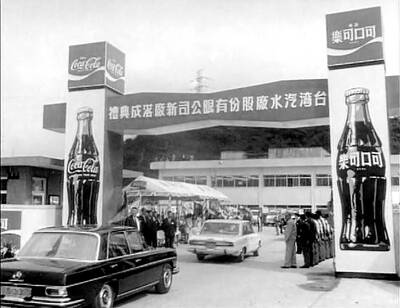
July 28 to Aug. 3 Former president Chiang Kai-shek (蔣介石) reportedly maintained a simple diet and preferred to drink warm water — but one indulgence he enjoyed was a banned drink: Coca-Cola. Although a Coca-Cola plant was built in Taiwan in 1957, It was only allowed to sell to the US military and other American agencies. However, Chiang’s aides recall procuring the soft drink at US military exchange stores, and there’s also records of the Presidential Office ordering in bulk from Hong Kong. By the 1960s, it wasn’t difficult for those with means or connections to obtain Coca-Cola from the
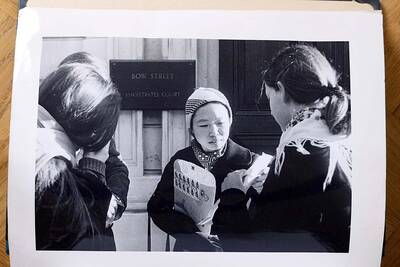
Fifty-five years ago, a .25-caliber Beretta fired in the revolving door of New York’s Plaza Hotel set Taiwan on an unexpected path to democracy. As Chinese military incursions intensify today, a new documentary, When the Spring Rain Falls (春雨424), revisits that 1970 assassination attempt on then-vice premier Chiang Ching-kuo (蔣經國). Director Sylvia Feng (馮賢賢) raises the question Taiwan faces under existential threat: “How do we safeguard our fragile democracy and precious freedom?” ASSASSINATION After its retreat to Taiwan in 1949, the Chinese Nationalist Party (KMT) regime under Chiang Kai-shek (蔣介石) imposed a ruthless military rule, crushing democratic aspirations and kidnapping dissidents from
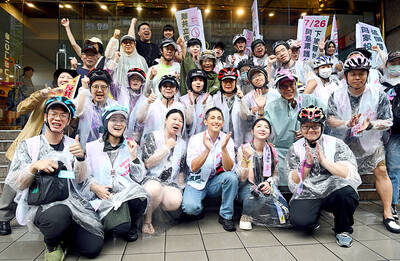
Taiwan is today going to participate in a world-first experiment in democracy. Twenty-four Chinese Nationalist Party (KMT) lawmakers will face a recall vote, with the results determining if they keep their jobs. Some recalls look safe for the incumbents, other lawmakers appear heading for a fall and many could go either way. Predictions on the outcome vary widely, which is unsurprising — this is the first time worldwide a mass recall has ever been attempted at the national level. Even meteorologists are unclear what will happen. As this paper reported, the interactions between tropical storms Francisco and Com-May could lead to
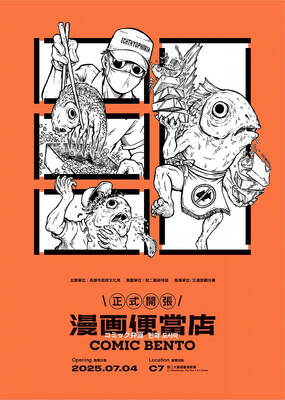
It looks like a restaurant — but it’s food for the mind. Kaohsiung’s Pier-2 Art Center is currently hosting Comic Bento (漫畫便當店), an immersive and quirky exhibition that spotlights Taiwanese comic and animation artists. The entire show is designed like a playful bento shop, where books, plushies and installations are laid out like food offerings — with a much deeper cultural bite. Visitors first enter what looks like a self-service restaurant. Comics, toys and merchandise are displayed buffet-style in trays typically used for lunch servings. Posters on the walls present each comic as a nutritional label for the stories and an ingredient


 RSS
RSS