


An hour after fielding the call last Saturday, the third of its kind in less than a month, Lieutenant Todd Bogardus stood at the edge of a steep trail, barking orders to gathering officers and volunteers in a race to save yet another hiker trapped in the White Mountains.
With winds howling at over 60kph, the sun slipping over the horizon and temperatures plummeting, the leader of the state's rescue team traced the GPS signal from the victim's cellphone. He radioed the coordinates to the National Guard crew hovering nearby in a Black Hawk helicopter, which soon afterward spotted the hiker's headlamp in the high, fog-shrouded snowdrifts of the Pemigewasset Wilderness.
From 45m above, the crew in the helicopter lowered a cable carrying a crewman, who snatched up Benjamin Davis, 28, a Suffolk Law School student suffering frostbite. If it weren't for the rescue, he probably would have died.
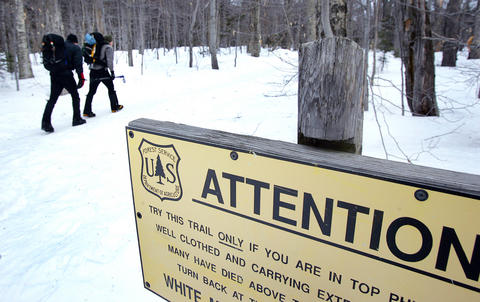
PHOTO: NY TIMES NEWS SERVICE
"I would say he was negligent," said Bogardus, coordinator of the search and rescue team for the New Hampshire Fish and Game Department, which oversees rescue efforts in the White Mountains.
"His leather boots were inadequate for the hike, and he didn't follow the weather reports. Had he followed the weather, he wouldn't have put so many people in danger."
Since the beginning of the year, Bogardus' team has launched 11 missions to rescue lost, missing, or injured people, two of whom died and at least another four of whom required medical attention after losing their way in the White Mountains.
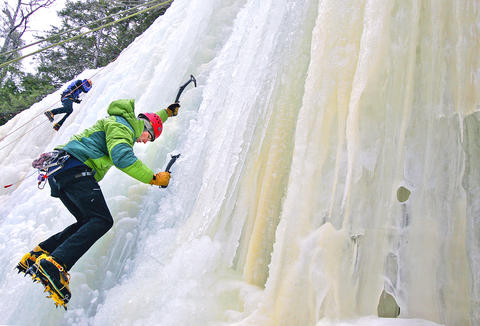
PHOTO: NY TIMES NEWS SERVICE
Such missions, which state officials say are becoming more frequent and more expensive, have raised questions about the responsibilities of hikers who venture into the wilderness at the expense of public agencies. They have also sparked an effort by New Hampshire lawmakers to pass new legislation that would require more lost hikers to repay the state for rescuing them.
From 2004 to the end of last year, the state spent more than US$1 million and devoted about 14,900 hours to rescue 725 people, according to the New Hampshire Fish and Game Department. Of those victims, 28 percent were rescued last year.
Last fiscal year, the department spent more than US$257,000 on rescue operations and for the first time ended the year with a deficit in its search and rescue account.
State officials and local mountaineers in part blame a growing class of novice adventurers, many of whom gain false confidence from new GPS devices, cellphones and flashy gear from proliferating outdoor stores such as REI and Eastern Mountain Sports.
In recent years, Brad White, the director of the International Mountain Climbing School in North Conway, has received more and more calls from people in the mountains asking for help.
"People call and say, 'I think I'm lost,'" he said. "They have a GPS system, but they don't know how to use it to figure out the coordinates. Sometimes, when we send the calls to Fish and Game, they say they've figured out they're still on the trail. There are lots of calls these days from people who just want someone to come in and get them, but it just doesn't happen like that."
He and others who have helped rescue lost hikers tell stories of people venturing deep into the mountains without compasses or maps. They rely on GPS devices and cellphones, but then the batteries die. Last Monday, two Virginia men caught in a torrential rainstorm and 2m-deep snow got lost when they followed their GPS the wrong way. It took rescuers two days to find Alex Obert, 30, and Steven McCay, 29, of Arlington, Virginia, who were on a 30km trek across the Presidential Range in the White Mountains. As the men tried to make their way out of the Dry River Wilderness on the south side of Mount Washington, a helicopter crew found their tracks in the snow.
In a phone interview at his home, Obert described himself and McCay as experienced hikers who had previously trekked in the area and had come prepared with GPS, two-way radios, avalanche beacons, cellphones and topographical maps. He said they were victims of the extreme weather and had trouble following their GPS, because they kept losing the signal.
"We took everything seriously," Obert said. "But if people are found negligent, I think it's valid they pay the state back. But I don't feel we were negligent."
The New Hampshire House is considering a bill that would change the language of a 1999 state law that allows public agencies to recoup expenses from those who "recklessly or intentionally create a situation requiring an emergency response."
"People doing dumb things have to be held accountable," said Dennis Abbott, chairman of the New Hampshire House's Fish and Game Committee, which will vote on the bill in coming weeks. "They're not just putting themselves in harm's way. They're putting a lot of other people in harm's way, and there needs to be some responsibility."
The proposed new language would lower the threshold for the public to compel repayment. The bill changes the language of the law from "recklessly" to "negligently" prompting an emergency response. For those who don't pay, the bill would allow the state to suspend the person's driver's license and other state licenses.
The difference, he and others said, is that "reckless" implies someone who becomes aware of a substantial risk and consciously disregards that risk; a "negligent" person is someone who fails to become aware of the risk that a reasonable person should have been aware of.
Over the past decade, the state has had little success in recovering costs from reckless hikers. Fifteen people or groups repaid the state US$23,780, less than half what the state says it paid for their rescues, according to the New Hampshire Fish and Game Department.
Some mountaineers on the rescue team don't think the law should change.
They wonder where the negligence line would be drawn; would someone hiking in jeans or with old equipment be considered negligent?
"You can't keep hikers to a higher standard than people on the street," said Silas Rossi, a guide in the White Mountains who has helped rescue those whose plans went awry. "Accidents happen, no matter how prepared you are."
But state officials argue the expense, danger, and manpower needed for mountain rescues make them different from emergency situations in everyday life. As calls for mountain rescues have increased in recent years, they insist the law must change.
Among the supporters of the new bill is New Hampshire Army National Guard Staff Sergeant Matt Stohrer, who served on the last three helicopter rescue missions in the White Mountains.
Last Saturday, after the call came over the radio from Bogardus, he was lowered from the helicopter hovering over Benjamin Davis into 2m of snow and high winds from the blades of the Guard's Black Hawk.
"I would describe these missions as more dangerous than getting shot at in Iraq," said Stohrer, who spent two years there.
On the ground, Stohrer detached himself from the cable and detonated a smoke grenade marking his position on the mountain with billows of red. He screamed over the roar, ordering Davis to walk through the snow toward him immediately.
Davis did not return repeated calls, and his mother declined to comment when reached at their home in Pennsylvania.
Stohrer said Davis struggled through the chest-deep snow in bare feet, because he had taken off his wet boots during the night in an attempt to dry them.
"They're putting all the rescuers' lives at risk," Stohrer said, "and I don't think that's right."

In late October of 1873 the government of Japan decided against sending a military expedition to Korea to force that nation to open trade relations. Across the government supporters of the expedition resigned immediately. The spectacle of revolt by disaffected samurai began to loom over Japanese politics. In January of 1874 disaffected samurai attacked a senior minister in Tokyo. A month later, a group of pro-Korea expedition and anti-foreign elements from Saga prefecture in Kyushu revolted, driven in part by high food prices stemming from poor harvests. Their leader, according to Edward Drea’s classic Japan’s Imperial Army, was a samurai

The following three paragraphs are just some of what the local Chinese-language press is reporting on breathlessly and following every twist and turn with the eagerness of a soap opera fan. For many English-language readers, it probably comes across as incomprehensibly opaque, so bear with me briefly dear reader: To the surprise of many, former pop singer and Democratic Progressive Party (DPP) ex-lawmaker Yu Tien (余天) of the Taiwan Normal Country Promotion Association (TNCPA) at the last minute dropped out of the running for committee chair of the DPP’s New Taipei City chapter, paving the way for DPP legislator Su

It’s hard to know where to begin with Mark Tovell’s Taiwan: Roads Above the Clouds. Having published a travelogue myself, as well as having contributed to several guidebooks, at first glance Tovell’s book appears to inhabit a middle ground — the kind of hard-to-sell nowheresville publishers detest. Leaf through the pages and you’ll find them suffuse with the purple prose best associated with travel literature: “When the sun is low on a warm, clear morning, and with the heat already rising, we stand at the riverside bike path leading south from Sanxia’s old cobble streets.” Hardly the stuff of your

Located down a sideroad in old Wanhua District (萬華區), Waley Art (水谷藝術) has an established reputation for curating some of the more provocative indie art exhibitions in Taipei. And this month is no exception. Beyond the innocuous facade of a shophouse, the full three stories of the gallery space (including the basement) have been taken over by photographs, installation videos and abstract images courtesy of two creatives who hail from the opposite ends of the earth, Taiwan’s Hsu Yi-ting (許懿婷) and Germany’s Benjamin Janzen. “In 2019, I had an art residency in Europe,” Hsu says. “I met Benjamin in the lobby


 RSS
RSS