


Dire warning to all adolescents: You can get "hooked from the first cigarette."
That is the headline in the December issue of The Journal of Family Practice. In the report that follows, Joseph R. DiFranza, a family health and community medicine specialist at the University of Massachusetts Medical School in Worcester, states that "very soon after that first cigarette, adolescents can experience a loss of autonomy over tobacco."
DiFranza, who studies tobacco dependence, described a typical teenage smoker - a 14-year-old girl who smokes only occasionally, about three cigarettes a week. She admitted to having failed at several efforts to quit. Each time she tried, cravings and feelings of irritability drove her back to smoking.
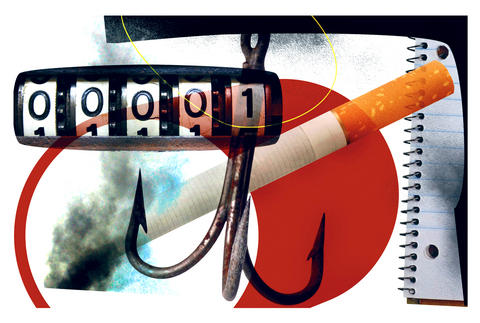
ILLUSTRATION: NY TIMES NEWS SERVICE
"We have long assumed that kids got addicted because they were smoking five or 10 cigarettes a day," DiFranza said in an interview. "Now we know that they risk addiction after trying a cigarette just once."
He based this conclusion on the findings of a 10-item checklist he and colleagues devised to help people of all ages determine whether they were hooked on nicotine. He reported in the journal:
"Studies on a cohort of seventh graders found that every symptom on this validated checklist had been experienced by at least one young person within weeks of starting to smoke, sometimes after the first cigarette. These results have been replicated many times.
"Three New Zealand national surveys involving 25,722 adolescent smokers who used this checklist revealed a loss of autonomy in 25 percent to 30 percent of young people who had smoked their one and only cigarette during the preceding month."
WHY TEENAGERS ARE DIFFERENT
Even occasional teenage smokers can experience the same symptoms of nicotine withdrawal that prompt adult smokers to light up again and again.
Robin J. Mermelstein, director of the Center for Health Behavior Research at the University of Illinois in Chicago and a longtime researcher on smoking behavior, said in an interview that DiFranza's message was important. But, Mermelstein added, "the vast majority of teenagers who try one or two cigarettes don't go on to become smokers."
"Some kids experience withdrawal symptoms earlier than others," she continued. "We still need to know how to predict who's going to get hooked."
DiFranza explained that a phenomenon called "dependence-related tolerance - how long after smoking a cigarette you can go before you need to smoke another one" - was long thought to be the same for adolescents and adults. But recent studies have shown that the brains of adolescents can become tolerant to nicotine after smoking fewer cigarettes than one a day, and it is tolerance that then drives them to smoke more often.
"The typical adult smoker begins to crave the next cigarette in 45 minutes to an hour after smoking," he said. "But kids can be addicted and not need to smoke again for days, even weeks."
Some adult smokers are no different from teenagers. One study found that adults who smoked only a few cigarettes a week found it hard to quit. "They experienced withdrawal symptoms, which some rated as unbearable," DiFranza reported. "Most of these self-described 'social smokers' were addicted to tobacco."
These findings come at a time when the once steady decline in teenage smoking in the US has leveled off, anti-smoking ads on television have all but disappeared and smoking in movies has risen to a near all-time high.
"Well over a dozen studies have shown that kids who watch movies with smoking are more likely to smoke," DiFranza said. "Smoking in movies is more common now than it was in the 1950s and '60s, whereas smoking among adults is half as common now as it was then. Movie producers are not reflecting real life."
Smoking among US teens had been declining steadily from peak levels reached in the mid-1990s through 2004, but the rate of decline decelerated during that period, and in 2005 it halted among eighth graders, the bellwether of smoking trends among teenagers. Today, about 13 percent of teenagers smoke at least once a month.
Studies in rats at Duke University revealed how a single cigarette could keep withdrawal symptoms at bay for far longer than the 12 hours it takes for nicotine to be eliminated from the body. The first dose of nicotine increased production of the neurotransmitter noradrenaline in a part of the brain called the hippocampus for at least 30 days after the nicotine was gone. Another Duke study found an increase in nicotine receptors in the brain the day after the animals got their first dose of nicotine.
NEW STRATEGIES NEEDED
"The take-home message: It only takes a day for the brain to remodel itself in response to one dose of nicotine," DiFranza wrote. "About one-quarter of young people experience a sensation of relaxation the first time they inhale from a cigarette, and this sensation predicts continued smoking."
Further evidence of how easily youngsters become addicted to nicotine comes from studies of quit rates among adolescent smokers. In one typical study, 40 percent of adolescents who tried to quit relapsed in one week or less; only 3 percent remained abstinent a year later.
These findings suggest that new, more forceful strategies are needed to combat smoking by youngsters, which typically leads to a lifetime of smoking. More than 90 percent of adult smokers report that they started smoking as adolescents.
DiFranza maintains that "public health initiatives are most helpful." These include raising the price of cigarettes, a strategy that helped reduce the smoking rate in New York City; a well-enforced nationwide effort to get retailers to stop selling cigarettes to minors; a wider ban on smoking in public places, especially those frequented by teenagers, like restaurants, video game parlors and bowling alleys; mass media campaigns, including broad use by the states of the tobacco industry's payout to sponsor anti-smoking commercials; and pressure on the movie industry to make films smoke-free.
He urged parents, including those who smoke themselves, to emphasize to their children that "it's a huge mistake to start smoking. If they never start, they'll never have to worry about quitting."

In late October of 1873 the government of Japan decided against sending a military expedition to Korea to force that nation to open trade relations. Across the government supporters of the expedition resigned immediately. The spectacle of revolt by disaffected samurai began to loom over Japanese politics. In January of 1874 disaffected samurai attacked a senior minister in Tokyo. A month later, a group of pro-Korea expedition and anti-foreign elements from Saga prefecture in Kyushu revolted, driven in part by high food prices stemming from poor harvests. Their leader, according to Edward Drea’s classic Japan’s Imperial Army, was a samurai

The following three paragraphs are just some of what the local Chinese-language press is reporting on breathlessly and following every twist and turn with the eagerness of a soap opera fan. For many English-language readers, it probably comes across as incomprehensibly opaque, so bear with me briefly dear reader: To the surprise of many, former pop singer and Democratic Progressive Party (DPP) ex-lawmaker Yu Tien (余天) of the Taiwan Normal Country Promotion Association (TNCPA) at the last minute dropped out of the running for committee chair of the DPP’s New Taipei City chapter, paving the way for DPP legislator Su

It’s hard to know where to begin with Mark Tovell’s Taiwan: Roads Above the Clouds. Having published a travelogue myself, as well as having contributed to several guidebooks, at first glance Tovell’s book appears to inhabit a middle ground — the kind of hard-to-sell nowheresville publishers detest. Leaf through the pages and you’ll find them suffuse with the purple prose best associated with travel literature: “When the sun is low on a warm, clear morning, and with the heat already rising, we stand at the riverside bike path leading south from Sanxia’s old cobble streets.” Hardly the stuff of your

Located down a sideroad in old Wanhua District (萬華區), Waley Art (水谷藝術) has an established reputation for curating some of the more provocative indie art exhibitions in Taipei. And this month is no exception. Beyond the innocuous facade of a shophouse, the full three stories of the gallery space (including the basement) have been taken over by photographs, installation videos and abstract images courtesy of two creatives who hail from the opposite ends of the earth, Taiwan’s Hsu Yi-ting (許懿婷) and Germany’s Benjamin Janzen. “In 2019, I had an art residency in Europe,” Hsu says. “I met Benjamin in the lobby


 RSS
RSS