


Graham Greene once wrote that a writer's childhood is the bank at which, in later life, he will cash his creative checks. In another exploration of the writer's inspiration, he also declared, in A Sort of Life, that novelists write out of "a desire to reduce a chaos of experience to some sort of order." If the extraordinary life and work of JG (Jim) Ballard is a case study of these observations, then Miracles of Life, his autobiography, is a detached commentary on a life foretold.
Between the ages of 13 and 33, the young Ballard suffered the kind of experience that perhaps only the 20th century could provide. The child of expat parents in Shanghai, he was interned in a Japanese prison camp in 1943. Having survived, and even thrived, in some grueling conditions, he came home to a country devastated by the war.
Here, in late adolescence, he was packed off to school (where, he notes, "the food was worse" than in camp), studied medicine at Cambridge university, dropped out, joined the RAF, was stationed in Canada and married Mary, settling down to family life in Shepperton just outside London. He was just beginning to make a name for himself as a new-wave science fiction writer, while raising three young children, when Mary died prematurely abroad, from a savage and inexplicable pneumonia.

That, in summary, is the meat of this autobiography. Vanity is the curse of successful writers, but Miracles of Life is impressively free from all forms of show (no name-dropping; no index; scarcely any photographs). Moreover, what this brief, modest and occasionally shattering book only glances at is the extraordinary body of work that has flowed from this remarkable life.
For many readers, Ballard is the author of the controversial novel Crash (1973), a surreal exploration of sexuality and the motor car. But before Crash, and before his wife's death, Ballard's novels had begun to shape a unique suburban dystopia. In its time, this vision was categorized as science fiction. Now we can see it more clearly as deeper, darker and more prophetic.
To fans of this early work, Miracles of Life will be at once disappointing and fascinating. The disappointment is intrinsic to Ballard's achievement. He has mined this material so often and so brilliantly in the past that he can hardly have much that's new to say. Read the 30-odd pages devoted to Lunghua Camp: remarkable enough, but not a patch on Empire of the Sun, the best-selling novel that transformed that experience into art.
Still, there are numerous compensating fascinations. Successful writers in old age are often reluctant to discuss their inspiration for fear of betraying the mystery of their art. Ballard, the former medical student who loved to dissect and has always stood out as an iconoclast, has no trouble with exposing some of his secrets.
Growing up in Shanghai, "the wickedest city in the world," he admits: "I would see something strange and mysterious, but treat it as normal," a juvenile manifesto for his surreal imagination. Ballard writes that his boyhood project was "to find the real in all this make-believe." But then, as a young man in post-war Britain, he found himself in "a world that was almost too real." Hence, he says, his adult determination to treat England, "as if it were a strange fiction."
A few years later, now at King's College, dissecting cadavers in the 1950s Cambridge of Crick and Watson, Ballard decides that "psychoanalysis and Surrealism were a key to the truth about existence and the human person-ality and also a key to myself."
In the battle to make sense of things, the "preposterous society" of England was no help. To save himself from "the suffocations of English life," Ballard seized on the great modernists, "Hemingway, Dos Passos, Kafka, Camus, Joyce and Dostoevsky." Slowly and painfully, he began to dissect the pathology of his early life, from Shanghai to Shepperton. His "entire fiction," he says, explores a psychic terrain that runs from "the threat of nuclear war to the assassination of President Kennedy, from the death of my wife to the violence that underpinned the entertainment culture of the last decades of the century."
There, indeed, is the bank at which Ballard has cashed his literary checks. But, because Ballard is never less than ruthlessly honest about what he sees and feels, Miracles of Life also tells quite another story, unconscious and inadvertent, perhaps, but finally brave in a way that elevates it to a level of greatness.
In this book, we discover a little boy who grew up with "patriotic newsreels, suspicious of all British adults," a nine-year-old steeped in GA Henty, Dickens and Charles Kingsley, who transcribes pages of Westward Ho!, and for whom "home" was the England of AA Milne, Just William and Chums. To this child of the British empire, "reality was a stage set that could be dismantled at any moment." A lesser character might have been overwhelmed, but that was no problem for "a 12-year-old who thrived on change." Shanghai Jim, as he was known in camp, made the most of internment. It was, he writes, "a prison where I found freedom." When the war was over, he was the boy who "knew that childhood had passed for good."
But, of course, it hadn't. When Ballard began to write, he would be shaped by his inheritance. "At heart," he confesses, "I was an old-fashioned storyteller with a lively imagination." This, perhaps, is the key to Ballard, an outcast of empire who found self-expression scavenging the fertile wasteland of 20th-century modernism. Tellingly, however, as an Anglo-Saxon narrator, he cannot conceal from his readers at the end the devastating news that this may be his last book.

In late October of 1873 the government of Japan decided against sending a military expedition to Korea to force that nation to open trade relations. Across the government supporters of the expedition resigned immediately. The spectacle of revolt by disaffected samurai began to loom over Japanese politics. In January of 1874 disaffected samurai attacked a senior minister in Tokyo. A month later, a group of pro-Korea expedition and anti-foreign elements from Saga prefecture in Kyushu revolted, driven in part by high food prices stemming from poor harvests. Their leader, according to Edward Drea’s classic Japan’s Imperial Army, was a samurai

The following three paragraphs are just some of what the local Chinese-language press is reporting on breathlessly and following every twist and turn with the eagerness of a soap opera fan. For many English-language readers, it probably comes across as incomprehensibly opaque, so bear with me briefly dear reader: To the surprise of many, former pop singer and Democratic Progressive Party (DPP) ex-lawmaker Yu Tien (余天) of the Taiwan Normal Country Promotion Association (TNCPA) at the last minute dropped out of the running for committee chair of the DPP’s New Taipei City chapter, paving the way for DPP legislator Su
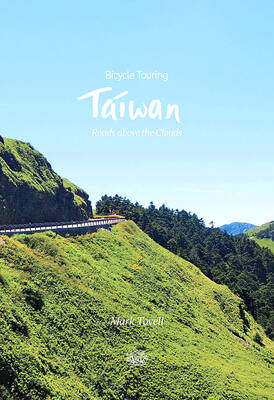
It’s hard to know where to begin with Mark Tovell’s Taiwan: Roads Above the Clouds. Having published a travelogue myself, as well as having contributed to several guidebooks, at first glance Tovell’s book appears to inhabit a middle ground — the kind of hard-to-sell nowheresville publishers detest. Leaf through the pages and you’ll find them suffuse with the purple prose best associated with travel literature: “When the sun is low on a warm, clear morning, and with the heat already rising, we stand at the riverside bike path leading south from Sanxia’s old cobble streets.” Hardly the stuff of your

Located down a sideroad in old Wanhua District (萬華區), Waley Art (水谷藝術) has an established reputation for curating some of the more provocative indie art exhibitions in Taipei. And this month is no exception. Beyond the innocuous facade of a shophouse, the full three stories of the gallery space (including the basement) have been taken over by photographs, installation videos and abstract images courtesy of two creatives who hail from the opposite ends of the earth, Taiwan’s Hsu Yi-ting (許懿婷) and Germany’s Benjamin Janzen. “In 2019, I had an art residency in Europe,” Hsu says. “I met Benjamin in the lobby


 RSS
RSS