


From 1882 to 1943 people perceived as being of Chinese origin were barred from immigration into the US under what have become known collectively as the Chinese Exclusion Laws. It remains the only exclusion based on race, rather than nationality, the US has ever enacted.
Even after 1943 it was all but impossible, at least on paper, for them to get in - a quota system established 105 as the total number of Chinese immigrants permitted, and even that minute number was not taken up, so stringent was the small print. Only in the mid-1960s, in the wake of a Civil Rights movement highlighting racially motivated discrimination generally, was the ban finally lifted.
Many continued to arrive after the ban, however, and many of them entered the country successfully. The way this was done was through a section in the laws that allowed entry to the children of US residents. Chinese who were already citizens therefore filed details with the authorities of children who had been born to them in China, but who in fact never existed, and then sold these "slots" to prospective immigrants via their agents.
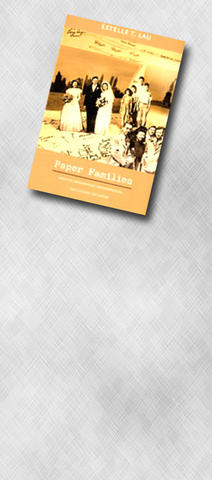
The problem for the authorities was that in those pre-DNA test times there was no way of establishing for certain who these people waiting on San Francisco's wharves actually were. Were they really the children of US citizens they claimed to be? The only way to check, or attempt to check, was to question them at length on the families they said they belonged to, the villages they'd supposedly come from, and even the number of pigs the man living in the second house along in the third row of houses from the north possessed. Long accounts of these extremely detailed interviews still survive, together with "crib sheets" describing a huge range of just such information that the US residents provided along with their "slots." A study of these forms the basis of this book.
The focus of Chinese arrivals was California, where large numbers had arrived in the wake of the 1849 Gold Rush, both to pan for gold themselves and to work on the railroads. Even then state legislation was enacted against them - there was a tax specifically on Chinese gold miners, their queues were forcibly cut off, and they were denied the right to testify in court (which meant that the numerous assaults on them couldn't be prosecuted).
Yet even at its height before 1882, Chinese immigration had accounted for under 5 percent of all arrivals in the US. So what were the reasons for the discrimination? One was that the Chinese were willing to work for lower rates than their counterparts and so were seen as undermining wage structures. Another was that they appeared clannish and unwilling to assimilate - a strange view for San Francisco in the mid-19th century where polyglot adventurers from every part of the globe were congregated. On a more mythic level, their numbers were perceived as being virtually unlimited, and China was thought of as a fountain of would-be immigrants that nothing could exhaust.
But at root lay the ancient desire for a scapegoat. With so much tension in the air, and so much poverty for the majority (though riches for the lucky few), some group had to be found to blame for the many disappointments. In Europe in the 1930s this unhappy lot fell on the Jews. In California in the second half of the 19th century it was the Chinese.
You might think that deception of the authorities in order to obtain immigration rights might be viewed as a shameful history. Not by this author. Estelle Lau - an attorney whose parents came to the US in the 1950s when the exclusion laws had been relaxed, though not abolished - sees the Chinese immigrants of old as heroic individuals struggling against unjust laws put in place by a racially motivated state.
Yet she can be remarkably even-handed. Of the hard-pressed authorities she writes, "It is not surprising that the immigration regulators did not trust the Chinese - they were not paranoid, they just saw what was going on."
Today there are some 1.6 million people of Chinese extraction living in the US, of whom nearly half were foreign-born. Asians as a whole account for less than one percent of the population but, following their economic success, are widely perceived as being "model minorities."
Would-be migrants from China are still trying to enter the US illegally, though they rank only 21st in the list according to country of origin. The wreck off New York City of the Golden Venture in 1993, with 260 migrants from China on board, many of whom drowned when trying to swim to shore, brought the problem before the public gaze once again. But with today's price for being smuggled into the country estimated at US$30,000, even those who succeed have to work for many years, usually in restaurants or the garment industry, to pay off their debt.
For their part, descendants of former Exclusion Laws-dodgers are still coming to terms with their history. Some have reverted to their original family names, but many have opted to remain with their adopted ones, even continuing to act as members of their paper families. For decades the pretense of consanguinity had to be kept up to deceive the ever-vigilant immigration authorities. "The fictions they created for immigration purposes," writes Lau, "became part of the lived reality of Chinese life in the United States."
It's the author's balance and lack of special pleading that makes Paper Families a sane and therefore agreeable book. There's even, surely, a wry joke concealed in her title. Mao Zedong (毛澤東) may have considered Western imperialists to be "paper tigers," but many American-Chinese were actually themselves members of "paper families." Perhaps Mao himself knew this. On balance it seems not unlikely.

In late October of 1873 the government of Japan decided against sending a military expedition to Korea to force that nation to open trade relations. Across the government supporters of the expedition resigned immediately. The spectacle of revolt by disaffected samurai began to loom over Japanese politics. In January of 1874 disaffected samurai attacked a senior minister in Tokyo. A month later, a group of pro-Korea expedition and anti-foreign elements from Saga prefecture in Kyushu revolted, driven in part by high food prices stemming from poor harvests. Their leader, according to Edward Drea’s classic Japan’s Imperial Army, was a samurai

The following three paragraphs are just some of what the local Chinese-language press is reporting on breathlessly and following every twist and turn with the eagerness of a soap opera fan. For many English-language readers, it probably comes across as incomprehensibly opaque, so bear with me briefly dear reader: To the surprise of many, former pop singer and Democratic Progressive Party (DPP) ex-lawmaker Yu Tien (余天) of the Taiwan Normal Country Promotion Association (TNCPA) at the last minute dropped out of the running for committee chair of the DPP’s New Taipei City chapter, paving the way for DPP legislator Su
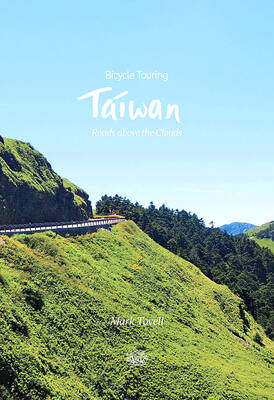
It’s hard to know where to begin with Mark Tovell’s Taiwan: Roads Above the Clouds. Having published a travelogue myself, as well as having contributed to several guidebooks, at first glance Tovell’s book appears to inhabit a middle ground — the kind of hard-to-sell nowheresville publishers detest. Leaf through the pages and you’ll find them suffuse with the purple prose best associated with travel literature: “When the sun is low on a warm, clear morning, and with the heat already rising, we stand at the riverside bike path leading south from Sanxia’s old cobble streets.” Hardly the stuff of your

Located down a sideroad in old Wanhua District (萬華區), Waley Art (水谷藝術) has an established reputation for curating some of the more provocative indie art exhibitions in Taipei. And this month is no exception. Beyond the innocuous facade of a shophouse, the full three stories of the gallery space (including the basement) have been taken over by photographs, installation videos and abstract images courtesy of two creatives who hail from the opposite ends of the earth, Taiwan’s Hsu Yi-ting (許懿婷) and Germany’s Benjamin Janzen. “In 2019, I had an art residency in Europe,” Hsu says. “I met Benjamin in the lobby


 RSS
RSS