


Scott is a Seattle-based health and science writer who says he "discovered" what he calls "the lost sense" of balance after he watched in horror as his 67-year-old father tumbled off a boulder and disappeared from sight during a hike in the Cascades.
Though his father hurt little more than his pride, McCredie became intrigued by what might have caused this experienced hiker, an athletic and graceful man, to lose his balance suddenly. His resulting science-and-history-based exploration led to a book, Balance: In Search of the Lost Sense, published last June by Little, Brown.
Noting that each year one in three Americans 65 and older falls, and that falls and their sometimes disastrous medical consequences are becoming more common as the population ages, McCredie wonders why balance is not talked about in fitness circles as often as strength training, aerobics and stretching. He learned that the sense of balance begins to degrade in one's 20s and that it is downhill - literally and figuratively - from there unless steps are taken to preserve or restore this delicate and critically important ability to maintain equilibrium.
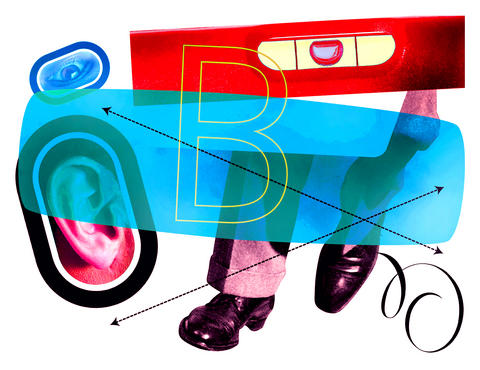
ILLUSTRATION: NY TIMES NEWS SERVICE
Vertigo, which can be caused by inner ear infections, low blood pressure, brain injuries, certain medications and some chronic diseases, is loss of balance in the extreme. Anyone who has experienced it - even if just from twirling in a circle - knows how disorienting and dangerous it can be. Really, without a sense of balance, just about everything else in life can become an insurmountable obstacle.
One normal consequence of aging is a steady decline in the three main sensory contributors to good balance - vision, proprioceptors on the bottoms of the feet that communicate position information to the brain and the tiny hairs in the semicircular canals of the inner ear that relay gravity and motion information to the brain. Add to that the loss of muscle strength and flexibility that typically accompany aging and you have a fall waiting to happen.
EXERCISING FOR EQUILIBRIUM
But while certain declines with age are unavoidable, physical therapists, physiatrists and fitness experts have repeatedly proved that much of the sense of balance can be preserved and even restored through exercises that require no special equipment or training. These exercises are as simple as standing on one foot while brushing your teeth or walking heel-to-toe with one foot directly in front of the other.
Marilyn Moffat and Carole Lewis, physical therapists, agree with McCredie that "balance is an area of physical fitness that is often overlooked," but they seek to correct that in their recent book Age-Defying Fitness. They define balance as "the ability of your body to maintain equilibrium when you stand, walk or perform any other daily activity" like putting on pants, walking on uneven ground or reaching for something on a shelf.
Moffat and Lewis suggest starting with a simple assessment of your current ability to maintain good balance. With a counter or sturdy furniture near enough to steady you if needed, perform this test:
1. Stand straight, wearing flat, closed shoes, with your arms folded across your chest. Raise one leg, bending the knee about 45 degrees, start a stopwatch and close your eyes.
2. Remain on one leg, stopping the watch immediately if you uncross your arms, tilt sideways more than 45 degrees, move the leg you are standing on or touch the raised leg to the floor.
3. Repeat this test with the other leg.
Now, compare your performance to the norms for various ages:
* 20 to 49 years old: 24 to 28 seconds.
* 50 to 59 years: 21 seconds.
* 60 to 69 years: 10 seconds.
* 70 to 79 years: 4 seconds.
* 80 and older: Most cannot do it at all.
If you are wise, whatever your age, you will want to strive for the norm of those younger than 50. To increase stability and strengthen the legs, stand with feet shoulder-width apart and arms straight out in front. Lift one foot behind, bending the knee at 45 degrees. Hold that position for five seconds or longer, if possible.
Repeat this exercise five times. Then switch legs. As you improve, try one-leg stands with your eyes closed.
You can also incorporate one-leg stands into daily routines - while on the telephone, for example, brushing your teeth, waiting in line or for a bus, or cooking and washing dishes.
EXERCISES TO BUILD A MOTOR SKILL
"Remember, balance is a motor skill," Moffat, professor of physical therapy at New York University, said in an interview. "To enhance it, you have to train your balance in the same way you would have to train your muscles for strength and your heart for aerobic capacity."
Moffat pointed out that balance is twofold: static while standing still and dynamic when moving, as in walking and climbing stairs. Two main routes improve balance - exercises that increase the strength of the ankle, knee and hip muscles and exercises that improve the function of the vestibular system.
Like one-leg stands, many can be done as part of a daily routine. Moffat recommends starting with strength exercises and, as you improve, adding vestibular training by doing some of them with closed eyes.
Sit-to-stand exercises once or twice a day increase ankle, leg and hip strength and help the body adjust to changes in position without becoming dizzy after being sedentary for a long time. Sit straight in a firm chair (do not lean against the back) with arms crossed. Stand up straight and sit down again as quickly as you can without using your arms. Repeat the exercise three times and build to 10 repetitions.
Heel-to-toe tandem walking is another anytime exercise, resembling plank walking popular with young children. It is best done on a firm, uncarpeted floor. With stomach muscles tight and chin tucked in, place one foot in front of the other such that the heel of the front foot nearly touches the toe of the back foot. Walk three or more meters and repeat the exercise once or twice a day.
Also try walking on your toes and then walking on your heels to strengthen your ankles.
Another helpful exercise is sidestepping. Facing a wall, step sideways with one leg (bring the other foot to it) 10 times in each direction. After mastering that, try a dance like maneuver that starts with sidestepping once to the right. Then cross the left leg behind, sidestep to the right again and cross the left leg in front. Repeat this 10 times. Then do it in the other direction.
In addition, the slow, continuous movements of tai chi, that popular Chinese exercise, have been shown in scientific studies to improve balance and reduce the risk of falls.

In late October of 1873 the government of Japan decided against sending a military expedition to Korea to force that nation to open trade relations. Across the government supporters of the expedition resigned immediately. The spectacle of revolt by disaffected samurai began to loom over Japanese politics. In January of 1874 disaffected samurai attacked a senior minister in Tokyo. A month later, a group of pro-Korea expedition and anti-foreign elements from Saga prefecture in Kyushu revolted, driven in part by high food prices stemming from poor harvests. Their leader, according to Edward Drea’s classic Japan’s Imperial Army, was a samurai

The following three paragraphs are just some of what the local Chinese-language press is reporting on breathlessly and following every twist and turn with the eagerness of a soap opera fan. For many English-language readers, it probably comes across as incomprehensibly opaque, so bear with me briefly dear reader: To the surprise of many, former pop singer and Democratic Progressive Party (DPP) ex-lawmaker Yu Tien (余天) of the Taiwan Normal Country Promotion Association (TNCPA) at the last minute dropped out of the running for committee chair of the DPP’s New Taipei City chapter, paving the way for DPP legislator Su

It’s hard to know where to begin with Mark Tovell’s Taiwan: Roads Above the Clouds. Having published a travelogue myself, as well as having contributed to several guidebooks, at first glance Tovell’s book appears to inhabit a middle ground — the kind of hard-to-sell nowheresville publishers detest. Leaf through the pages and you’ll find them suffuse with the purple prose best associated with travel literature: “When the sun is low on a warm, clear morning, and with the heat already rising, we stand at the riverside bike path leading south from Sanxia’s old cobble streets.” Hardly the stuff of your

Located down a sideroad in old Wanhua District (萬華區), Waley Art (水谷藝術) has an established reputation for curating some of the more provocative indie art exhibitions in Taipei. And this month is no exception. Beyond the innocuous facade of a shophouse, the full three stories of the gallery space (including the basement) have been taken over by photographs, installation videos and abstract images courtesy of two creatives who hail from the opposite ends of the earth, Taiwan’s Hsu Yi-ting (許懿婷) and Germany’s Benjamin Janzen. “In 2019, I had an art residency in Europe,” Hsu says. “I met Benjamin in the lobby


 RSS
RSS