


White as snow? That is exactly what it looks like. In fact, it looks more like snow than almost any other picture. Utagawa Hiroshige's view of Shisaku shows three rocky promontories stretching out into a dark blue sea, each turned a flawless white by the soft petals descending from above, a snowfall that appears both completely still and yet mysteriously quick as it spirals in its measured patterns.
This truth about snow — weightless stasis at a distance, flutter close up — is what Hiroshige gets down so beautifully with his array of white marks descending from a blue-black band of sky. And yet his print is a marvelous lie. For each of the snowflakes, from sea level all the way up to heaven, is exactly equal in size.
You wouldn't see them this way in reality; in fact, you couldn't see this scene at all unless you had clambered to a peak so high the seascape lay like a carpet below and you weren't worried about imminent twilight. So this view must surely be fantasy — except that it has its truths and its perfect topographical clarity. Could it be reality exaggerated and simplified (and flattened) all at once or is it so stylized as to be practically modern?

PHOTO: NY TIMES NEWS SERVICE
That is what Western artists loved about Hiroshige's prints when they first flowed through Europe after the end of Japan's self-imposed isolation in 1853. Tilted space, flat planes, proleptic editing, absent shadows: painters from Degas to Cezanne learnt from these innovations. Cezanne papered the walls of Giverny with Japanese prints; Van Gogh made effortful copies of Hiroshige.
Effortful because Hiroshige's compositions are so weird that if you tried to put them together like jigsaws, Van Gogh's preferred method, the pieces would scarcely seem to fit. Take Plum Estate, Kameido: the foreground is filled with a large, dark tree obscuring the tiny figures admiring cherry blossom in the distance; this tree's blossoms are, in turn, partly obscured by the title of the print. On the left, a big notice, of all things, juts in at such an odd angle its words aren't legible; experts surmise it's a warning against vandalism.
Hiroshige once famously blocked a foreground with a horse's backside and one senses a quirky wit at play in his art. His powerful series, Fifty-Three Stations of the Tokaido Highway, where Mount Fuji rises above the travelers like a think bubble: Fuji on the mind, proceeds like a road movie in freeze frame. The characters get closer and closer to the landmark, true subject of the series, and then abruptly pass it by.

PHOTO: NY TIMES NEWS SERVICE
But this selection of prints from the British Museum's superb collection, by artist Julian Opie, shows another side of Hiroshige from the popular street scenes or noodle bowls or visions of Fuji. By concentrating on the late works — all vertical, right against landscape convention — it makes you consider him with new eyes.
For Hiroshige's Famous Views, as they're known, could be famous for sheer spectacle alone: breathtaking gorges, miniature people attempting bridges above ravines of icy water, night skies blossoming with fireworks. They take you deep into Japan, from the bay in Toyama spanned by a hundred linked boats, a mariner stepping gingerly between them, to the Paired-Sword rocks of Satsuma rising like jagged blades out of waves drawn like tiny Fujis, upon which sightseers sway in perilous boats.
But it is another kind of sighting, beyond armchair travel, that seems to be at the heart of late Hiroshige. There is that wonderful Japanese tradition of ritualized viewing — one of his prints shows a “moon viewing point” — but Hiroshige takes the little dramas of twilight or geese against a winter sun further into the realms of depiction.
Some of his prints are exceptionally inventive when it comes to describing the way we see the world, near and far. Yachts on a wide sea are shown as tiny, white rectangles, entirely outlined in black except for the lower edge, implying the dissolution of objects immersed in water. The tide as it froths up the beach is just a band of white edged with tiny black hyphens like hemstitch, somehow suggesting motion as well as definition.
And the same marks turned vertical, like exclamation marks, describe rice plants in water, each paddy field reflecting the moon, over and again, in its surface. And then the lines elongate into needle-sharp striations running almost the length of the scene; not quite the action of a downpour, with its million of separate drops, but very much how it looks and feels.
Haze and haar, snowfall and mist: Hiroshige's weather lies on and in the scene like some strange, non-naturalistic lighting effect. An artist for all seasons, his works are almost superfluously dated by the lunar month, since one can generally go by the details — spring blossom, harvest moons — but the atmospherics are much more intangible. One sees that a salt beach gets some of its crystal whiteness from a tincture of the sea's blue, but not how its waterlogged softness is implied. And moonlight, casting eerily pale shadows, pervades the scene less like light than ether.
Hiroshige used the bokashi technique — wiping ink from the block before printing — like nobody else, getting radiant cross-fading effects of sea into sky, dark into dawn, air into moisture; you can see how much Whistler's Nocturnes borrow from him. And yet, as Opie says, he also takes your eye through a landscape, up hill and down dale and across gorges, with the hyper-precision of a computer-game landscape. It is a strange combination, but then it is always hard to catch Hiroshige's character as an artist. Less sublime than Hokusai, less sensual than Utamaro and determinedly demotic at one stage (the government fixed his prices low so more people could buy them), he does seem to pass into a new and more radical purity in later life.
The foreground vanishes to free the immensity of distance. People grow smaller, skies higher until they meet the dark imperium of outer space. By the time you get to the final Snow, Moon and Flowers series, humanity has vanished and nature takes over. Snow rises to the sky, whirlpools are drawn like flowers and one feels imagination has taken over and the prints aspire to the concision of haiku. Wave-blossoms as snow to water and blooming out of season: it could have been written for Hiroshige's whirlpools.

In late October of 1873 the government of Japan decided against sending a military expedition to Korea to force that nation to open trade relations. Across the government supporters of the expedition resigned immediately. The spectacle of revolt by disaffected samurai began to loom over Japanese politics. In January of 1874 disaffected samurai attacked a senior minister in Tokyo. A month later, a group of pro-Korea expedition and anti-foreign elements from Saga prefecture in Kyushu revolted, driven in part by high food prices stemming from poor harvests. Their leader, according to Edward Drea’s classic Japan’s Imperial Army, was a samurai

The following three paragraphs are just some of what the local Chinese-language press is reporting on breathlessly and following every twist and turn with the eagerness of a soap opera fan. For many English-language readers, it probably comes across as incomprehensibly opaque, so bear with me briefly dear reader: To the surprise of many, former pop singer and Democratic Progressive Party (DPP) ex-lawmaker Yu Tien (余天) of the Taiwan Normal Country Promotion Association (TNCPA) at the last minute dropped out of the running for committee chair of the DPP’s New Taipei City chapter, paving the way for DPP legislator Su
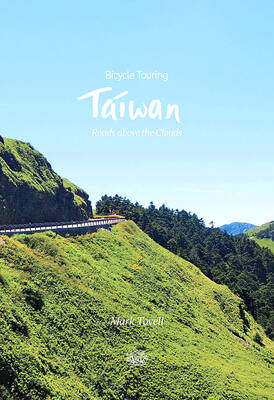
It’s hard to know where to begin with Mark Tovell’s Taiwan: Roads Above the Clouds. Having published a travelogue myself, as well as having contributed to several guidebooks, at first glance Tovell’s book appears to inhabit a middle ground — the kind of hard-to-sell nowheresville publishers detest. Leaf through the pages and you’ll find them suffuse with the purple prose best associated with travel literature: “When the sun is low on a warm, clear morning, and with the heat already rising, we stand at the riverside bike path leading south from Sanxia’s old cobble streets.” Hardly the stuff of your

Located down a sideroad in old Wanhua District (萬華區), Waley Art (水谷藝術) has an established reputation for curating some of the more provocative indie art exhibitions in Taipei. And this month is no exception. Beyond the innocuous facade of a shophouse, the full three stories of the gallery space (including the basement) have been taken over by photographs, installation videos and abstract images courtesy of two creatives who hail from the opposite ends of the earth, Taiwan’s Hsu Yi-ting (許懿婷) and Germany’s Benjamin Janzen. “In 2019, I had an art residency in Europe,” Hsu says. “I met Benjamin in the lobby


 RSS
RSS