


I meet Lee in the ballroom of an old Venetian hotel. In late afternoon, the room is dark and shadowy. It makes a suitable backdrop for a discussion of a film as ambiguous and unsettling as Lust, Caution (色,戒). The director is unapologetic about his film.
"The pacing relates to the information that is given," he says. "We Chinese need to go back to the world we used to live in.
"It's a lot of fun for the Chinese to watch the first half, to remind us of our innocence and how things used to be. Then comes the real deal. But for non-Chinese, you don't get that benefit. I am sure the Chinese viewer will have a blast, but when the Western viewer reads subtitles, it is very frustrating. You have that feeling: what the hell is going on. But I had to make the movie right for myself and for the Chinese audience."
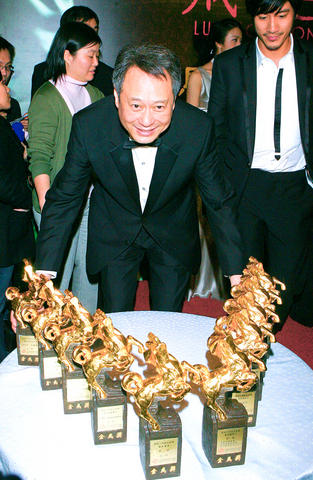
PHOTO: TAIPEI TIMES
A complex espionage thriller set in Shanghai and Hong Kong during the late 1930s and early 1940s, Lust, Caution is not a crowd-pleaser in the vein of Lee's Crouching Tiger, Hidden Dragon (臥虎藏龍). Instead of gravity-defying martial artistry, it consists mainly of characters talking. When there is violence - for example, when the students try to assassinate a man named Yee, played by Tony Leung Chiu-wei (梁朝偉), who has a Rasputin-like aversion to dying - it is realistic and dismaying. When they plunge a knife in the man's stomach, it bounces out.
And, like the violence, the sex is dealt with equally frankly. "They [historians] tell you about the glorious war, the fight. They don't tell you that it is very hard to kill someone. They tell you that the women spies seduced the men and killed them. They don't tell you about the sex." Lee laughs wearily as he explains his attempts in the film to look behind the official stories about the Japanese occupation of Shanghai.
Just as he did in Brokeback Mountain (when adapting Annie Proulx's story for the screen), Lee has taken a short piece of fiction and has fleshed it out, giving it an epic quality. Lust, Caution is based on a 28-page story by Eileen Chang (張愛玲). "She writes about women's sexuality and feeling for love during the most macho war we have had. It is like - how dare she!" Lee says. "It is very gutsy work. That triggers me to investigate my own upbringing and patriotism."
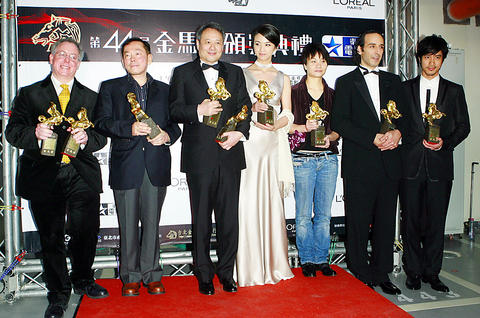
PHOTO: PAN SHAO-TANG,TAIPEI TIMES
It quickly becomes apparent, for Lee himself, how personal and even autobiographical Lust, Caution is. For example, Yee's very specific gait is based on that of Lee's father. The director admits to a close identification with the spy played by Tang Wei (湯唯), too. "When we were doing the movie, I used to joke that I carry the head and purity of the idealistic student, the heart of Wang Jia-zhi (王佳芝) and the balls of Mr Yee," Lee says.
He then adds that Leung has projected aspects of Lee's own character into Yee. A curious remark, certainly, given that Yee isn't a remotely sympathetic character. He is a quisling, collaborating with the Japanese and overseeing the torture and killing of Chinese rebels. Then again, it is Yee's personal and sexual life that intrigues him. "I desire it but I cannot do it. I make it into a movie. He projects a lot of that part of myself. It is a romance I never really experienced that I was longing for. It is almost like a dream."
Like the students, whose high-minded ideals are shaken when they get their hands dirty with plotting and assassination, Lee acknowledges that he has been "shocked by reality, naive in some ways, not really knowing what to do in an adult world, like a big kid."
As for Wang, played by Wei, he identifies with her because: "it seems that only by pretending, by getting far away from reality, she can reach her true self ... to touch the real you that you try to cover up."
"For this project, I had to strip down and get to the heart of the darkness in some way," he says. His instinct, he says, as he filmed Leung and Wei making love was to look the other way. "I don't make pornography, so when you get down to that, it is very painful to shoot. You fight with your moral sense. You are deeply confused. It is embarrassing to coach the actors through it - to verbalize and to give indications. You are revealing your secrets when you are shooting like that." The sex scenes were shot on a closed set with only four people present - the couple, the director and the cinematographer.
Lee defends the sex scenes as being utterly integral to the film. Yes, it is inevitable that the scandal surrounding these scenes will dominate discussion of the movie. "That bothers me. It gives me sleepless nights."
At a press conference earlier in the day, he had fielded the sex questions patiently enough. Did they really do it? To Lee, that isn't the right question. What is important is that the audience has to believe in the scenes. Look at the eyes, not the bodies.
In the end, though, Lee's real preoccupation isn't the sex. Nor is it the politics. Nor is it the chance to bring back to life an era in Chinese history that is in danger of being forgotten. Like Brokeback Mountain, it is an emotionally charged story of a forbidden love. Lust, Caution may begin as an espionage thriller in which the politics and social history are foregrounded. By the final reel, though, it has turned into a full-blown weepie. At its core, this is a film about romantic obsession - "doomed, impossible romantic love."
The middle-aged director, who is happily married, grounded and emotionally stable, just can't help but be drawn to tales of amour fou.
"After Brokeback and this one, I do believe deeply inside that I am a romantic," Lee admits. "I was never romantic in real life. That is why I have to make movies about it."
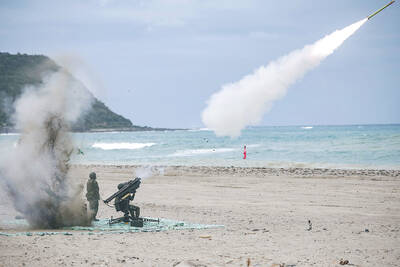
In late October of 1873 the government of Japan decided against sending a military expedition to Korea to force that nation to open trade relations. Across the government supporters of the expedition resigned immediately. The spectacle of revolt by disaffected samurai began to loom over Japanese politics. In January of 1874 disaffected samurai attacked a senior minister in Tokyo. A month later, a group of pro-Korea expedition and anti-foreign elements from Saga prefecture in Kyushu revolted, driven in part by high food prices stemming from poor harvests. Their leader, according to Edward Drea’s classic Japan’s Imperial Army, was a samurai

The following three paragraphs are just some of what the local Chinese-language press is reporting on breathlessly and following every twist and turn with the eagerness of a soap opera fan. For many English-language readers, it probably comes across as incomprehensibly opaque, so bear with me briefly dear reader: To the surprise of many, former pop singer and Democratic Progressive Party (DPP) ex-lawmaker Yu Tien (余天) of the Taiwan Normal Country Promotion Association (TNCPA) at the last minute dropped out of the running for committee chair of the DPP’s New Taipei City chapter, paving the way for DPP legislator Su

It’s hard to know where to begin with Mark Tovell’s Taiwan: Roads Above the Clouds. Having published a travelogue myself, as well as having contributed to several guidebooks, at first glance Tovell’s book appears to inhabit a middle ground — the kind of hard-to-sell nowheresville publishers detest. Leaf through the pages and you’ll find them suffuse with the purple prose best associated with travel literature: “When the sun is low on a warm, clear morning, and with the heat already rising, we stand at the riverside bike path leading south from Sanxia’s old cobble streets.” Hardly the stuff of your
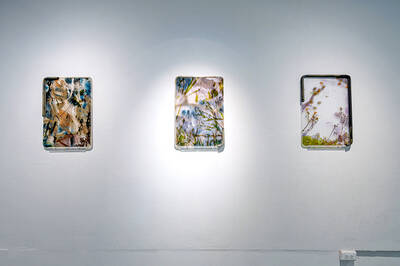
Located down a sideroad in old Wanhua District (萬華區), Waley Art (水谷藝術) has an established reputation for curating some of the more provocative indie art exhibitions in Taipei. And this month is no exception. Beyond the innocuous facade of a shophouse, the full three stories of the gallery space (including the basement) have been taken over by photographs, installation videos and abstract images courtesy of two creatives who hail from the opposite ends of the earth, Taiwan’s Hsu Yi-ting (許懿婷) and Germany’s Benjamin Janzen. “In 2019, I had an art residency in Europe,” Hsu says. “I met Benjamin in the lobby


 RSS
RSS