


Low waist, high slits, pure silk, wide belts: chic lingerie has never been so sexy. For men, that is.
Leano Lien (連宗旺) opened the boutique underwear chain Body Formula four years ago. His first shop was in Taipei's young, hip Ximending District (西門町), and has since expanded into the more mainstream East District (東區).
The simplest designs, starting at NT$700, provide a tailored cut that gives lift to the buttocks and definition in front. More creative options are as sheer as anything in the women's department and are accessorized with pendant medals and leather pouches. At the most basic level, the form-flattering skivvies are meant to be comfortable and hygienic. They're also meant to be seen.
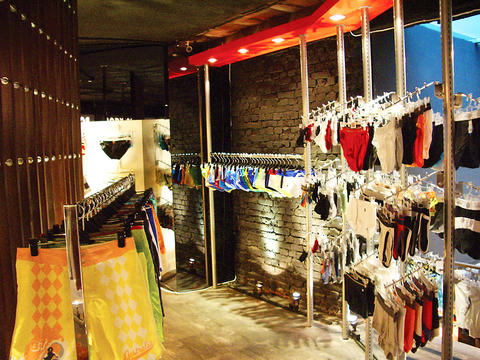
PHOTO: COURTESY OF BODY FORMULA
And while Body Formula's underwear is intended to be sexy, Lien was eager to specify sexy-classy, not sexy-porn. Body Formula takes care to distinguish itself from sex stores.
"Many of our Japanese suppliers are meticulous in ensuring that their products are not degraded by being sold in sex shops," Lien said. With prices going up well into the thousands, these are clothing items aimed at giving pleasure to the wearer, and are anything but a party gimmick.
"The emphasis is very much on good cut and high quality materials," Lien said. "It overturns the conventional idea that underpants are not intended to be seen. Now they are as much a fashion statement as any other item of our clothing. They are an item of clothing that we must change regularly, so there is no reason why they shouldn't also be interesting from a fashion perspective."
Lien primarily imports Japanese labels such as Dugas, pointing out that these are more suitable for an Asian figure. "Asians can't always fill out the fuller cut in the buttocks of some of the US labels," Lien said, "and if they're baggy and ill-fitting, they really don't look good."
Lien started his business after returning from studying in Japan. "My friends would often ask me to bring back pants from Japan because they were not available in Taiwan." Now, such fashionable underwear has already made it into some of the hipper local department stores, and Lien is looking for new labels to add to his already wide section.
Recently the Chinese Nationalist Party (KMT) and its Mini-Me partner in the legislature, the Taiwan People’s Party (TPP), have been arguing that construction of chip fabs in the US by Taiwan Semiconductor Manufacturing Co (TSMC, 台積電) is little more than stripping Taiwan of its assets. For example, KMT Legislative Caucus First Deputy Secretary-General Lin Pei-hsiang (林沛祥) in January said that “This is not ‘reciprocal cooperation’ ... but a substantial hollowing out of our country.” Similarly, former TPP Chair Ko Wen-je (柯文哲) contended it constitutes “selling Taiwan out to the United States.” The two pro-China parties are proposing a bill that
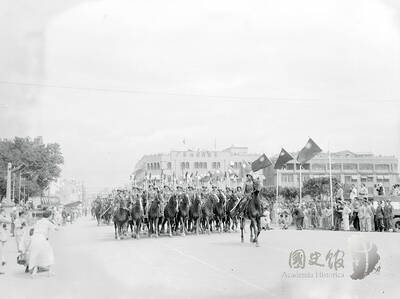
March 9 to March 15 “This land produced no horses,” Qing Dynasty envoy Yu Yung-ho (郁永河) observed when he visited Taiwan in 1697. He didn’t mean that there were no horses at all; it was just difficult to transport them across the sea and raise them in the hot and humid climate. “Although 10,000 soldiers were stationed here, the camps had fewer than 1,000 horses,” Yu added. Starting from the Dutch in the 1600s, each foreign regime brought horses to Taiwan. But they remained rare animals, typically only owned by the government or

Institutions signalling a fresh beginning and new spirit often adopt new slogans, symbols and marketing materials, and the Chinese Nationalist Party (KMT) is no exception. Cheng Li-wun (鄭麗文), soon after taking office as KMT chair, released a new slogan that plays on the party’s acronym: “Kind Mindfulness Team.” The party recently released a graphic prominently featuring the red, white and blue of the flag with a Chinese slogan “establishing peace, blessings and fortune marching forth” (締造和平,幸福前行). One part of the graphic also features two hands in blue and white grasping olive branches in a stylized shape of Taiwan. Bonus points for
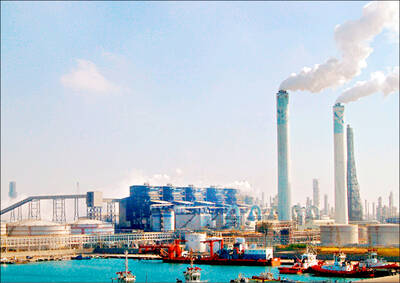
Last month, media outlets including the BBC World Service and Bloomberg reported that China’s greenhouse gas emissions are currently flat or falling, and that the economic giant appears to be on course to comfortably meet Beijing’s stated goal that total emissions will peak no later than 2030. China is by far and away the world’s biggest emitter of greenhouse gases, generating more carbon dioxide than the US and the EU combined. As the BBC pointed out in their Feb. 12 report, “what happens in China literally could change the world’s weather.” Any drop in total emissions is good news, of course. By


 RSS
RSS