


Toward the end of My Colombian War Silvana Paternostro hits on the perfect Spanish word to express her sense of dislocation. She is desubicada, which she translates as "difficult and kind of ridiculous, and always out of place." It shows, even to her family. "The stork dropped her in the wrong country," her father says.
For a journalist it sometimes helps to be a little ridiculous and out of place. Alienation imparts a sense of urgency to Paternostro's intimate, emotion-saturated portrait of the homeland with which she cannot come to terms, a sentimental journey undertaken after decades living in the US and working as a journalist in New York. Her confusion, and her often astounding ignorance of her own country, ends up being an asset, as she reconnects with her family and tries to sort out how Colombia developed into an international Wal-Mart for cocaine and marijuana, and a world leader in several major crime categories, including murder and kidnapping.
The story, for her, is personal. In a country riven by a decades-long struggle between conservative landowners and leftist guerrillas, her family counts as one of the more prominent kidnapping targets. The maternal surname Montblanc on her Colombian identity card immediately links her with El Carmen, a vast agricultural estate created by her grandfather in the mountains near her hometown, Barranquilla, a port on the Caribbean coast. Nearly 40 Montblancs have been abducted and held for ransom.
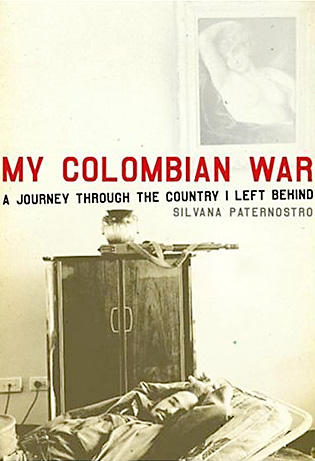
Paternostro, who left Colombia as a teenager to attend school in the US, tuned out Colombia for most of her adult life. She wrote about Nicaragua and Cuba, or about Latin American sexual politics in her book In the Land of God and Man. A map of Colombia she sees at a press briefing in the late 1990s catches her by surprise. "I had no idea half of it was jungle," she writes. The rising tide of violence in her homeland, and her own conflicted sense of identity, draws her back. "I wanted to feel what it was like to be Colombian," she writes.
Those feelings turn out to be complicated. Staying with her grandmother in Barranquilla, Paternostro rediscovers her childhood, an enchanted time when she had her own servant-playmate, drivers at her beck and call, and a legion of relatives who protected and cosseted her. The flavors and the colors are vivid, like the block of candied grapefruit that her deeply religious grandmother keeps hidden in a closet. It's easy to see why a high-spirited, ambitious girl might want to escape from an environment as sticky and cloying as the hidden grapefruit.
Through her grandparents and assorted relatives still living in Barranquilla, Paternostro feels her way through Colombian politics, which can seem like a domestic drama. The same quarrels, repeated over and over, drive her to distraction. The Colombian mind-set infuriates her.
"Colombians don't vote for human beings, they vote for saviors," she writes in disgust after her countrymen abandon the once-popular President Andres Pastrana, who tried to woo the rebels with gentle diplomacy, and stampede to the hard-line Alvaro Uribe.
In a narrow journalistic sense, Paternostro fumbles her mission. She leaves for Colombia intent on making contact with guerrillas, on seeing close-up the unending war among the Marxists, the army and the private paramilitary forces subsidized by the landowners. Mostly, though, she just hangs around and waits for things to happen. A visit to El Carmen turns out to be so fraught with peril, because of rebel roadblocks, that it takes months to arrange and then can be made only by private airplane. She stays for four hours.
When a cease-fire breaks down, Paternostro balks at traveling to the demilitarized zone where rebel leaders and government representatives will hold a fateful summit conference. Instead she covers the story by watching television.
The down time and the thwarted opportunities force Paternostro to build her story from the inside out, but by chatting with relatives, seeking out old servants and looking up childhood friends she delivers a much more compelling picture of contemporary Colombia and the roots of its problems than she otherwise might have. The feudal power structure in her own home speaks volumes about the country's endemic social conflicts. "My grandparents are coming alive," she reflects at one point, "and so is Colombia."
Paternostro, in probing her dual identity, stews a little too long on occasion. A streak of narcissism runs through the book, starting with the title. Colombia's violence and fractured politics sometimes seem important chiefly because they provide a compelling backdrop for the author's emotional states, analyzed in every shade.
The obsessive eye that turns inward also turns outward, however. It sees acutely the proud, isolated bewilderment of conservative families like her own, the hopeless misery in a country where 97 percent of the arable land is owned by 3 percent of the population, the sheer pointlessness of an insurgency led by guerrillas who are "perhaps the least-liked revolutionaries in history."
Paternostro returns to New York. "I am not sure why - it seems like one never is - but it did not work out between us," she writes. Too bad for her. A gift for the rest of us.

In late October of 1873 the government of Japan decided against sending a military expedition to Korea to force that nation to open trade relations. Across the government supporters of the expedition resigned immediately. The spectacle of revolt by disaffected samurai began to loom over Japanese politics. In January of 1874 disaffected samurai attacked a senior minister in Tokyo. A month later, a group of pro-Korea expedition and anti-foreign elements from Saga prefecture in Kyushu revolted, driven in part by high food prices stemming from poor harvests. Their leader, according to Edward Drea’s classic Japan’s Imperial Army, was a samurai

The following three paragraphs are just some of what the local Chinese-language press is reporting on breathlessly and following every twist and turn with the eagerness of a soap opera fan. For many English-language readers, it probably comes across as incomprehensibly opaque, so bear with me briefly dear reader: To the surprise of many, former pop singer and Democratic Progressive Party (DPP) ex-lawmaker Yu Tien (余天) of the Taiwan Normal Country Promotion Association (TNCPA) at the last minute dropped out of the running for committee chair of the DPP’s New Taipei City chapter, paving the way for DPP legislator Su
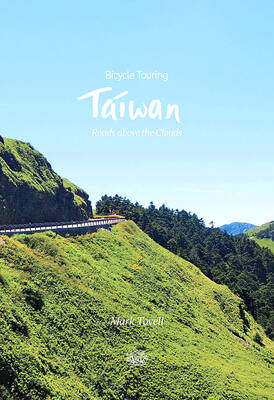
It’s hard to know where to begin with Mark Tovell’s Taiwan: Roads Above the Clouds. Having published a travelogue myself, as well as having contributed to several guidebooks, at first glance Tovell’s book appears to inhabit a middle ground — the kind of hard-to-sell nowheresville publishers detest. Leaf through the pages and you’ll find them suffuse with the purple prose best associated with travel literature: “When the sun is low on a warm, clear morning, and with the heat already rising, we stand at the riverside bike path leading south from Sanxia’s old cobble streets.” Hardly the stuff of your
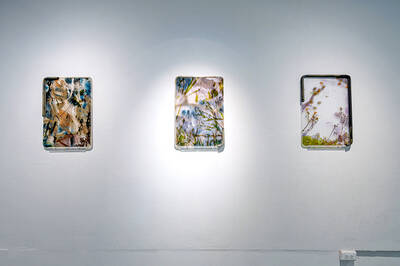
Located down a sideroad in old Wanhua District (萬華區), Waley Art (水谷藝術) has an established reputation for curating some of the more provocative indie art exhibitions in Taipei. And this month is no exception. Beyond the innocuous facade of a shophouse, the full three stories of the gallery space (including the basement) have been taken over by photographs, installation videos and abstract images courtesy of two creatives who hail from the opposite ends of the earth, Taiwan’s Hsu Yi-ting (許懿婷) and Germany’s Benjamin Janzen. “In 2019, I had an art residency in Europe,” Hsu says. “I met Benjamin in the lobby


 RSS
RSS