


It's been 39 years since Jane Birkin fell in love with Serge Gainsbourg, 27 years since they split up and 16 years since Gainsbourg died, but you'd never guess. Paris has never let its most iconic couple separate - you can, Birkin says, still not get through a day in this city without hearing the immortal intimacies of Je t'Aime... Moi Non Plus from somewhere - and anyway Birkin herself, at 60, has chosen to be living proof that love can survive divorce and death. She still spends most nights with Gainsbourg, singing his songs on an endless cabaret tour, breathing life into words he wrote with her, his muse, in mind. Birkin's apartment, just off the Boulevard St Germain, decked in crimson silk, cast in permanent twilight, crammed with old photographs and a collection of stuffed animals, is made for this perpetual seance. She shares it with a corpulent bulldog, Dora, who lounges on a chaise.
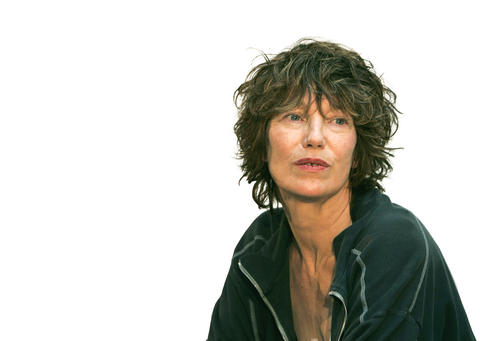
The original ingenue, Birkin has never given up her wide eyes, though now they peer out from behind glasses. She talks in an unstoppable girlish rush, with a forced lightness, as if she fears, if she stops speaking, that everything will be revealed as messier and darker than she will allow. Things are routinely "jolly" and "fun." Her mother used to tell her to stop saying "you" and "one" when she meant "I," but it's a habit she can't break; she comes across, partly as a result, as both likeably self-effacing and self-obsessed.
Having been world famous as a lover - Je t'Aime was outlawed by the BBC and the Pope - Birkin has lived alone for 15 years, since she split up with her third husband, the film director, Jacques Doillon, who could not compete with her grief for Gainsbourg. She has arranged much of her current life, she suggests, as a strategy against being by herself. Her personal organizer is the size of a phone book. When we meet she's just back from Luxembourg where she was launching her autobiographical film, Boxes, and taking the opportunity to talk about Myanmar and her friend Aung San Suu Kyi.
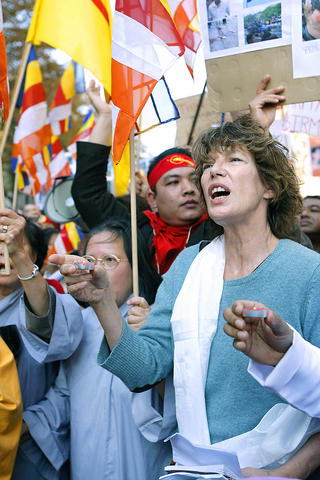
Before Luxembourg, Birkin had been in Rio de Janeiro at a film festival where she had found some Buddhist monks to share her platform. And prior to that she met French President Sarkozy to persuade him, with partial success, to impose sanctions on the Burmese junta. For the first half hour of our interview, as she explains all this without pause, I'm wondering if we are going to get beyond the hypocrisy of Total Oil, and the merits of energy sanctions in Chad before she has to dash off to an appointment with Hermes, to talk about Birkin handbags.
One of the reasons that Parisians have loved Birkin is her passion for causes - she has always been a marcher. She arrived in Paris just after the Evenements of May 1968, but she has made sure she has hardly missed a protest since: anti-capital punishment ("we were pelted with vegetables on la Republique"), pro-abortion ("Serge was not convinced, though I knew of at least two girls he had made get rid of pregnancies"), anti-Le Pen, Vietnam, Nicaragua, Bosnia, Chechnya and Iraq. The Myanmar march she helped to organize was a disappointment. "There were only a hundred of us," she says, wounded by the thought.
Birkin, the daughter of a war hero, has always had a mortal fear of not doing enough. "I try not to lie awake with that awful thought, 'I could have helped,'" she says. "For me, the worst words in the world are, 'Fuck, I could have been there.'" Her father David, a naval commander in special operations, won the Legion d'Honneur for his role in saving British airmen from the Normandy coast on Christmas Day 1943; on his return from war he became an artist and married Noel Coward's leading lady, Judy Campbell. Jane was the middle of three children, in thrall of her elder brother Andrew, who became a film director and part-time Peter Pan obsessive. When I ask her what she thinks of as home, she says that home is her childhood, "a land that I can never verify," though she has, in some respects, apparently never left it.
Her parents gave her that aristocratic English fear of convention: she was, at all costs, to lead a charmed life, and she took them at their word. At 17 she married John "James Bond theme" Barry and had her first daughter, Kate, with him. A year later she appeared in Antonioni's seminal 1960s film Blow-Up, where she gained a certain notoriety as the first actress to show pubic hair in mainstream cinema. By the time she met Gainsbourg, on the set of the film Slogan in Paris, she was divorced, a refugee from London's King's Road.
To Parisians, Gainsbourg was a kind of native hybrid of Woody Allen and Bob Dylan; when he died, Paris came to a halt. Former French president Mitterand called him "our Baudelaire." Like many homegrown French cultural heroes, however, Gainsbourg never really made it as an export. Another reason the French loved Birkin was, you suspect, that she was the first foreigner not only to get the point of Gainsbourg, but to fall in love with him. In 1968, when she was 21 and Gainsbourg 40, she had the nerve to take Brigitte Bardot's place in his life and his bed. (Gainsbourg explained to her that he was afraid of Bardot's breasts.)
Nothing in Birkin's life has matched their courtship. She shows me the leather-bound book of his songs that he gave her, inscribed in red ink: "To Jane, A few Chansons Cruelle, Je t'Aime moi non plus, Serge'. She talks about their first night out together as if she has just returned home from it: "Serge sweetly doesn't know how to dance but we go to Regine's, then to a Russian club, and Serge pushes 100 Franc notes into the musicians' violins so they will play the Valse Triste of Sibelius as we get into a taxi; after that we went to an amazing place where Mexican singers Serge knew were playing with Joe Turner, the great jazz man; from there to Madame Arthur, a transvestite club, where Serge's father played the piano before the war. These gentlemen dressed up as ladies, who I had never seen the like of, come and sit on Serge's knee; after that, at dawn, we went to have a croissant on the Pigalle and all the prostitutes said hello to Serge. I just thought, 'Wow.' He had the keys to the city, or to all of the cities of Paris.'"
That all-night party lasted throughout the 1970s; Paris was the film set for Birkin and Gainsbourg's hopelessly turbulent marriage. She was in love with the doomed romance that her ageing alcoholic husband represented. "If I was bought flowers I used to let them die in the wrapping because I thought it looked romantic," she recalls. "Now I cut the stalks and put them in a vase. I want things to live now; I didn't always."
I wonder if it's possible for her to separate her idea of Serge from her idea of Paris?
"Not at all," she says. "Like Paris, sometimes Serge had the virtue of political incorrectness, or at least he never stood where you thought he would. For example, for all his provocation, he had a love of the police; he gave a great deal of money to the police widows' fund. At four in the morning no one else would be awake, so he went down to the police station at the bottom of the road with bottles of Krug champagne and sat up drinking with the night officers, telling Belgian jokes. He would come back with the gendarmes at incredible hours of the night, because he thought they should taste my Lancashire hotpot."
Family life must have been quite challenging?
"What we didn't realize was that it might be difficult for the children to be at school with their parents being on the radio like that, with Je t'Aime, and so on," she says brightly. "Serge did have a habit of chaining me up to radiators for photos, so that might have been quite hard for them, too. For us, though, it was very jolly."
By the time he died, Gainsbourg had had two heart attacks and had lost a portion of his liver, though he continued to drink and chain-smoke Gauloises as before. Does she believe she could have saved him from himself?
"I don't think I could," she says. "Everywhere he went in Paris people said, 'Hey Serge, this round is on me.' And he could not refuse. Someone called him a suicidaire optimiste, and that is very accurate. I don't think he thought he would die at 63, though. He thought he would have two or three chances at redemption first."
The great dislocation in Birkin's life occurred that week in 1991. When she was on her way to Gainsbourg's funeral, she heard that her father had died in England. She could not imagine a shock of pain like it. Sometimes, these days, she thinks of them together, the two men she wanted most to please. "They used to take their Mandrax together like two old owls," she recalls. "I'd say, 'Have you taken your sleeping drug?' and they would answer, 'No, non, non,' nodding off."
Her pain allows Birkin to forgive Gainsbourg anything, in retrospect. She left him after 12 years, pregnant with Jacques Doillon's child, and there is something unsettling about her subservience to his memory. "He was a permanent adolescent," she says at one point, as if this were the mark of his genius. Wasn't that hard to bear? "It was impertinent of me to try to change him," she suggests.
This meekness extends to the troubling films Gainsbourg made with their daughter, the actress Charlotte. Charlotte Forever, a home movie of sorts, and Lemon Incest, a record and video, applied some of the atmosphere of Je t'Aime to father and daughter. Gainsbourg's fans saw these films as further evidence of his taboo-breaking provocation, though it is hard to watch them now - Gainsbourg and his 12-year-old daughter dancing half undressed, he clutching her chin with a leather gloved hand, or entwined in a bed with silk sheets - without considerable unease. Was Birkin disturbed by them?
"No, I was the one who persuaded her to do it, you see," she says, with her spry innocence. "Therefore I felt responsible for the pain she felt in doing it."
But why did she want to put her daughter through that pain?
"I thought she should do it for her father. He loved her so much but the only way he could express it was by record and film. I thought she would regret it if she didn't and I knew he would be mortified if she refused him."
Wasn't it a strange way of showing fatherly affection?
"Lemon Incest was divine, I thought. There was never anyone as shy as Serge, he was tormented by his shyness. None of the children ever saw him with his clothes off, or in the bath. He would not have known how to embrace his children, hold them tight unless there was a camera. He wouldn't have wanted to embarrass Charlotte, his only way of saying he loved her was on record."
Birkin has lately had a go at telling her side of the story on film in Boxes, which she has written and directed based on her own compartmentalized lives: three husbands and three daughters. The girls were involved with the film, and she gave them final approval. Charlotte cried all through it, but then wrote a note saying "Don't change a word." With Kate [her daughter with Barry] she talked about childhood into the night, and Louie [her daughter with Doillon] had grown up with most of it anyway. Birkin clearly gives her daughters the kind of intense support you imagine she was given herself, and also the same pressure: to be something extraordinary. She will only countenance their genius. "There's a huge melancholy in Kate, she is a great artist, a photographer; no doubt she will make wonderful films," she says. "Charlotte should be Katharine Hepburn, she has that elegance and funniness and a tragedy when her face is inert. She can make you cry without moving a muscle. Lou will go on the road and sing her songs in a caravan with a guitar. She should have at least four children, and save her husband from the guillotine and get back to England and shake up her relations like Madame de la Tour du Pin [diarist of the Revolution]."
It's touching this, but also a little unnerving, born of the prime force in Birkin's life, which she continues to live in fear of. "Next week I am doing the montage of a documentary I made three weeks ago about a puppeteer in Palestine," she says, "and in the afternoon I am rehearsing for the new show that will be on the road in Europe. Why do I do this? I don't want to be a bore."
Having lived such a vivid early life, Birkin says she has no fear of mortality, welcomes it, as long as she can go before her children. In the meantime she has a desperation to avoid settling into old age. "I sometimes fear I am like that other undersea creature who spends its whole life searching for the perfect rock and when it finds it, it eats the one thing it does not need any more, its brain. The motto is: never find your rock."
She moved into this apartment seven years ago, and she is in a moving mood again, she suggests. "I think it would be nice to have a garden to draw in like Serge and I had, or an attic where you can have coffee on the roof." Packing would be an issue. Before she rushes out she talks me through some of the objects that fill every inch of surface and wall: her father's pipe, a naked woman in a shell her younger sister made ("I should just like to touch her all the time"), all the children's old birthday cards, Charlotte's tooth box for the tooth fairies.
She pauses over more photographs of Serge, and traces her hand on the framed manuscript of some of his lyrics, wine-stained and ash-burned.
Does she miss the fights as well, I wonder?
"Oh," she says, "I miss them most of all."
What was her favorite?
She thinks for a moment. "One time we were in a bar and Serge had turned my basket, my famous basket, upside down and gone through the contents to the amusement of everybody because there were some very sordid things in the bottom. I was vowing vengeance and there was a custard pie on the table and before I could think twice my fingers were under the pie and the pie had been launched at Serge." She laughs. "He walked out, and with pieces of pie falling off him he walked down Boulevard St Germain. At this point I thought desperate measures were needed, so I dashed in front of him, ran down some steps to the Seine, and I threw myself into the river. There was a kind of whirlpool, which made it tricky."
What happened next?
"Well for one thing my top, which was St Laurent, hand-made, shrunk to nothing and Serge of course was absolutely delighted. Anyhow, I clambered out and we gaily walked home arm in arm." She pauses, thinks of strolling down the riverbank, soaking wet. "Serge was, you might say, a fan of the grand gesture.

In late October of 1873 the government of Japan decided against sending a military expedition to Korea to force that nation to open trade relations. Across the government supporters of the expedition resigned immediately. The spectacle of revolt by disaffected samurai began to loom over Japanese politics. In January of 1874 disaffected samurai attacked a senior minister in Tokyo. A month later, a group of pro-Korea expedition and anti-foreign elements from Saga prefecture in Kyushu revolted, driven in part by high food prices stemming from poor harvests. Their leader, according to Edward Drea’s classic Japan’s Imperial Army, was a samurai

The following three paragraphs are just some of what the local Chinese-language press is reporting on breathlessly and following every twist and turn with the eagerness of a soap opera fan. For many English-language readers, it probably comes across as incomprehensibly opaque, so bear with me briefly dear reader: To the surprise of many, former pop singer and Democratic Progressive Party (DPP) ex-lawmaker Yu Tien (余天) of the Taiwan Normal Country Promotion Association (TNCPA) at the last minute dropped out of the running for committee chair of the DPP’s New Taipei City chapter, paving the way for DPP legislator Su

It’s hard to know where to begin with Mark Tovell’s Taiwan: Roads Above the Clouds. Having published a travelogue myself, as well as having contributed to several guidebooks, at first glance Tovell’s book appears to inhabit a middle ground — the kind of hard-to-sell nowheresville publishers detest. Leaf through the pages and you’ll find them suffuse with the purple prose best associated with travel literature: “When the sun is low on a warm, clear morning, and with the heat already rising, we stand at the riverside bike path leading south from Sanxia’s old cobble streets.” Hardly the stuff of your
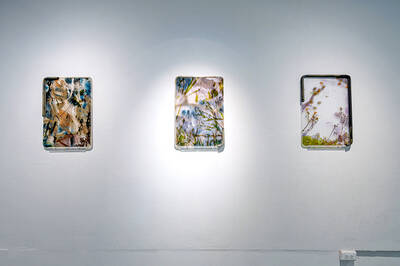
Located down a sideroad in old Wanhua District (萬華區), Waley Art (水谷藝術) has an established reputation for curating some of the more provocative indie art exhibitions in Taipei. And this month is no exception. Beyond the innocuous facade of a shophouse, the full three stories of the gallery space (including the basement) have been taken over by photographs, installation videos and abstract images courtesy of two creatives who hail from the opposite ends of the earth, Taiwan’s Hsu Yi-ting (許懿婷) and Germany’s Benjamin Janzen. “In 2019, I had an art residency in Europe,” Hsu says. “I met Benjamin in the lobby


 RSS
RSS