

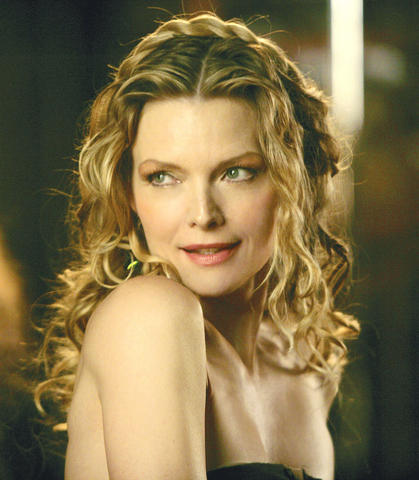
In Stardust, a sprawling, effects-laden fairy tale with the thundering stamina of a marathon horse race, Michelle Pfeiffer is Lamia, as deliciously evil a witch as the movies have ever invented. Shooting deadly green lightning from rings on her tapering long-nailed fingers, she suggests a seriously lethal beauty contestant of a certain age who will stop at nothing to seize the crown.
The eternal youth and beauty she and her sisters covet can be attained only by cutting out and eating the heart of Yvaine (Claire Danes), an actual fallen star that, upon crashing to the ground in the imaginary kingdom of Stormhold, assumes human form. Yvaine must be found, captured and eviscerated.
But since Lamia has only a limited amount of magic to deploy before she begins to shrivel into a grotesque, balding hag, she must conserve her resources. As fire spirals from her hands like serpent tongues, she metamorphoses from a feline beauty with a sickly sweet smile into various stages of decrepitude. Her nightmare image of herself comes and goes as she unleashes and renews her powers.

PHOTOS: COURTESY OF UIP
By all rights, Lamia shouldn't be the center of Stardust. The spine of the tale is a conventional initiation story in which Tristan (Charlie Cox), a poor young villager from the English town of Wall, promises to bring the prettiest local girl (Sienna Miller) a fallen star like the shooting one that has just zoomed overhead; she gives him a week to deliver.
Even when the movie goes haywire with an extraneous comic gambit involving an airborne pirate ship, it barrels forward with a fearless audacity. Far too many characters are crowded together for comfort, and there are serious casting errors, but the movie assumes that its churning energy, lightened with whimsy, will carry the day. And, to an extent, it does.
The most glaring of several mistakes in casting is Danes' charm-free Yvaine, a cranky older version of her teenage character on the television series My So-Called Life. Even after Yvaine mellows and warms to Tristan, who discovers her in a crater and becomes her protector, Danes has a distracting habit of scrunching her features into a scowl unbefitting a supernatural heroine who aspires to live happily ever after. At a certain point you may find yourself imagining how much better Stardust might have been with Gwyneth Paltrow in the role.
Yvaine is pursued by an entire hunting party's worth of characters, whose goals blur into a general stampede. It begins with the death of Stronghold's cagey monarch (Peter O'Toole), who pits his seven sons against one another for the throne, which can be won only through possession of a ruby pendant worn by Yvaine. After fraternal massacre, three brothers remain to fight it out while the others' ghosts amusedly comment from above like a supernatural Greek chorus.
Beyond Lamia, the movie suffers from a dire lack of strong, clear-cut characters, with one outrageous exception. Halfway through the story, Tristan and Yvaine are rocketed into space, where they eventually plunk down on an amphibious pirate ship suspended from a dirigible. Enter Robert De Niro in his all-time campiest screen performance as its skipper, Captain Shakespeare.
Wearing a demonic grin and speaking in a caricature of the New York mobster voice he used in Analyze This, he yanks the movie out of its quasi-medieval mists-of-northern-Britain past into a farcical limbo. The fearsome captain is soon revealed to have dual identities. Alone in his quarters, he exchanges his pirate duds for the costume of a cancan-dancing, boa-twirling Folies-Bergere chorus girl prancing before a mirror to the sounds of Offenbach. The crew, it turns out, knows about his tendencies but has maintained a respectful silence.
If De Niro's drag routine makes as much sense in Stardust as a kazoo solo inserted into a Mozart string quartet, it makes movie-trivia sense if you think of it as a response to Johnny Depp's fey Pirates of the Caribbean character, Jack Sparrow. In that case, this joke about a joke is either a piece of inspired madcap fun or an excruciating embarrassment.
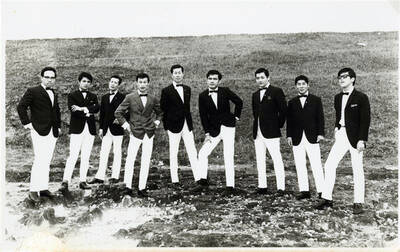
Sept. 28 to Oct. 4 Opening in 1971, Singapore’s Wisma Theatre (海燕歌劇院) was entirely modeled after Taiwanese live variety shows, combining singing, dancing and drama. Even its performers were recruited from Taiwan. The formula was an instant hit, selling out on the third night with the crowd fighting outside for tickets. Among its key figures was 31-year-old Chi Li-nan (紀利男), an acclaimed saxophonist and band leader who had entered Taiwan’s live entertainment scene at age 19 with zero musical training. Chi wasn’t even supposed to be there. He had accompanied his girlfriend, pop singer Shang Kuan Ping (上官萍), to negotiations with Wisma’s agent.

In 1951, the Central Propaganda Department of the Chinese Nationalist Party’s (KMT) Central Reform Committee launched an English-language magazine, which, for the next 75 years, would serve as a mouthpiece for Taiwan’s government. Initially titled the Free China Review, and later rechristened as the Taiwan Review, the magazine published its final issue in March. Former editor Richard Vuylsteke has described the magazine as Taiwan’s “landmark foreign language publication going abroad.” The magazine was not universally respected. Some international scholars, including a few contacted for this article, dismissed it as a “propaganda rag.” But others, including Shelley Rigger, a top US researcher at

Mark Carney built a global profile this year by standing up to US President Donald Trump. If some prediction-market traders and prominent admirers are right, the Canadian prime minister could end the year with the Nobel Peace Prize and Time magazine’s Person of the Year. Carney briefly became the favorite Monday for the 2026 Nobel Peace Prize on Kalshi, a US-based prediction market, when traders on the exchange put his chances at 14 percent. His odds later fell, illustrating the highly speculative nature of the wagering. There is no public evidence Carney is on the Nobel Committee’s secret shortlist for the prize
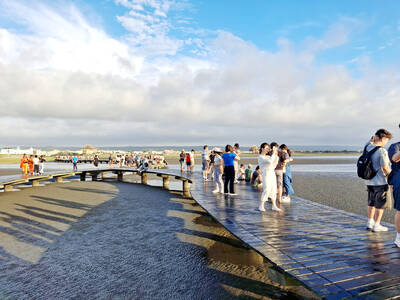
Off the coast of Taichung lies the well known Gaomei Wetlands (高美濕地), a popular nature preserve. On weekends, especially in the evenings, the site’s walkways are crowded with sunset watchers, its mudflats filled with people wading and taking pictures of the local wildlife. Birds, amphibious fish, crabs and other organisms flourish. A few hundred meters to the south Berth number 8 of the Port of Taichung juts inland, surrounded by chemical plants, cement factories, chemical storage sites, warehouses and wind turbines. This infrastructure, critical to the running of a major industrial economy, will be targeted in wartime. Though they do not


 RSS
RSS