


In the quaint seaside community of Gloucester, Massachusetts, on Cape Ann, one gray clapboard house stands out from the rest. It has a big white dome rising from the top, with a sliding shutter that opens to the sky and a powerful telescope inside. "My wife got an ocean view and I got a view of the sky," said Mario Motta, 55, a cardiologist and astronomy enthusiast, of the house they built three years ago.
At a time when amateur astronomy is becoming increasingly popular - thanks in part to the availability of high-tech equipment like digital cameras that filter out light pollution - Motta and his wife, Joyce, are among a growing number of Americans incorporating observatories into new or existing homes. Manufacturers of observatory domes report increasing sales to homeowners, and new residential communities are being developed with observatories as options in house plans.
"As the baby boomers and wealthy tech types retire, they want challenging hobbies like astronomy, and have enough cash stashed away to afford to build their own observatories," said Richard Olson, president of the Ash Manufacturing Co in Plainfield, Illinois, which makes steel domes for observatories. His customers used to be limited to academic and research institutions, but within the last five years, he said, homeowners have begun making requests, to the point where 25 percent of his sales are to people like Steve Cullen, a 41-year-old retired senior vice president of the Symantec Corp, who is building a home and observatory on 77 hectares in Rodeo, New Mexico.
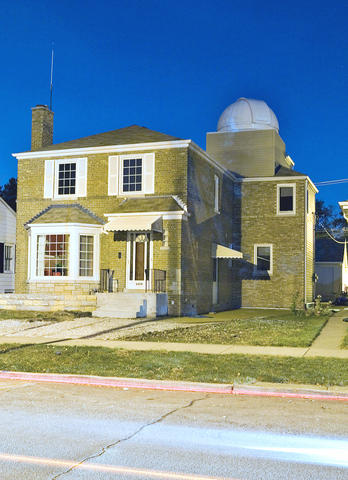
PHOTO: NY TIMES NEWS SERVICE
Cullen said he chose the location because it has "some of the darkest skies and clearest weather for space photography in the US," (Most sophisticated telescopes now allow for the addition of digital cameras.) He expects the total cost of his observatory, which is still under construction, to be close to US$340,000, including a US$225,000 telescope, but his is a high-end project.
Most home observatories have between US$10,000 and US$40,000 in equipment, including telescopes, computers, refractors, filters and tracking mechanisms, according to astronomy equipment retailers. The total budget for an observatory can range from US$50,000 to more than US$500,000, depending on how technologically advanced the equipment and the size and complexity of the structure.
Motta also photographs deep space from his home's observatory, posting his images of distant galaxies online and publishing them in astronomy magazines and journals.
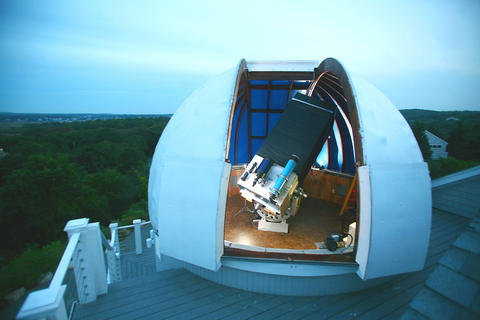
PHOTO: NY TIMES NEWS SERVICE
His telescope, which he constructed himself, weighs well over a 45kg, and would be cumbersome to move outdoors if he didn't have an observatory. And like most sophisticated telescopes, it would also require at least an hour of careful re-calibration if relocated.
"The reason why people don't use their telescopes is they are such a pain to haul out and set up," said John Spack, 50, a certified public accountant who had a domed observatory built on top of an addition to his house in Chicago last year. "Now, if I want to get up at 3am and look at something, I just open the shutter."
Like observatories at research facilities and museums, most home observatories now have computers that rotate the dome so the telescope is oriented toward precisely what the user wants to see. Once fixed on a point in space, the dome continues to slowly rotate to compensate for the earth's rotation, so whatever is in view doesn't move out of range.
"It's all fully automated, real high-tech," said Spack, who estimated that he spent at least US$100,000 to build and equip his observatory. Many home observatories also allow remote real-time views through the telescope from any computer with an Internet connection.
Roy and Elise Furman, who own a software company, view the cosmos through the telescope in their vacation house observatory in Portal, Arizona, both when they are there and when they are at home, in Philadelphia.
"Philadelphia skies are so light polluted, we got depressed trying to do astronomy," said Furman, 48. So the couple bought the Portal property, which is about 16km from Rodeo and part of a community called Arizona Sky Village, founded in 2003. Half of the 15 adobe-style homes there have matching domed observatories, and five more observatory homes are under construction. "We are a bunch of astronomy buffs looking through our telescopes out in the middle of nowhere," said Furman, 57.
Other astronomy-themed residential developments include Deerlick Astronomy Village in Sharon, Georgia, about 160km east of Atlanta, established in 2004, and Chiefland Astronomy Village in Chiefland, on Florida's west coast, which began in 1985 as a place for amateur astronomers to buy or rent land on which to camp. Within the last five years, several houses with observatories have been built there.
These communities encourage home observatories, but elsewhere, "people do run into problems with deed restrictions," said Jerry Smith, president of Technical Innovations, a manufacturer of observatory domes in Gaithersburg, Maryland. The company started in 1991 and primarily served universities and government agencies, but since 2002 individual consumers have accounted for 60 percent of the 1,400 domes it has sold.
To avoid overheating and warping the viewing equipment, Smith said, "it is better to have a white dome, because it's reflective, but we have had to do them in earth tones because that is the only way to get them approved by property owners' associations."
Domes in home observatories are typically made of metal or fiberglass and range in size from 2.5m to 9m in diameter. They are sold in kits from manufacturers like Ash or Technical Innovations and start at about US$5,000, depending on the size, materials and features. The price includes a computer-controlled motorized system that opens the dome's sliding or hatch-like shutter and rotates the dome.
The telescope beneath the dome requires "a dedicated foundation, so it's not subject to the vibrations transmitted by people walking around in the building," said Gregory La Vardera, an architect in Merchantville, New Jersey, who designed Cullen's observatory. This usually involves elevating the instrument on a discrete concrete pier. A telescope mount is bolted to the pier and the mount is motorized so it rotates the telescope in sync with the dome.
Observatories cannot be air-conditioned because any difference between the inside and outside air would distort the telescope's optics, La Vardera said. For comfort, most home observatories have a separate insulated and air-conditioned control room that houses all the computer equipment. These rooms often look like studies, with lots of space photography hanging on the walls.
"I have a lot of astronomy books on the bookshelves so I can feel knowledgeable," said Eric Gershwin, the chairman of clinical immunology at the University of California, Davis, about the control room in his home's observatory in Davis. An avid amateur astronomer, Gershwin, 61, had the observatory built 10 years ago and has been tweaking the instrumentation and control systems ever since. "You're never done," he said. "Right now I'm updating the computers."
Helping people with the installation and computerization of observatories has become a sideline for Kris Koenig, 45, a video producer from Chico, California, who specializes in astronomy-themed productions.
"It started a couple of years ago, when I helped set up the digital equipment in some public and private observatories locally," Koenig said, adding that he is now getting at least half a dozen calls for assistance a month just through word of mouth. He charges US$500 to US$1,000 an hour depending on the difficulty of the job, plus travel expenses. His most recent project involved linking a California home observatory's telescope to an entertainment center, so the images could be broadcast on a big-screen television.
The work is gratifying, he said. "It's great that so many people want to bring the universe home."

In late October of 1873 the government of Japan decided against sending a military expedition to Korea to force that nation to open trade relations. Across the government supporters of the expedition resigned immediately. The spectacle of revolt by disaffected samurai began to loom over Japanese politics. In January of 1874 disaffected samurai attacked a senior minister in Tokyo. A month later, a group of pro-Korea expedition and anti-foreign elements from Saga prefecture in Kyushu revolted, driven in part by high food prices stemming from poor harvests. Their leader, according to Edward Drea’s classic Japan’s Imperial Army, was a samurai

The following three paragraphs are just some of what the local Chinese-language press is reporting on breathlessly and following every twist and turn with the eagerness of a soap opera fan. For many English-language readers, it probably comes across as incomprehensibly opaque, so bear with me briefly dear reader: To the surprise of many, former pop singer and Democratic Progressive Party (DPP) ex-lawmaker Yu Tien (余天) of the Taiwan Normal Country Promotion Association (TNCPA) at the last minute dropped out of the running for committee chair of the DPP’s New Taipei City chapter, paving the way for DPP legislator Su

It’s hard to know where to begin with Mark Tovell’s Taiwan: Roads Above the Clouds. Having published a travelogue myself, as well as having contributed to several guidebooks, at first glance Tovell’s book appears to inhabit a middle ground — the kind of hard-to-sell nowheresville publishers detest. Leaf through the pages and you’ll find them suffuse with the purple prose best associated with travel literature: “When the sun is low on a warm, clear morning, and with the heat already rising, we stand at the riverside bike path leading south from Sanxia’s old cobble streets.” Hardly the stuff of your

Located down a sideroad in old Wanhua District (萬華區), Waley Art (水谷藝術) has an established reputation for curating some of the more provocative indie art exhibitions in Taipei. And this month is no exception. Beyond the innocuous facade of a shophouse, the full three stories of the gallery space (including the basement) have been taken over by photographs, installation videos and abstract images courtesy of two creatives who hail from the opposite ends of the earth, Taiwan’s Hsu Yi-ting (許懿婷) and Germany’s Benjamin Janzen. “In 2019, I had an art residency in Europe,” Hsu says. “I met Benjamin in the lobby


 RSS
RSS