


After the literary critic Anatole Broyard died in 1990, his family arranged a memorial reception at a suburban Connecticut yacht club. It was a club that claimed to have no black members until, after Broyard's death, his mixed racial lineage was made known. After that, the club cited him as evidence of integration.
What was it like for Broyard to keep his secret in such surroundings? For a self-made man who had come so far in life, reading so many books in the process, did the clubhouse's view of Long Island Sound bring to mind the grand illusions of "The Great Gatsby?"
Not likely, says his smart, tough-minded daughter, Bliss Broyard, in One Drop, an investigative memoir about her father's life. As this fascinating, insightful book makes clear, Broyard left a legacy of racial confusion and great autobiographical material, not necessarily in that order.
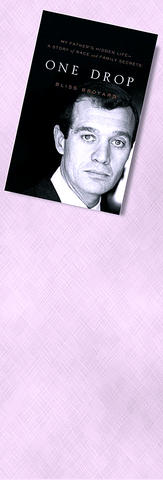
Broyard shares her father's bracingly unsentimental spirit, to the point where she knows that he had none of Jay Gatsby's self-congratulatory outlook or sense of American tragedy. More to the point, she says, "It never seemed to occur to him that someone might want to keep him out."
When a guest at the memorial service noticed three light-skinned black people sitting with the Broyards, he was surprised that the family had so much help. But those weren't the servants; they were black Broyards who had been kept at arm's length by Anatole, whose birth certificate listed him as white. By the time he got to Connecticut, after early years in New Orleans, a Brooklyn boyhood and time spent in the army and Greenwich Village, he no longer talked about his lineage. Black friends assumed he was black. White people didn't ask what they thought of as rude questions. It was a rare moment in the Broyard household - say, when dinner guests realized that Bliss and her brother, Todd, knew nothing about their black heritage - when race seemed to make any difference at all.
Only after her father died did Broyard begin to realize how little she understood. And so she began, in ways that elevate One Drop far above the usual family-revisionist memoir, to make up for lost time. She knew no Broyards in New York, but found plenty in Los Angeles, even bringing them together for a family reunion as an early step in her process of discovery. What made this gathering tricky is that some Broyards regarded themselves as white and others as black, drawing vehemently different conclusions from similar sets of facts.
Broyard knew that her father's heritage was an open secret when she found a close confidant in Henry Louis Gates Jr, the renowned scholar. She got to know Gates by his nickname, Skip; she marveled at how generous he was with his time and interest. Then she learned that he planned to write the Broyard story for The New Yorker, and she was infuriated at having been so manipulatively treated. "Years later," she writes astutely, "I'd realize that my biggest fear was that Gates, a stranger who had never even met my father, would understand him better than I could." But she sharply excoriates Gates for his tactics, his glibness and the harm that she feels his article inflicted on her family.
When she published her first book, a story collection called My Father, Dancing in 2000, Broyard had not written about race. Yet her book was included in the African-American Book Expo in Chicago and on the Black History Month agenda. An investigation into her own past and her family's was clearly something she could not avoid.
A half-hidden family history is no guarantee of an interesting one, however. And for all its prodigious research, One Drop deals more engrossingly with the stories of Broyard and her closest relatives than it does with the 18th-century origins of the Broyards in the US.
Nonetheless, armed with the knowledge that genealogical Web sites are almost as popular as pornographic ones, Broyard zealously assembled an account of her roots. Among the first things she discovers about a large, Creole, New Orleans-based family like hers is that racial delineations and stereotypes make no sense at all.
And slavery, which she regards as a defining issue in matters of black identity, holds its own share of surprises. "In a few short hours, I'd gone from believing that my great-grandmother was born a slave to discovering that she'd grown up in a family of black slave owners," she writes after one fact-finding trip. "These weren't the noble tragic figures I'd been expecting to encounter."
Though its scope is large, the heart of One Drop lies with the author's father. She must try - as Philip Roth did in The Human Stain, a book that was seemingly prompted by the Broyard story but goes unmentioned here - to understand the choices he made, whether by action or omission. In a speculative account of what happened when her father applied for a Social Security card, Broyard guesses at how he might have been flummoxed by the decision of what racial identity to choose yet unaware of how important this choice would be. "I doubt that my father walked away feeling that he'd redirected the course of his life," she writes.
Drawing on both her father's autobiographical account and some of what Gates had to say, One Drop culminates in a cultural and intellectual history of Broyard's life and times. His Greenwich Village days (described in his book Kafka Was the Rage) were full of ambition and contention, not to mention consummate lady-killing. (Broyard was "New Orleans French, handsome, sensual, ironic," according to the hot-blooded diarist Anais Nin.) And some of his most assertive early essays about race and hip-ness made his bona fides clear.
Broyard proudly kept a 1950 issue of Commentary near the family's dinner table. But the author's identifying note had been neatly cut out of the contributor's page. Now his daughter knows what it said: that Anatole Broyard was "an anatomist of the Negro personality in a white world." And she wonders, with lucid and sharp introspection, how her own life would have changed if she had known that sooner.
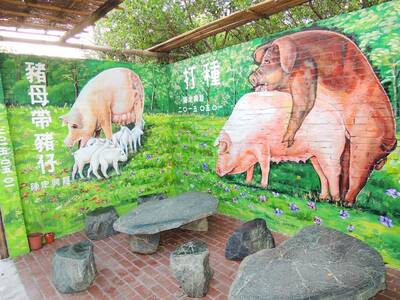
May 6 to May 12 Those who follow the Chinese-language news may have noticed the usage of the term zhuge (豬哥, literally ‘pig brother,’ a male pig raised for breeding purposes) in reports concerning the ongoing #Metoo scandal in the entertainment industry. The term’s modern connotations can range from womanizer or lecher to sexual predator, but it once referred to an important rural trade. Until the 1970s, it was a common sight to see a breeder herding a single “zhuge” down a rustic path with a bamboo whip, often traveling large distances over rugged terrain to service local families. Not only

Ahead of incoming president William Lai’s (賴清德) inauguration on May 20 there appear to be signs that he is signaling to the Chinese Communist Party (CCP) and that the Chinese side is also signaling to the Taiwan side. This raises a lot of questions, including what is the CCP up to, who are they signaling to, what are they signaling, how with the various actors in Taiwan respond and where this could ultimately go. In the last column, published on May 2, we examined the curious case of Democratic Progressive Party (DPP) heavyweight Tseng Wen-tsan (鄭文燦) — currently vice premier
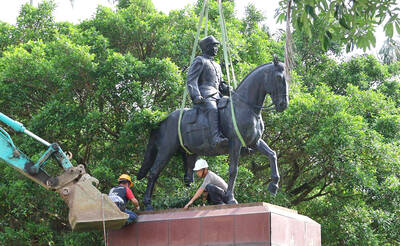
The last time Mrs Hsieh came to Cihu Park in Taoyuan was almost 50 years ago, on a school trip to the grave of Taiwan’s recently deceased dictator. Busloads of children were brought in to pay their respects to Chiang Kai-shek (蔣中正), known as Generalissimo, who had died at 87, after decades ruling Taiwan under brutal martial law. “There were a lot of buses, and there was a long queue,” Hsieh recalled. “It was a school rule. We had to bow, and then we went home.” Chiang’s body is still there, under guard in a mausoleum at the end of a path

Last week the Directorate-General of Budget, Accounting and Statistics (DGBAS) released a set of very strange numbers on Taiwan’s wealth distribution. Duly quoted in the Taipei Times, the report said that “The Gini coefficient for Taiwanese households… was 0.606 at the end of 2021, lower than Australia’s 0.611, the UK’s 0.620, Japan’s 0.678, France’s 0.676 and Germany’s 0.727, the agency said in a report.” The Gini coefficient is a measure of relative inequality, usually of wealth or income, though it can be used to evaluate other forms of inequality. However, for most nations it is a number from .25 to .50


 RSS
RSS