


They have monikers that sound like exotic birds - cleeks, spring-neck brassies, long-nose baffing spoons - but actually specify types of antique golf clubs, a sampling of the nearly 800 in the collection of Jeffery Ellis, which Sotheby's is to sell in New York on Sept. 27 and Sept. 28. The pre-sale viewing begins Sept. 20.
"It's our first single-owner golf memorabilia sale in New York, and we expect it to realize more than US$4 million," said Leila Dunbar, the specialist in charge.
Ellis' clubs were made from 1600 to 1930, when the era of the wooden-shaft club came to an end. Fashioned with shafts of aged hickory, ash or lemonwood, these early clubs have heads with an insert of ram's horn or a lead backweight. They are works of art, with the golden patina of age.
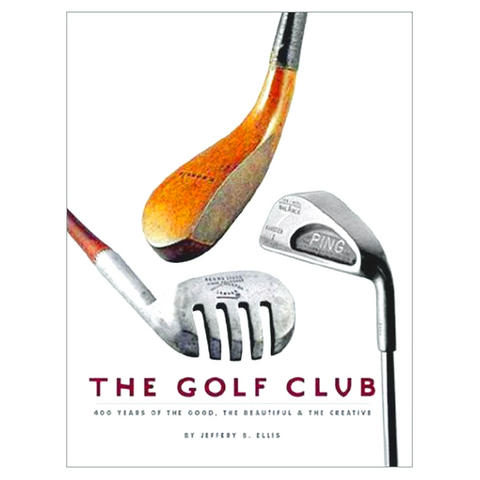
PHOTOS: NY TIMES NEWS SERVICE
"Golf has generated the most creative equipment of any sport," Ellis said.
There are clubs with long wooden heads called long-nose clubs (used to drive, play shots toward the green and putt); long, middle and short wooden spoons (used as fairway clubs for approach shots); irons (for getting balls out of cart tracks, sand, rocks or high grass); and rakes (employed to get relief from temporary pools of water). The variations seem limitless, but then there are 14 clubs in an average golf bag.
Dunbar, herself a golfer, doesn't know who will bid on these clubs: individual collectors, golfers or owners of golf courses. Most of the lots are estimated to sell for a few hundred US dollars.
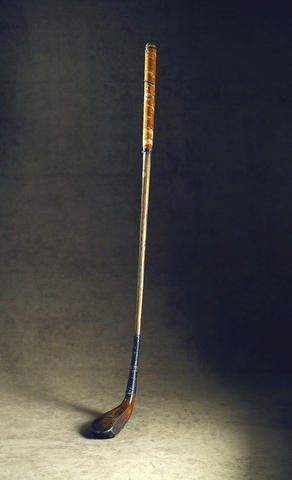
PHOTO: NY TIMES NEWS SERVICE
"There are more than 56 million golfers worldwide, and half are in the US," she said. "Every golfer collects something: a logo ball, medals, commemorative shirts and hats, sporting paintings and posters. These clubs represent the history of the game before the 1930s. Golf is not like baseball - think of baseball cards - which has 50 times more memorabilia."
Ellis, a native of Oak Harbor, Washington, has been a serious golfer since he was seven. He has collected antique clubs for more than 30 years.
"My goal was to collect one of every different kind of antique golf club, but only the most creative, innovative and historic examples - clubs that tried to push the envelope and make golf better," Ellis said. "I strove for clubs no one else had, and clubs that did not exist anywhere else in the world. Variety is what I was after."
He is not referring to the vintage clubs one sees at garage sales and on eBay.
In 1979 Ellis quit his job at an insurance company and turned his hobby into a full-time business: buying, selling and trading antique collectible golf clubs on his Web site, antiqueclubs.com. He also works as a consultant to golf companies like Callaway.
"Then, in the 1980s, he saw there was no definitive reference book on clubs, so he decided to write one," Dunbar said. "It took him 10 years to finish The Club-maker's Art: Antique Golf Clubs and Their History." In 2003 he published a second book: The Golf Club: 400 Years of the Good, the Beautiful and the Creative." Almost all the clubs in the sale are featured in these books.
Why is he selling his collection?
"It's the natural conclusion of what I've been all about," Ellis said. "I've done what I set out to do. I've collected, and I've written books on the topic. There's not much left for me to track down, acquire and write about. I always saw myself as a curator, never as a final owner."
He is also unhappy that he can no longer enjoy his clubs.
"The collection is so much bigger than I ever thought it would be," he said. "There is no place I can put the clubs. They stay locked up in a huge vault."
Today, golf clubs are mass-produced and made with steel. Until about 1930 clubs were made by hand with specially chosen types of wood. Like the majority of cabinetmakers, most golf club craftsmen did not sign their work. Ellis said not all club-makers were documented, and only four club-makers working before 1800 are known to have marked their clubs.
Some club-makers were so talented, however, they could be compared to great American colonial furniture craftsmen, famous cabinetmakers like the Goddards and Townsends of Newport.
The top lot in the sale, Number 260, is a long-nose putter stamped "A.D." that is attributed to Andrew Dickson of Leith, Scotland (around 1753). Dickson was one of a handful of club-makers who marked clubs with their own initials in the 1700s. Leith claims to be the true home of golf because it is where the earliest recorded game was played, in 1457, and where the official rules of golf were formulated in 1744 (before those at the Royal and Ancient Golf Club of St Andrews, arguably the world's most famous course).
"That putter took my breath away when I first saw it," Ellis said. "Dickson's clubs have a distinct look. Every one is a hand-sculpted work of art."
Dickson grew up in a family of renowned makers of golf balls and clubs. A 1743 poem written by Thomas Mathison refers to a golf club made with the finest ash shaft and whose head was pond'rous with lead and fac'd with horn that was the work of Dickson who in Leitha dwells/and in the art of making clubs excels. It is also recorded that as a boy Dickson caddied for the Duke of York (the future James II).
His putter is estimated at US$200,000 to US$300,000.
Many top craftsmen were retained as official club-makers by golf courses like St Andrews. Such men might make and repair clubs, serve as greens keepers and caddies, even lay out the holes of the course. Inevitably a few also became the best players of their day. The sale includes several clubs made by these men.
"They were the first real professionals," Ellis said. "Prior to the 1860s the only money that changed hands in golf was at public winner-take-all matches, and when these club-makers won, they were able to take a portion of the winnings."

In late October of 1873 the government of Japan decided against sending a military expedition to Korea to force that nation to open trade relations. Across the government supporters of the expedition resigned immediately. The spectacle of revolt by disaffected samurai began to loom over Japanese politics. In January of 1874 disaffected samurai attacked a senior minister in Tokyo. A month later, a group of pro-Korea expedition and anti-foreign elements from Saga prefecture in Kyushu revolted, driven in part by high food prices stemming from poor harvests. Their leader, according to Edward Drea’s classic Japan’s Imperial Army, was a samurai

The following three paragraphs are just some of what the local Chinese-language press is reporting on breathlessly and following every twist and turn with the eagerness of a soap opera fan. For many English-language readers, it probably comes across as incomprehensibly opaque, so bear with me briefly dear reader: To the surprise of many, former pop singer and Democratic Progressive Party (DPP) ex-lawmaker Yu Tien (余天) of the Taiwan Normal Country Promotion Association (TNCPA) at the last minute dropped out of the running for committee chair of the DPP’s New Taipei City chapter, paving the way for DPP legislator Su

It’s hard to know where to begin with Mark Tovell’s Taiwan: Roads Above the Clouds. Having published a travelogue myself, as well as having contributed to several guidebooks, at first glance Tovell’s book appears to inhabit a middle ground — the kind of hard-to-sell nowheresville publishers detest. Leaf through the pages and you’ll find them suffuse with the purple prose best associated with travel literature: “When the sun is low on a warm, clear morning, and with the heat already rising, we stand at the riverside bike path leading south from Sanxia’s old cobble streets.” Hardly the stuff of your

Located down a sideroad in old Wanhua District (萬華區), Waley Art (水谷藝術) has an established reputation for curating some of the more provocative indie art exhibitions in Taipei. And this month is no exception. Beyond the innocuous facade of a shophouse, the full three stories of the gallery space (including the basement) have been taken over by photographs, installation videos and abstract images courtesy of two creatives who hail from the opposite ends of the earth, Taiwan’s Hsu Yi-ting (許懿婷) and Germany’s Benjamin Janzen. “In 2019, I had an art residency in Europe,” Hsu says. “I met Benjamin in the lobby


 RSS
RSS