


Millions of Egyptians could be forced permanently from their homes, the country's ability to feed itself devastated.
That's what likely awaits this already impoverished and overpopulated nation by the end of the century, if predictions about climate change hold true. The World Bank describes Egypt as particularly vulnerable to the effects of global warming, saying it faces potentially "catastrophic" consequences.
"The situation is serious and requires immediate attention. Any delay would mean extra losses," said Mohamed el-Raey, an environmental scientist at Alexandria University.

PHOTO: AP
A big reason is the vulnerability of Egypt's breadbasket - the Nile Delta, a fan-shaped area of rich, arable land where the Nile River spreads out and drains into the Mediterranean Sea. Although the Delta makes up only 2.5 percent of Egypt's land mass, it is home to more than a third of this largely desert country's 80 million people.
The Delta was already in danger, threatened by the side effects of southern Egypt's Aswan Dam. Though the dam, completed in 1970, generates much-needed electricity and controls Nile River flooding, it also keeps nutrient sediment from replenishing the eroding Delta.
Add climate change to the mix, and the Delta faces new uncertainties that could have a potentially more devastating effect on Egypt.
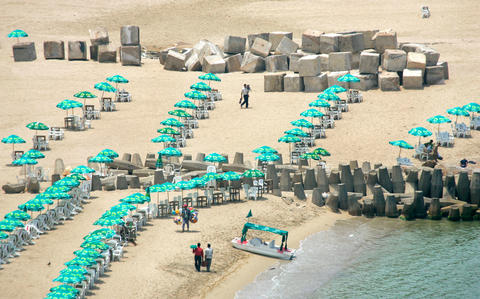
PHOTO: AP
Scientists generally predict that the Mediterranean, and the world's other seas, will rise between 30cm and 1m by the end of the century, flooding coastal areas along the Delta.
Already, the Mediterranean has been creeping upward about 2cm annually for the last decade, flooding parts of Egypt's shoreline, el-Raey said.
By 2100, the rising waters could wipe out the sandy beaches that attract thousands of tourists. Also at risk would be the buried treasures archaeologists are still uncovering in ancient Alexandria, once the second most important city in the Roman Empire.
But those losses would pale to the impact of the worst-case scenario that some scientists are predicting - global warming unexpectedly and rapidly breaking up the Greenland and West Antarctic ice sheets.
If this happens, seas could rise by about 4.9m, causing mass devastation to the region, according to a World Bank study released this year.
Richard Alley, a geosciences professor at Penn State University, said the sheets are collapsing at slow rate, but much faster than scientists thought a decade ago. A complete collapse could take "at least centuries," said Alley, an expert on ice melt.
But even minimal sea rise in the next century would have serious consequences for Egypt, experts warn.
A rise 1m would flood a quarter of the Delta, forcing about 10.5 percent of Egypt's population from their homes, according to the World Bank. The impact would be all the more staggering if Egypt's population, as expected, doubles to about 160 million by the middle of the century. The Delta is already densely packed with about 4,000 people per 2.6km2.
Also hit would be Egypt's food supply. Nearly half of Egypt's crops, including wheat, bananas and rice, are grown in the Delta.
Areas not under water would also be affected, with salt water from the Mediterranean contaminating the fresh ground water from the Nile River used for irrigation.
But the unique and fragile ecosystem of the Delta makes the job of protecting it much greater - and human activity has already made the task harder.
For thousands of years, annual Nile floods deposited mud, sand and minerals that replenished the Delta and prevented erosion. But for the past three decades, the Aswan Dam has curbed the sediment from resettling in the Delta and allowed erosion to flourish.
"The sediment created a balance. Now the coastal processes are acting alone without sediments counteracting, and the balance has been changed," said Omran Frihy, a retired coastal researcher in Alexandria who has published several reports on sea level rise and erosion.
In Egypt, as in much of Africa, global warming is rarely discussed. But the government in Cairo is beginning to confront the problem.
In Alexandria, authorities are spending US$300 million to build concrete sea walls to protect the beaches along the Mediterranean, Frihy said. Sand is being dumped in some areas to replenish dwindling beaches.
Similar walls are going up in other parts of the coast including Rashid, where archaeologists in 1799 discovered the Rosetta Stone that unlocked the secrets of ancient Egyptian writing.
The government is also preparing a "national strategy study" on ways to adapt to climate change, said Maged George, Egypt's minister of environmental affairs.
Mohamed el-Shahawy, a climate scientist at the Egyptian Environmental Affairs Agency, said the government was obtaining a vulnerability index and detecting the most vulnerable regions.
"Egypt is trying to protect its shores," el-Shahawy said. "After this we will request that the world help. We have to protect ourselves. But it costs so much.
On the Net
Maps of predicted sea level rise affect on Nile Delta: maps.grida.no/go/graphic/potential_impact_of_sea_leve l_rise_nile_delta

In late October of 1873 the government of Japan decided against sending a military expedition to Korea to force that nation to open trade relations. Across the government supporters of the expedition resigned immediately. The spectacle of revolt by disaffected samurai began to loom over Japanese politics. In January of 1874 disaffected samurai attacked a senior minister in Tokyo. A month later, a group of pro-Korea expedition and anti-foreign elements from Saga prefecture in Kyushu revolted, driven in part by high food prices stemming from poor harvests. Their leader, according to Edward Drea’s classic Japan’s Imperial Army, was a samurai

The following three paragraphs are just some of what the local Chinese-language press is reporting on breathlessly and following every twist and turn with the eagerness of a soap opera fan. For many English-language readers, it probably comes across as incomprehensibly opaque, so bear with me briefly dear reader: To the surprise of many, former pop singer and Democratic Progressive Party (DPP) ex-lawmaker Yu Tien (余天) of the Taiwan Normal Country Promotion Association (TNCPA) at the last minute dropped out of the running for committee chair of the DPP’s New Taipei City chapter, paving the way for DPP legislator Su
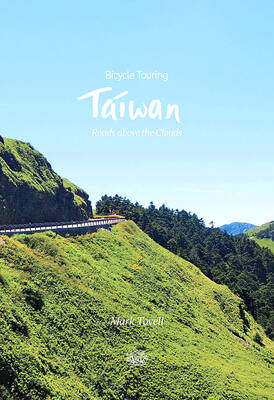
It’s hard to know where to begin with Mark Tovell’s Taiwan: Roads Above the Clouds. Having published a travelogue myself, as well as having contributed to several guidebooks, at first glance Tovell’s book appears to inhabit a middle ground — the kind of hard-to-sell nowheresville publishers detest. Leaf through the pages and you’ll find them suffuse with the purple prose best associated with travel literature: “When the sun is low on a warm, clear morning, and with the heat already rising, we stand at the riverside bike path leading south from Sanxia’s old cobble streets.” Hardly the stuff of your

Located down a sideroad in old Wanhua District (萬華區), Waley Art (水谷藝術) has an established reputation for curating some of the more provocative indie art exhibitions in Taipei. And this month is no exception. Beyond the innocuous facade of a shophouse, the full three stories of the gallery space (including the basement) have been taken over by photographs, installation videos and abstract images courtesy of two creatives who hail from the opposite ends of the earth, Taiwan’s Hsu Yi-ting (許懿婷) and Germany’s Benjamin Janzen. “In 2019, I had an art residency in Europe,” Hsu says. “I met Benjamin in the lobby


 RSS
RSS