


Inside the many rehearsal rooms at Shih Chien University's department of music, international jazz professionals and local amateurs are warming up. Each room hosts a workshop that places emerging Taiwanese jazz musicians - or those interested in the genre - with seasoned professionals from Europe. Hsieh Chi-pin (謝啟彬), the man behind the Taipei International Jazz Festival and Summer Jazz Academy, sits on a small amplifier looking harried. "In the first year it was 75 students …, this year we have almost 95," he said.
But increasing participation in the festival isn't all that's keeping Hsieh busy. In the five years since returning to Taiwan from Brussels, he has lectured extensively on jazz history, brought Jazz Improvisation Ensemble Technique to the course-list at Shih Chien University, played to packed venues across the island and put out two CDs - most recently Mr. BeBu (Mr.比布), which was released Aug. 3 and is named after his son.
Hsieh helped form the Academy because of his own experience as a musician-in-training in Taiwan. "I come from a classical [music] background and I was looking for someone to teach me [John] Coltrane," Hsieh said, referring to one of his jazz heroes. But it was only after graduating from the Chinese Culture University that Hsieh could develop his passion for jazz.
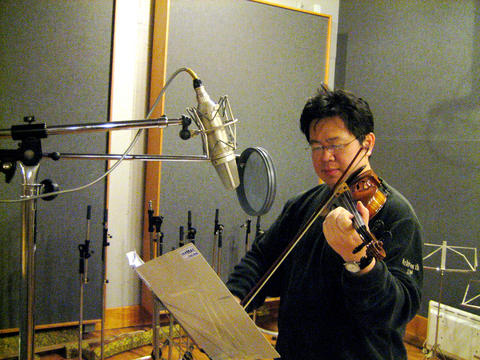
It was then that he went to Belgium to study the genre at the Royal Conservatory of Music. In July 2002, after five years of study, he earned a masters degree and returned to Taiwan, where he has been publicizing jazz.
Part of this campaign is The Duo Project - a new album featuring him and his wife, Chang Kai-ya (張凱雅), and European jazz artists such as John Ruocco, Bart DeNolf and Pino Guarraci. This project incorporates traditional Taiwanese music styles into swing, bop, fusion, funk, and tango
"The compositions are ours," said Hsieh, but "we write about our influences - Belgium and Europe." Songs such as Chang's Ling Long Toy (玲瓏仔) and Hsieh's Penguin Trashcan (企鵝垃圾桶) draw on memories of growing up in southern Taiwan. "But we don't want to be pigeonholed as doing Taiwanese music by Taiwanese musicians," he said.
Avoiding this kind of label was accomplished by adding international performers to the lineup of musicians. Aside from Hsieh and Chang, all the musicians playing on the album are active on the European jazz scene and the work was recorded over a three-day period at a studio in Belgium.
As with many art traditions emanating from the West, jazz requires a core group of enthusiasts who are often educators, musicians or, in the case of Hsieh both, to survive and flourish.
"The idea is to let people see that if you want to learn jazz or play jazz better, there is a discipline or an education system. And we can provide that education system," he said.
Hsieh says that as students develop proficiency in jazz, audiences are sure to start paying attention. "When you use that kind of thing (education) and when you play on stage the audience will see you and say 'you guys are serious,' and you can start … to build up your fan [base] and the audience [will] come to your venues.
"If they know you are playing on a regular basis they won't come," he said. "But if they know it's a one-off concert, the venue will be packed."
It's a problem of which Tsai Huei-yang (蔡輝陽), owner of Blue Note, a jazz club located in Shida, is only too well aware. On a night last week, while a quartet played jazz standards, I asked if events like Hsieh's Taipei International Jazz Festival has increased his clientele. "It's remained pretty constant. But a lot more students are interested in playing at the club," Hsieh said.
Comparing his bar with Brown Sugar, a club noted for bringing over international acts, Tsai says he focuses on local talent by providing them a place to jam. Hsieh and Chang will play the venue on Sept. 3.
Hsieh says creating an infrastructure for jazz, however, isn't limited to the classroom or gigs. In addition to a Web site (www.chipin-kaiya.com), a project begun in 2000 to promote jazz by writing about the local and international scene, Hsieh also published Urban Jazz for two years before it closed.
Hsieh contrasts Taiwan with Japan's larger and more established jazz scene. "You go to Japan [and] you have swing journals and all kinds of different jazz music and the market is bigger," he said. "The audience, musicians and students buy the magazine[s] and they won't only see the international scene but local musicians."
Though this year's Taipei jazz festival and academy were a great success, Hsieh says there is still a long way to go before Taiwan reaches the kind of jazz consciousness seen in Japan.
"Most people have become lonely in a way because when you listen to jazz for longer and longer you develop your own personal taste. And somehow you cannot share the music you love because the community isn't big enough," he said.
Be that as it may, it is a community that is growing, helped in large part by Hsieh's infectious love of jazz and his energetic promotion of the genre.

In late October of 1873 the government of Japan decided against sending a military expedition to Korea to force that nation to open trade relations. Across the government supporters of the expedition resigned immediately. The spectacle of revolt by disaffected samurai began to loom over Japanese politics. In January of 1874 disaffected samurai attacked a senior minister in Tokyo. A month later, a group of pro-Korea expedition and anti-foreign elements from Saga prefecture in Kyushu revolted, driven in part by high food prices stemming from poor harvests. Their leader, according to Edward Drea’s classic Japan’s Imperial Army, was a samurai

The following three paragraphs are just some of what the local Chinese-language press is reporting on breathlessly and following every twist and turn with the eagerness of a soap opera fan. For many English-language readers, it probably comes across as incomprehensibly opaque, so bear with me briefly dear reader: To the surprise of many, former pop singer and Democratic Progressive Party (DPP) ex-lawmaker Yu Tien (余天) of the Taiwan Normal Country Promotion Association (TNCPA) at the last minute dropped out of the running for committee chair of the DPP’s New Taipei City chapter, paving the way for DPP legislator Su

It’s hard to know where to begin with Mark Tovell’s Taiwan: Roads Above the Clouds. Having published a travelogue myself, as well as having contributed to several guidebooks, at first glance Tovell’s book appears to inhabit a middle ground — the kind of hard-to-sell nowheresville publishers detest. Leaf through the pages and you’ll find them suffuse with the purple prose best associated with travel literature: “When the sun is low on a warm, clear morning, and with the heat already rising, we stand at the riverside bike path leading south from Sanxia’s old cobble streets.” Hardly the stuff of your
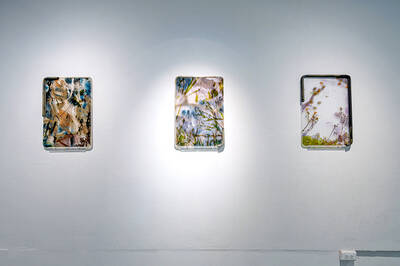
Located down a sideroad in old Wanhua District (萬華區), Waley Art (水谷藝術) has an established reputation for curating some of the more provocative indie art exhibitions in Taipei. And this month is no exception. Beyond the innocuous facade of a shophouse, the full three stories of the gallery space (including the basement) have been taken over by photographs, installation videos and abstract images courtesy of two creatives who hail from the opposite ends of the earth, Taiwan’s Hsu Yi-ting (許懿婷) and Germany’s Benjamin Janzen. “In 2019, I had an art residency in Europe,” Hsu says. “I met Benjamin in the lobby


 RSS
RSS