


People in the US are living in a world of pain and they are popping pills at an alarming rate to cope with it.
The amount of five major prescription painkillers sold at retail establishments rose 88 percent between 1997 and 2005, according to an Associated Press analysis of statistics from the Drug Enforcement Administration.
More than 90,720kg of codeine, morphine, oxycodone, hydrocodone and meperidine were purchased at retail stores during the most recent year represented in the data. That total is enough to give more than 300mg of painkillers to every person in America.
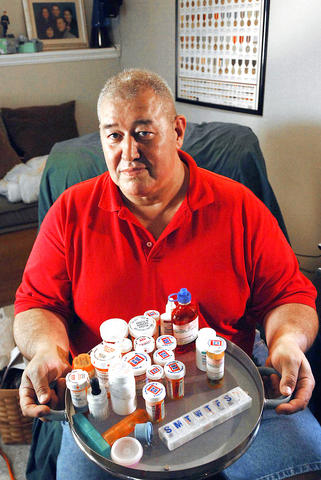
PHOTO: AP
Oxycodone, the chemical used in OxyContin, is responsible for most of the increase. Oxycodone use jumped nearly six-fold between 1997 and 2005. The drug gained notoriety as "hillbilly heroin,'' often bought and sold illegally in Appalachia.
An AP investigation found these reasons for the increase:
* The population is getting older. As age increases, so does the need for pain medications. In 2000, there were 35 million people older than 65. By 2020, the Census Bureau estimates the number of elderly in the US will reach 54 million.
* Drug makers have embarked on unprecedented marketing campaigns.
* Spending on drug marketing has gone from US$11 billion in 1997 to nearly US$30 billion in 2005, congressional investigators found. Profit margins among the leading companies routinely have been three and four times higher than in other Fortune 500 industries.
* A major change in pain management philosophy is now in its third decade. Doctors who once advised patients that pain is part of the healing process began reversing course in the early 1980s; most now see pain management as an important ingredient in overcoming illness.
Retired Staff Sergeant James Fernandez, 54, of Fredericksburg, Virginia, survived two helicopter crashes and Gulf War Syndrome over 20 years in the Marine Corps. He remains disabled from his service-related injuries and takes the equivalent of nine painkillers containing oxycodone every day.
"It's made a difference,'' he said. "I still have bad days, but it's under control.''
Such stories should hearten longtime advocates of wider painkiller use, such as Russell Portenoy, head of New York's Beth Israel pain management department. But they have not.
"I'm concerned and many people are concerned,'' he said, "that the pendulum is swinging too far back.''
Consider: More people are abusing prescription painkillers because the medications are more available. The vast majority of people with prescriptions use the drugs safely. But the number of emergency room visits from painkiller abuse has increased more than 160 percent since 1995, according to the government.
Perhaps no place illustrates the trends and consequences for the world of pain better than Myrtle Beach, South Carolina, a sprawling community of strip malls, hotels and bars perched along a 100km strip of sand on the Atlantic Ocean. The metro area, which includes three counties, is home to 350,000 people but sees more than 14 million tourists annually, drawn to its warm water, golf courses and shopping.
During the eight-year period reflected in government figures, oxycodone distribution increased 800 percent in the area of Myrtle Beach, partly due to a campaign by Purdue Pharmaceuticals. The privately held company has pleaded guilty to lying to patients, physicians and federal regulators about the addictive nature of their drug.
Use of other drugs soared in the area, too: Hydrocodone use increased 217 percent; morphine distribution went up 180 percent; even meperidine, most commonly sold as Demerol, jumped 20 percent.
It is no small wonder that federal authorities suspected the area was home to a notorious "pill mill,'' or a clinic that dispenses prescription medication without verifying that it is needed.
The US attorney for South Carolina secured a 58-count indictment in June 2002 against seven physicians and one employee of the Comprehensive Care and Pain Management Center, a nondescript storefront on Myrtle Beach's main drag.
Tipped off by local pharmacists concerned about an increase in the volume of painkiller prescriptions, the federal investigation created a furor in the medical profession. The owner, Michael Woodward, was sentenced to 15 years in the case and has relinquished his license.
A second physician, Deborah Bordeaux, had worked at the clinic less than two months before quitting in disgust. Bordeaux, now serving a two-year prison term, was threatened with a 100-year sentence if she did not help the prosecution.
Officials with the Justice Department and the DEA would not discuss what some activists say is a "war on doctors.''
The DEA cites 108 prosecutions of physicians during the past four years; 83 pleaded guilty or no contest, while 16 others were convicted by juries. Eight cases are pending, and one physician is being sought as a fugitive.
In congressional testimony, the agency's deputy assistant administrator, Joseph Rannazzisi, estimated that fewer than 1 percent of the nation's physicians - under 9,000 - illegally provide prescription drugs to patients. He told lawmakers it is far more common for people to illegally obtain prescription drugs from friends and family members.
"It is not merely illegal but could feed or lead to an addiction and place that loved one in a life-threatening situation,'' Rannazzisi said.
It is impossible to reliably measure painkiller abuse.
A 2004 government study estimated between 2 million and 3 million doses of codeine, hydrocodone and oxycodone are stolen annually from pharmacies, distributors and drug manufacturers.

In late October of 1873 the government of Japan decided against sending a military expedition to Korea to force that nation to open trade relations. Across the government supporters of the expedition resigned immediately. The spectacle of revolt by disaffected samurai began to loom over Japanese politics. In January of 1874 disaffected samurai attacked a senior minister in Tokyo. A month later, a group of pro-Korea expedition and anti-foreign elements from Saga prefecture in Kyushu revolted, driven in part by high food prices stemming from poor harvests. Their leader, according to Edward Drea’s classic Japan’s Imperial Army, was a samurai

The following three paragraphs are just some of what the local Chinese-language press is reporting on breathlessly and following every twist and turn with the eagerness of a soap opera fan. For many English-language readers, it probably comes across as incomprehensibly opaque, so bear with me briefly dear reader: To the surprise of many, former pop singer and Democratic Progressive Party (DPP) ex-lawmaker Yu Tien (余天) of the Taiwan Normal Country Promotion Association (TNCPA) at the last minute dropped out of the running for committee chair of the DPP’s New Taipei City chapter, paving the way for DPP legislator Su

It’s hard to know where to begin with Mark Tovell’s Taiwan: Roads Above the Clouds. Having published a travelogue myself, as well as having contributed to several guidebooks, at first glance Tovell’s book appears to inhabit a middle ground — the kind of hard-to-sell nowheresville publishers detest. Leaf through the pages and you’ll find them suffuse with the purple prose best associated with travel literature: “When the sun is low on a warm, clear morning, and with the heat already rising, we stand at the riverside bike path leading south from Sanxia’s old cobble streets.” Hardly the stuff of your

Located down a sideroad in old Wanhua District (萬華區), Waley Art (水谷藝術) has an established reputation for curating some of the more provocative indie art exhibitions in Taipei. And this month is no exception. Beyond the innocuous facade of a shophouse, the full three stories of the gallery space (including the basement) have been taken over by photographs, installation videos and abstract images courtesy of two creatives who hail from the opposite ends of the earth, Taiwan’s Hsu Yi-ting (許懿婷) and Germany’s Benjamin Janzen. “In 2019, I had an art residency in Europe,” Hsu says. “I met Benjamin in the lobby


 RSS
RSS