


When Yang Jie left home at 18, he was doing what people from China's hardscrabble Fujian Province have done for generations: emigrating in search of a better living overseas.
What set him apart was his destination. Instead of the traditional adopted homelands like the US and Europe, where Fujianese have settled by the hundreds of thousands, he chose southern Africa, making his way to this small landlocked country.
"Before I left China," said Yang, now 25, "I thought Africa was all one big desert," a place forever bathed in terrible heat. So he figured ice cream would naturally be in high demand, and with money pooled from relatives and friends, he created his own factory at the edge of Lilongwe, Malawi's capital. Malawi's climate, in fact, is subtropical, but that has not stopped his ice cream company from becoming the country's biggest.

PHOTO: NY TIMES NEWS SERVICE
Stories like this have become legion across Africa over the past five years or so, as hundreds of thousands of Chinese have discovered the continent, setting off to do business in a part of the world that had been terra incognita for their countrymen. The Xinhua News Agency recently estimated that at least 750,000 Chinese were working or living for extended periods on the continent, a reflection of burgeoning economic ties between China and Africa that reached US$55 billion in trade last year, compared with less than US$10 million a generation earlier.
Even when Yang arrived here in 2001, he said, he could go weeks without encountering another traveler from his homeland. But as surely as his investments in the country have prospered, he said, an increasingly large community of Chinese migrants has taken root, and now runs everything from small factories to health care clinics and trading companies.
During the previous wave of Chinese interest in Africa, in the 1960s and 1970s, an era of radical socialism and proclaimed Third World solidarity, European and American companies held sway over economies across most of the continent. Here and there, though, the Chinese made their presence felt, often as a curious sight: drably dressed, state-run work brigades that built stadiums, railroads and highways, often crushing rocks and performing other heavy labor by hand.
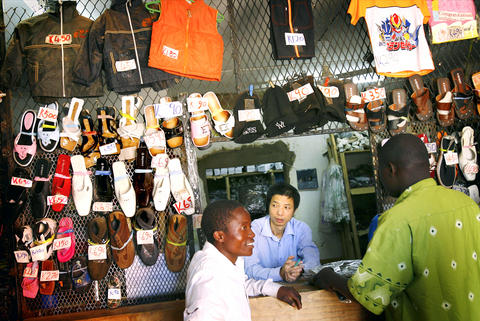
PHOTO: NY TIMES NEWS SERVICE
Today, in many of the countries the new Chinese emigrants have settled in, like Chad, Chinese-owned pharmacies, massage parlors and restaurants serving a variety of regional Chinese cuisines can be found. The Western presence, once dominant, has steadily dwindled, and essentially consists nowadays of relief experts working for international agencies or oil workers, living behind high walls in heavily guarded enclaves.
At first, this new Chinese influx was driven largely by word of mouth, as pioneers like Yang relayed news back home of abundant opportunities in a part of the world where many economies lie undeveloped or in ruins.
Conditions like these often deter Western investors, but for many budding Chinese entrepreneurs, Africa's emerging economies are inviting precisely because they seem small and accessible. Competition is often weak or nonexistent, and for African customers, the low prices of many Chinese goods and services make them more affordable than their Western counterparts.

PHOTO: NY TIMES NEWS SERVICE
You Xianwen sold his pipe laying business in Chengdu this year to move to Ethiopia's capital, Addis Ababa, to join a startup company with a Chinese partner he had previously only met online. "Back where I come from, we are pretty independent people," You, 55, said. "My brothers and sisters all supported my decision to come here. In fact, they say that if things really work out for me, they would like to move to Africa, too."
You said he had considered other African countries, including Zambia, before settling on Ethiopia. "Luckily, I didn't decide to go there," he said, explaining that he had been frightened by the recent anti-Chinese protests in that country.
His new business, ABC Bioenergy, builds devices that generate combustible gas from ordinary refuse, providing what You said would be an affordable alternative source of energy in a country where electricity supplies are erratic and prices high.
You's partner here, Mei Haijun, first came to Ethiopia a decade ago to work at a Chinese-built textile factory, and has since married an Ethiopian woman, with whom he has a child. "When I first came here, you could go two months without seeing another Chinese person," he said. "But it is a different era now. There's a flight to China every day."
There has been an increase in air traffic between China and countries like Ethiopia, with Chinese companies now scrambling to add new routes, as the Chinese government and big Chinese companies increase their stake in Africa.
Much of that activity reflects an intense appetite for African oil and mineral resources needed to fuel China's manufacturing sector, but big Chinese companies have quickly become formidable competitors in other sectors as well, particularly for major public works contracts. China is building major new railroad lines in Nigeria and Angola, large dams in Sudan, airports in several countries and new roads, it seems, almost everywhere.
One of the largest road builders, China Road & Bridge Construction, has picked up where the solidarity brigades of an earlier generation left off. The company, which is owned by the Chinese government, has 29 projects in Africa, many of them financed by the World Bank or other lenders, and it maintains offices in 22 African countries.
On a recent Ethiopian Airlines flight from Addis Ababa to Beijing brimming with Chinese contractors, workers from Road and Bridge and other companies swapped notes on the grab bag of countries they work in, and debated about the difficulties of learning Portuguese and French in places like Mozambique and Ivory Coast.
Africans view the influx of Chinese with a mix of anticipation and dread. Business leaders in Chad, a central African nation with deepening oil ties to China, are bracing for what they suspect will be an army of Chinese workers and investors.
"We expect a large influx of at least 40,000 Chinese in the coming years," said Renaud Dinguemnaial, director of Chad's chamber of commerce. "This massive arrival could be a plus for the economy, but we are also worried. When they arrive, will they bring their own workers, stay in their own houses, send all their money home?"
In Zambia, where anti-Chinese sentiment has been building for several years, merchants at the central market in Lusaka, the capital, said that if Chinese wanted to come to Africa, they should come as investors, building factories, not as petty traders who compete for already-scarce customers for inexpensive items like flip-flops and T-shirts.
"The Chinese claim to come here as investors, but they are trading just like us," said Dorothy Mainga, who sells knockoff Puma sneakers and Harley Davidson T-shirts in the Kamwala Market in Lusaka. "They are selling the same things we are selling at cheap prices. We pay duty and tax, but they use their connections to avoid paying tax."
Although Chinese oil workers have been kidnapped in Nigeria and in Ethiopia, where nine were killed by an armed separatist movement in May, the growing Chinese presence around the continent has produced few serious incidents.
Misunderstandings are common, however, and resentments inevitably arise. Africans in many countries complain that Chinese workers occupy jobs that locals are either qualified for or could be easily trained to do. "We are happy to have the Chinese here," said Dennis Phiri, a 21-year-old Malawian university student who is studying to become an engineer. "The problem with the Chinese companies is that they reserve all the good jobs for their own people. Africans are only hired in menial roles."
Another frequently heard criticism is that the Chinese are clannish, sticking among themselves day and night.
In Addis Ababa, in what is a typical arrangement for most large companies, the 200 Chinese workers for the Road & Bridge Corp all live in a communal compound, eating food prepared by cooks brought from China and even receiving basic health care from a Chinese doctor.
"After a day off, you wonder what you're doing here, so we like to keep working," said Cheng Qian, the country manager for the road building company in Ethiopia. He added that his family had never visited him during several years of work here. "They have no interest in Africa," he said. "If it were Europe, things would be different."
Sometimes, the Chinese approach has created serious frictions with African workers. At a leading hotel here in Lilongwe, breakfast guests stared as an agitated Chinese traveling salesman, sweating profusely, screamed at his staff minutes before his promotional pitch on nutritional supplements was set to begin.
"You say it is not your fault, but the way you are doing things is just stupid, stupid," the man sputtered before a clutch of humiliated-looking African assistants. "You people are unbelievable."
The scene was redolent of the waves of heavy-handed European colonialists, pushy American executives and members of the Indian and Lebanese diasporas who have settled in Africa to seek their fortunes, often to suffer worker revolts or failed businesses. When the salesman had finally left the room, members of the restaurant staff gathered near the door and vented their disgust. "We don't need people like that to come here and colonize us again," said one of them.
After nearly seven years in Malawi, Yang Jie, the ice cream maker, seems to have learned better. Greeting his workers at the ice cream factory, he begins the day by asking, "How did you sleep last night?"
One of them quickly replied, "Very well," sounding a bit formal.
"Don't tell me a lie," Yang answered with a sly, friendly smile. "It's OK to tell me your worries.""

In late October of 1873 the government of Japan decided against sending a military expedition to Korea to force that nation to open trade relations. Across the government supporters of the expedition resigned immediately. The spectacle of revolt by disaffected samurai began to loom over Japanese politics. In January of 1874 disaffected samurai attacked a senior minister in Tokyo. A month later, a group of pro-Korea expedition and anti-foreign elements from Saga prefecture in Kyushu revolted, driven in part by high food prices stemming from poor harvests. Their leader, according to Edward Drea’s classic Japan’s Imperial Army, was a samurai

The following three paragraphs are just some of what the local Chinese-language press is reporting on breathlessly and following every twist and turn with the eagerness of a soap opera fan. For many English-language readers, it probably comes across as incomprehensibly opaque, so bear with me briefly dear reader: To the surprise of many, former pop singer and Democratic Progressive Party (DPP) ex-lawmaker Yu Tien (余天) of the Taiwan Normal Country Promotion Association (TNCPA) at the last minute dropped out of the running for committee chair of the DPP’s New Taipei City chapter, paving the way for DPP legislator Su
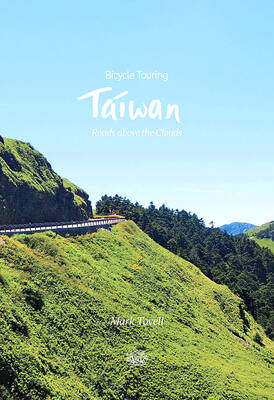
It’s hard to know where to begin with Mark Tovell’s Taiwan: Roads Above the Clouds. Having published a travelogue myself, as well as having contributed to several guidebooks, at first glance Tovell’s book appears to inhabit a middle ground — the kind of hard-to-sell nowheresville publishers detest. Leaf through the pages and you’ll find them suffuse with the purple prose best associated with travel literature: “When the sun is low on a warm, clear morning, and with the heat already rising, we stand at the riverside bike path leading south from Sanxia’s old cobble streets.” Hardly the stuff of your

Located down a sideroad in old Wanhua District (萬華區), Waley Art (水谷藝術) has an established reputation for curating some of the more provocative indie art exhibitions in Taipei. And this month is no exception. Beyond the innocuous facade of a shophouse, the full three stories of the gallery space (including the basement) have been taken over by photographs, installation videos and abstract images courtesy of two creatives who hail from the opposite ends of the earth, Taiwan’s Hsu Yi-ting (許懿婷) and Germany’s Benjamin Janzen. “In 2019, I had an art residency in Europe,” Hsu says. “I met Benjamin in the lobby


 RSS
RSS