


Christiane Amanpour, CNN's chief international correspondent - and a woman said to be the world's highest-paid reporter - greets me at the network's London office with a businesslike handshake and apologies for having to eat lunch through the interview. We are here to talk about Amanpour's new documentary series God's Warriors. In the programs, which took seven months to make, she reports on the growing overlap between religious fervor and politics and profiles those within Christianity, Islam, and Judaism who view themselves as part of the battle for cultural supremacy and political power.
In the flesh, Amanpour, 49, seems a world away from her image as a hardened war correspondent. The tall, imposing figure who has become a fixture on our TV screens, is relaxed and friendly. In many ways this documentary is a departure for her - a move from fast-paced reporting of the world's danger zones to a more reflective program.
"I feel that everyone wants a peek inside religion and extreme religion at the moment," she says, "because we just don't understand it. Every time I open a newspaper or turn on the TV there is something about religion and people are looking for information. Through the documentary we wanted to actually show how very fervently religious people believe that it is their duty to change the culture and politics to reflect God's will. Each and every one of them really believes that they have the direct line to God. How can you argue with these people?"
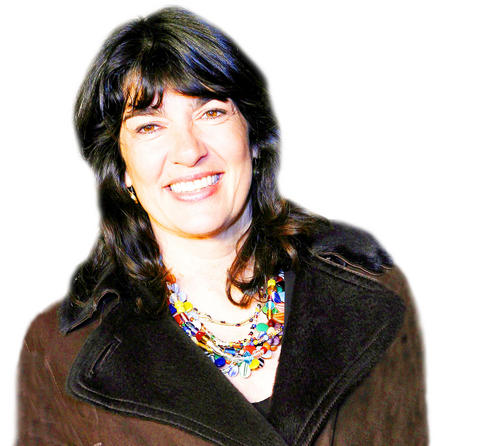
PHOTO: EPA
Amanpour was born in the UK (her mother is British) but spent her first 11 years living in Tehran before returning to the UK to complete her education at a convent school. She then moved to the US to start university. On summer holiday from her liberal arts degree at the University of Rhode Island, she was desperate to secure work in journalism and a program editor at BBC Radio 4's The World Tonight took a chance on her - she was soon on her way to a reporting career. Post-university she took up a job at the local Rhode Island TV station before hearing that English accents were de rigueur at the then-fledgling CNN. Stints reporting the fall of the Berlin Wall, the first Gulf war and the Balkans conflict quickly followed.
Having covered so many world-changing events, I wonder whether Amanpour has her own vision of a road map for peace today?
"If I was queen of the world? I would do everything I could to bring rapprochement between the Palestinians and the Israelis in the case of Islamic and Jewish extremism.

PHOTO: EPA
I would also try to encourage democracy in a way that doesn't necessarily come by being imposed by the gun, but is helped by a democratic world that understands each nation and culture is different and that democracy won't look the same everywhere. In the case of extremism you need brave politics and brave politicians who need to understand the greater good and not to play to the people who scream the loudest."
Does Amanpour ever reach a point at which she doesn't want to dig any deeper, when the truth feels too frightening?
"No, I find information empowering and lack of information makes me feel afraid. Does knowing what I know make me feel secure? No. But it does mean I have the tools to be forewarned, if not forearmed. I also think that one of our big problems, as a society, is ignorance. For example, the US military is caught in Iraq without enough translators - end of story. They don't have enough people in the entire military who speak Arabic and it is a vital tool."
Amanpour knows she isn't the only one who believes that knowledge is power.
"I think, contrary to what a lot of news executives think, people have a thirst for serious news and information and it's not just about Paris Hilton or Anna Nicole Smith. That's fine and has its place but not in place of what we do. Lots of the executives think that the audience is stupid and I don't subscribe to that. They think, "Just give them any crap and that will be fine. In fact, the more crap the better,' - and I feel exactly the opposite."
Amanpour is the first to admit that the job has become even tougher as her personal responsibilities have increased. Nine years ago she married former US state department spokesman James Rubin and in 2000 their son, Darius, was born.
"I became a foreign correspondent at a time when I was single so I didn't have that extra something to sacrifice. It becomes much more of a sacrifice when you get married and have a child because you just don't want to leave home - it's as basic and as human as that."
Despite the push-pull of work and family commitments, when I ask Amanpour if she thinks there is a difference between male and female war reporters, she says with a glint in her eye: "It's the same, but different." She recalls an incident during the first Gulf war when she was based in Saudi Arabia; a Saudi prince drove her to the Kuwait border to spot Iraqi tanks, landing her an exclusive story.
"Men are generally gracious towards women and that's their default reaction. They don't think a woman needs to be treated as aggressively as a man in the initial encounter. They're mistaken, but that's what they believe."
And how does she feel about the increasing dangers journalists are facing trying to get the story out of the world's most hostile areas? "Without a doubt the climate has changed for journalists. The leading cause of death among journalists on assignments in the past few years is murder. It does make me worried and I have to be much more careful when I travel now than in the past."
Amanpour cites the war in Bosnia as the most significant of her career. Faced with genocide and western leaders who were reluctant to intervene, news reporters kept telling the story until the world took notice.
"I know that the power of well-told news is phenomenal because all of us showed that in Bosnia. We didn't have an agenda; we just put the pictures on air of the terrible things that were being done to human beings. [Former British prime minister] Blair, [former US president Bill] Clinton and the others intervened much quicker in Kosovo than they would have done because they didn't want to have to face more pictures of Muslims being slaughtered. Some people accused me of being pro-Muslim in Bosnia but I realized that our job is to give all sides an equal hearing, but in cases of genocide you can't just be neutral. You can't just say, 'Well this little boy was shot in the head and killed in besieged Sarajevo and that guy over there did it but maybe he was upset because he had an argument with his wife.' No, there is no equality there and we had to tell the truth."

In late October of 1873 the government of Japan decided against sending a military expedition to Korea to force that nation to open trade relations. Across the government supporters of the expedition resigned immediately. The spectacle of revolt by disaffected samurai began to loom over Japanese politics. In January of 1874 disaffected samurai attacked a senior minister in Tokyo. A month later, a group of pro-Korea expedition and anti-foreign elements from Saga prefecture in Kyushu revolted, driven in part by high food prices stemming from poor harvests. Their leader, according to Edward Drea’s classic Japan’s Imperial Army, was a samurai

The following three paragraphs are just some of what the local Chinese-language press is reporting on breathlessly and following every twist and turn with the eagerness of a soap opera fan. For many English-language readers, it probably comes across as incomprehensibly opaque, so bear with me briefly dear reader: To the surprise of many, former pop singer and Democratic Progressive Party (DPP) ex-lawmaker Yu Tien (余天) of the Taiwan Normal Country Promotion Association (TNCPA) at the last minute dropped out of the running for committee chair of the DPP’s New Taipei City chapter, paving the way for DPP legislator Su
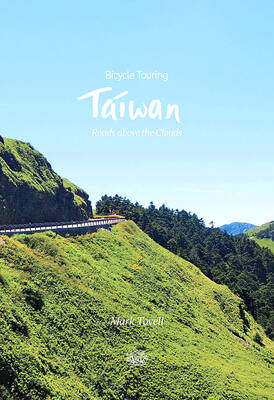
It’s hard to know where to begin with Mark Tovell’s Taiwan: Roads Above the Clouds. Having published a travelogue myself, as well as having contributed to several guidebooks, at first glance Tovell’s book appears to inhabit a middle ground — the kind of hard-to-sell nowheresville publishers detest. Leaf through the pages and you’ll find them suffuse with the purple prose best associated with travel literature: “When the sun is low on a warm, clear morning, and with the heat already rising, we stand at the riverside bike path leading south from Sanxia’s old cobble streets.” Hardly the stuff of your
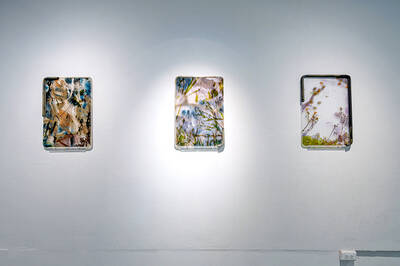
Located down a sideroad in old Wanhua District (萬華區), Waley Art (水谷藝術) has an established reputation for curating some of the more provocative indie art exhibitions in Taipei. And this month is no exception. Beyond the innocuous facade of a shophouse, the full three stories of the gallery space (including the basement) have been taken over by photographs, installation videos and abstract images courtesy of two creatives who hail from the opposite ends of the earth, Taiwan’s Hsu Yi-ting (許懿婷) and Germany’s Benjamin Janzen. “In 2019, I had an art residency in Europe,” Hsu says. “I met Benjamin in the lobby


 RSS
RSS