


Up until the 20th century, the production of art was, by and large, a dialogue between the artist and the work they were creating. With its emphasis on new media such as video games, virtual worlds and the Internet - collectively called new media - contemporary art broadens the field within which artists create. Long gone are the days, new media artists suggest, when a painter works alone in a room with a brush and canvas or a sculptor with stone. Today contemporary artists collaborate with experts in various fields, from computer scientists to biotechnologists - thus turning creators into "project managers" - to create works that take into account the museumgoers' entire sensory experience.
One of the first artist collectives to promote this sensibility was V2_Institute for Unstable Media, an interdisciplinary center for research and development in the field of art and media technology. Founded in 1981 by a group of multimedia artists, the institute explores the relationship and interaction between art, technology, media and society. It seems natural, then, that the theoretical underpinnings of the installations in MOCA, Taipei's current exhibition, curated by V2's artistic director Alex Adriaansens, are steeped in contemporary thought about technology and its effect on society.
Like the exhibit's title suggests, interaction is a key theme that runs throughout the exhibition. Zachery Liberman's Drawn epitomizes this ethos by using software to transform pictures drawn on paper by participants - who thereby become artists - onto a screen. The participants then manipulate the images on the screen where the created image moves and changes shape. Viewers are placed in a position where they decide if they want to become creators, directors or supervisors of their work or the works of others.

PHOTOS: COURTESY OF MOCA
Similar to Liberman's installation, Pockets Full of Memories by George Legrady has the public contribute an image of an object in their possession to an archive that grows throughout the duration of the exhibition. An algorithm is then used to sort the objects into a two-dimensional matrix that is projected onto the museum wall according to the similarities defined by the contributor's semantic descriptions. The data is also accessible on the Internet (www.pocketfullofmemories.net).
Like the manipulation of images, Marnix de Jijs' Beijing Accelerator plays a game with the physical and visual perception of speed and acceleration. This he does by sitting a participant in a racing chair that is mounted on a motorized structure equipped with a joystick. A screen is positioned a meter or so in front of the user and while they control both the direction and speed of the chair images of Beijing are projected onto the screen. If the user cannot synchronize the speed of the chair with the moving images, her balance system will send different information to the brain than the eyes resulting in a feeling of discomfort.
Discomfort is precisely what one feels when playing //////////fur//// art entertainment interfaces' PainStation - Enhanced Dueling Artefact. Based on the video table tennis game Pong, players rest their left hand on a sensor field - known as Pain Execution Unit - and are tormented by extreme heat, electrical shocks and lashes of a whip if they miss the ball. The first player who fails to withstand the pain - one young female participant shrieked loudly when whipped - loses the game. In the words of its creators, "Pong has lost its innocence, just like the players of PainStation."

Not all is fun and games. There is also a serious side to the japes and pranks by the artists, who seem more willing to inflict pain than to edify the museumgoer. Shane Cooper's Feed is a sculpture made of plants and television screens. Composed of two parts, the upper half is a wall of television screens, each tuned to a different channel, and the bottom is a "garden" of ferns that can survive under conditions of extreme lighting. Though the ferns are capable of surviving on this diet of radiation emitted by the cathode ray tubes, can the same be said for the millions of couch potatoes that the work metaphorically simulates?
Though some installations in the exhibit seem better suited to a museum of technology than a museum of contemporary art, the exhibition is well worth a visit because it offers insight into the collaborative nature of contemporary art and the interactive ethos between viewer and artist.
In late October of 1873 the government of Japan decided against sending a military expedition to Korea to force that nation to open trade relations. Across the government supporters of the expedition resigned immediately. The spectacle of revolt by disaffected samurai began to loom over Japanese politics. In January of 1874 disaffected samurai attacked a senior minister in Tokyo. A month later, a group of pro-Korea expedition and anti-foreign elements from Saga prefecture in Kyushu revolted, driven in part by high food prices stemming from poor harvests. Their leader, according to Edward Drea’s classic Japan’s Imperial Army, was a samurai

The following three paragraphs are just some of what the local Chinese-language press is reporting on breathlessly and following every twist and turn with the eagerness of a soap opera fan. For many English-language readers, it probably comes across as incomprehensibly opaque, so bear with me briefly dear reader: To the surprise of many, former pop singer and Democratic Progressive Party (DPP) ex-lawmaker Yu Tien (余天) of the Taiwan Normal Country Promotion Association (TNCPA) at the last minute dropped out of the running for committee chair of the DPP’s New Taipei City chapter, paving the way for DPP legislator Su
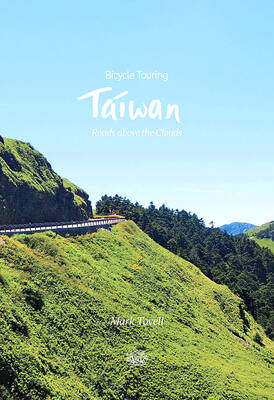
It’s hard to know where to begin with Mark Tovell’s Taiwan: Roads Above the Clouds. Having published a travelogue myself, as well as having contributed to several guidebooks, at first glance Tovell’s book appears to inhabit a middle ground — the kind of hard-to-sell nowheresville publishers detest. Leaf through the pages and you’ll find them suffuse with the purple prose best associated with travel literature: “When the sun is low on a warm, clear morning, and with the heat already rising, we stand at the riverside bike path leading south from Sanxia’s old cobble streets.” Hardly the stuff of your
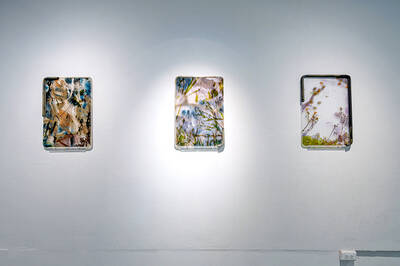
Located down a sideroad in old Wanhua District (萬華區), Waley Art (水谷藝術) has an established reputation for curating some of the more provocative indie art exhibitions in Taipei. And this month is no exception. Beyond the innocuous facade of a shophouse, the full three stories of the gallery space (including the basement) have been taken over by photographs, installation videos and abstract images courtesy of two creatives who hail from the opposite ends of the earth, Taiwan’s Hsu Yi-ting (許懿婷) and Germany’s Benjamin Janzen. “In 2019, I had an art residency in Europe,” Hsu says. “I met Benjamin in the lobby


 RSS
RSS