


Matthew Lien is at home. He's sitting in his comfy chair, framed by flat screens and computers. There's a rack of keyboards and on either side of his desk are two speakers, on top of which are statues of Guang Yu (關羽, representing righteousness) and Buddha. Perched just above eye level are Lien's Golden Bell and Golden Melody awards.
Taipei Times: You seem busy, what are you up to?
Mathew Lien: I've got three big projects on at the moment: A TV series, four live shows next month and an LP release. And they're all on deadline.
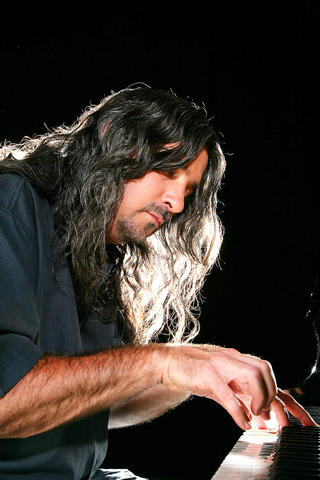
PHOTO: COURTESY OF MATHEW LIEN
TT: The concerts are celebrating the release of your first record in Taiwan 10 years ago. How come you made a home for yourself here?
ML: When I completed the album Bleeding Wolves (1995) my manager said it was a disaster and my career was over. But it was sent off to MIDEM (a music trade fair held annually in Cannes, France) and one of the labels that picked it up was in Taiwan, Wind Records. Much to their surprise and mine it took off like wildfire.
TT: Did you know much about Taiwan then?
ML: I had no idea about Taiwan at all. I had a toy when I was a kid that said, "Made in Taiwan," and because of that I never thought Taiwan was part of China. All I knew was that we were selling a lot of records and making money.
TT: Is Taiwan independent?
ML: Taiwan is. Actually, there's a flaw in your question. The point is not whether Taiwan should be independent but whether it should unite.
TT: The album was about the slaughter of wolves in Canada, right?
ML: Wolf kill in the Yukon territories changed my life. The government decided to kill wolves to benefit big game hunters from the US, that's when I thought this is a huge injustice and lobbied against it. I was hotly political and became a well-known personality at this time. When we lost and the wolf kill program went ahead it was like a sucker punch to the gut. I went from angry to hurt and suffering and put that into music. That's where Bleeding Wolves came from.
TT: Was there a happy ending?
ML: We toured Bleeding Wolves and because of the title I got a lot of press, which publicized the plight of the wolves and eventually led to a tourism boycott of the Yukon territories. This eventually made the government reverse its policy.
TT: When did you first visit Taiwan?
ML: That was for the 1998 Da-an Park Concert, to promote Confluence. We hoped 3,000 to 4,000 people would turn up but 15,000 came. Then my passport expired and I had to go to Hong Kong, but the vibe was so different, it was so emotionally cold. I guess I had already fallen in love with Taiwan and I wanted to return immediately, sit at a roadside stall and drink Taiwan Beer (which he endorses).
TT: I know you were deeply affected by the 921 Earthquake in 1999. Where were you at the time?
ML: I was in Yukon by the radio, listening to the death toll go up by the hour. And because I had done this road show going around Taiwan to record music for the album Voyage to Paradise, I was very affected and wanted to do something about it. We held a benefit concert and this brought out 30,000 people and raised more than US$600,000 for the recovery efforts.
TT: The next year you held a concert to establish Earth Day in Taiwan. It was celebrated everywhere but Taiwan this year, what happened?
ML: Yeah, the famous concert in the rain. Getting Taiwan to synchronize with the rest of the world on environmental issues is like pulling teeth. It's not easy to do. It's difficult for Taiwan to look at issues like global warming, so rather than push a mule where it doesn't want to go I try to work in the direction of a flow. It's not been the best use of my time.
TT: Your Web site refers to you as an eco-musician?
ML: I may be referred to as an eco-musician but that's not what I call myself. I'm not big on titles, containers and boxes. Eco-musician was great as a promotional tool when I first came here because no one was using it before.
TT: You've gained a reputation for recording nature and selling it as music.
ML: A lot of people ask the remarkably stupid question, "Why do you record nature?" The fundamental flaw there is, who's saying the sounds of nature aren't music? Where are people's heads on that one? Nature's sounds are definitely instrumentation because the sound of water or of wind is like an element and it helps me to paint an emotional picture.
TT: This was how you produced arguably your most significant musical achievement, the 2005 Golden Melody Award-winning record Journey of Water?
ML: It took about two years of composing and recording in a variety of wild locations. It's one of the reasons that I like working in Taiwan so much, because working with the cultural entities here it pushes my music in directions it would never go. What we did then with Journey of Water, because it was so linear and had such a good story, was to transform it into a kind of speech performance, which we have given well over a 100 times, in universities, high schools, at regional and local government cultural events.
TT: Do you consider the Golden Melody to be your biggest award?
ML: Hmmm. I'm stuck between that and being made an ambassador for Aboriginal culture, because both of them allowed me to represent others and promote other musicians and cultures: To act as a mirror to reflect light onto others.
TT: Wasn't the Golden Melody about you?
ML: No, you go back and look at my speech. I accepted it on behalf of over 100 musicians and I said thank you in four different languages.
TT: Don't you like being the star, center stage, the light shining on you?
ML: Actually, that's the really egotistical thing about music that really troubles me. There is an art aspect to a stage performance. I'm not opposed to a stage performance as such, that's my disclaimer, but I just don't want it to be about me. So I want to go back to what music is really all about, to where it originates. The stage isn't it. The stage is an alien element. I want to put the star back in his or her original environment.
TT: This is what you've done with your recently launched television series Ha-Fun Taiwan on Hakka TV?
ML: Having traveled around Taiwan a lot I noted that a lot of the faces making music aren't necessarily the same ones seeking the musical limelight. I find these musicians, record them on location, in their environment, come back here (to my home studio) and record new music around it. The neat thing is that at the end we have a music video and original music.
(Matthew Carl Lien was born 42 years ago in San Diego, US. He's been married once and has three kids. His great grandmother was Iroquois; his mother is German and father Norwegian. The former Aerospace engineer got tired of his cubicle and gave up his job, relocating to the Yukon territories. Lien stayed with his mom in San Diego to attend school and spent summer holidays with dad in Canada. He's quite proud of the fact that he didn't graduate from high school and largely taught himself to play the piano).
ML: I was like a bird, flying south in the winter and north in the summer. I guess that's why I can never stay in one place. I've continued this migratory pattern to this day. I spend six months here and six months back home.
TT: It's exciting but a rootless life has its downside too?
ML: It's not all good. There is a tremendous amount of difficulty and loneliness. It can be bizarre. When you do a big event for hundreds or thousands of people you engage them and look them in the eye and make a connection and then you go back to the hotel room. Every one of those people says they love you and support you, but no one really gives a fuck what you feel like at the end of the day. You realize that you're just a commodity, a product. The fact that you're moving around so much means you don't have that one special person to turn to.
TT: Were you always going to be a musician?
ML: I remember people asking me, "What are you gonna do when you leave school?" and I said, "I'm gonna be a famous musician." That was, like, so naive, but by the same token, I believe in creative visualization and if we see something and believe that it's good and is in harmony with who we are, then we can make it come true.
TT: Most musicians have a story about paying their dues. Do you?
ML: White Horse is a small town in Canada with about 20,000 people, I gigged there seasonally for about five years, that's where I trained my voice and paid my dues. I was drunk five nights a week. It got to the point where I couldn't get up on stage without having a drink. I had to have two beers before I could even look at the piano. Then people would buy me drinks all night, until I was drunk as a skunk and happy as a clam and everyone was having a great time. But the next morning I felt like shit. Then, it would start all over again. I was making good money and that's how I managed to fund the first album Music to See By (1987).
TT: Your latest release is a four-CD piano set called Moving Through Twilight.
ML: What I did when I first learned to play the piano was not learn songs but just play. As I get older, just sitting down and letting my emotions pour into the piano has become more important. All my life I've been knocking around universities, churches and concert venues looking for grand pianos. It's got to be a grand piano because they are different. There's a reason they're so expensive. They have all the harmonic resonance. If you throw a pebble in a small puddle it will just go brrrrp, but if you throw it into a large pool or pond than it resonates for eternity. One note is the ultimate for me. In that one note is infinity. At that moment anything is possible. When the music is freeform and the music is leading you, that's the point. Sometimes tears will stream down my face when I'm not even thinking about playing, just feeling. That's been the challenge of titling this album (which was going to be called Untitled), it's more than just music, it's the core of emotion.
TT: Love is all you need. True or false?
ML: That's naive, because if you went to Darfur and told them, "All you need is love," you would feel a bit of a fool. So, I would say we need love. Respect leads to love.
TT: Are you a placid or emotional person?
ML: I'm making an effort to moderate my dynamics because of the effect it has on others. Other people are under the same pressure and me being in a temper doesn't help. I've only recently learned that.
TT: What describes you best? Cuddly, frightening like a bear, or hippy chic?
ML: All those and more. It depends on when you find me.
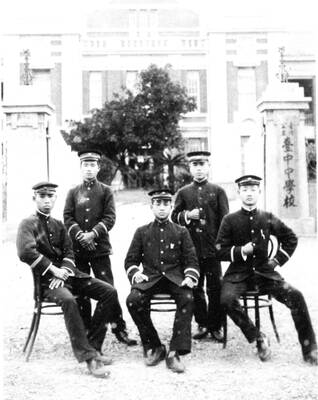
April 28 to May 4 During the Japanese colonial era, a city’s “first” high school typically served Japanese students, while Taiwanese attended the “second” high school. Only in Taichung was this reversed. That’s because when Taichung First High School opened its doors on May 1, 1915 to serve Taiwanese students who were previously barred from secondary education, it was the only high school in town. Former principal Hideo Azukisawa threatened to quit when the government in 1922 attempted to transfer the “first” designation to a new local high school for Japanese students, leading to this unusual situation. Prior to the Taichung First
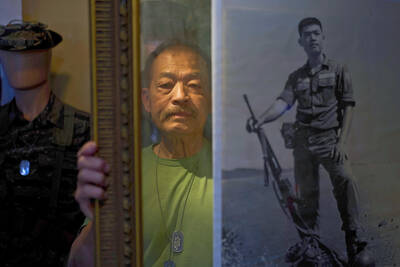
When the South Vietnamese capital of Saigon fell to the North Vietnamese forces 50 years ago this week, it prompted a mass exodus of some 2 million people — hundreds of thousands fleeing perilously on small boats across open water to escape the communist regime. Many ultimately settled in Southern California’s Orange County in an area now known as “Little Saigon,” not far from Marine Corps Base Camp Pendleton, where the first refugees were airlifted upon reaching the US. The diaspora now also has significant populations in Virginia, Texas and Washington state, as well as in countries including France and Australia.

On April 17, Chinese Nationalist Party (KMT) Chairman Eric Chu (朱立倫) launched a bold campaign to revive and revitalize the KMT base by calling for an impromptu rally at the Taipei prosecutor’s offices to protest recent arrests of KMT recall campaigners over allegations of forgery and fraud involving signatures of dead voters. The protest had no time to apply for permits and was illegal, but that played into the sense of opposition grievance at alleged weaponization of the judiciary by the Democratic Progressive Party (DPP) to “annihilate” the opposition parties. Blamed for faltering recall campaigns and faced with a KMT chair

Article 2 of the Additional Articles of the Constitution of the Republic of China (中華民國憲法增修條文) stipulates that upon a vote of no confidence in the premier, the president can dissolve the legislature within 10 days. If the legislature is dissolved, a new legislative election must be held within 60 days, and the legislators’ terms will then be reckoned from that election. Two weeks ago Taipei Mayor Chiang Wan-an (蔣萬安) of the Chinese Nationalist Party (KMT) proposed that the legislature hold a vote of no confidence in the premier and dare the president to dissolve the legislature. The legislature is currently controlled


 RSS
RSS