


A network of low cost airlines in Southeast Asia has expanded to the extent where spending today in Bangkok, tomorrow in Singapore and the day after that in Hong Kong is a realistic option for travelers.
Budget airlines may have simple standards when it comes to comfort and service, but they make up for that in their pricing policy.
Europe has been experiencing a boom in budget airline travel since the late 1990s. But in Southeast Asia, the phenomenon is relatively new.
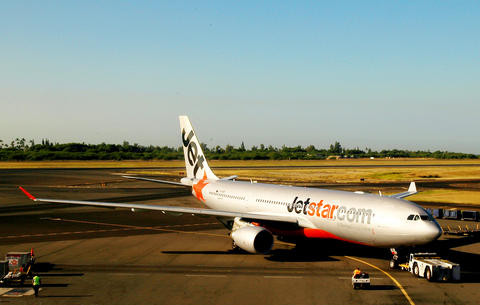
PHOTO: AP
It is now possible to travel for as little as US$67 from Jakarta to Bali or Bangkok to Manila without having to book far in advance.
The Internet is the best place to book a ticket. Airlines such as Air Asia, Tiger Airways and Jetstar have comprehensive networks servicing Thailand, Malaysia, Indonesia and Cambodia.
In addition to those airlines come other operators who service single routes or just domestic airports.
"This is a great development for backpack tourists," says Wolfgang Georg Arlt, a member of the faculty of International Tourism Management at Westkueste Highschool in Heide in Germany.
One drawback, however, is that travelers must know their way around Southeast Asia as budget airline offers are not very well publicized.
One problem low cost airlines are facing is the region's infrastructure.
"Many airports in Southeast Asia are only suitable for turbo-prop aircraft," according to Lutz Schmidt from the tourist trade journal FVW International in Hamburg.
Most airline fleets consist of jet propelled planes that can land at just a few airports. On the other hand that also means the region has plenty of potential to develop.
But for the moment many operators are forced to fly the same routes thereby making competition fierce.
Schmidt says he expects the number of operators to consolidate and prices to rise eventually.
He advises potential air travelers to compare ticket prices closely. Not every offer includes costs such as tax, service charges, insurance and fuel surcharges.
The Malaysian carrier Air Asia, for example, does not include those costs in its initial prices. Nevertheless, compared to other carriers Air Asia is relatively good value.
A one-way ticket from Bangkok to Singapore costs about US$68. The same charge applies to flights from Kuala Lumpur to Macau.
A domestic flight such as Bangkok to the holiday island of Phuket costs about US$41 one-way.
Air Asia flies to destinations in Thailand, Singapore, Indonesia, the Philippines, Cambodia, Vietnam, Brunei and China.
A luggage allowance of 15kg per passenger is included in the price.
There's no seat reservation, passengers choose their places when they go on board. Drinks and snacks are available at an extra charge.
One advantage of Air Asia is that it flies to major airports such as Suvharnabumi in Bangkok and Changi in Singapore - the main entry points for backpack tourists visiting the region.
Air Asia is planning to extend its network to India and Tiger Airways is planning to do the same.
Tiger is 49 percent-owned by Singapore Airlines and also has a wide selection of flights available for less than US$67.
Apart from destinations in China, Vietnam, Thailand, Indonesia and the Philippines, Tiger also services airports in Australia.
A ticket to Darwin or Perth from Singapore costs less than US$134.
Prices like that make Tiger Airways a big competitor for the Quantas-owned budget carrier Jetstar.
Jetstar services a number of destinations in Australia and recently began flying to airports in Southeast Asia.
Jetstar flies to Cambodia, Vietnam, Thailand, Hong Kong, Indonesia, Malaysia, Singapore, Taiwan, the Philippines and Myanmar. The airline also services routes to Hawaii, Japan and New Zealand. In the past three years, Jetstar carried 17 million passengers.
"A million of them flew at a price less than A$50 (about US$41)," says Nasrin Shaikh, spokesman for Jetstar's parent company Quantas in Frankfurt.
Long-haul flights are more expensive. Jetstar offers flights from Bangkok to Honolulu via Sydney, but they cost US$545 one-way to Sydney and an additional US$517 to Hawaii.
The price may seem high but it's still less than a conventional airline, according to Shaikh.
Some budget airlines only fly to domestic airports. Nok-Air flies exclusively within Thailand and Lion Air is Indonesia's low cost carrier.
Pacific Airlines has concentrated its network on Vietnam. Cebu Pacific Air services the Philippines.
Domestic airlines like those are a good way to travel quickly to destinations in the provinces. Flights costs between US$27 and US$41 for a one-way ticket.
Arlt says most budget airlines in Southeast Asia have very high standards that outshine their European counterparts.
Recently the Chinese Nationalist Party (KMT) and its Mini-Me partner in the legislature, the Taiwan People’s Party (TPP), have been arguing that construction of chip fabs in the US by Taiwan Semiconductor Manufacturing Co (TSMC, 台積電) is little more than stripping Taiwan of its assets. For example, KMT Legislative Caucus First Deputy Secretary-General Lin Pei-hsiang (林沛祥) in January said that “This is not ‘reciprocal cooperation’ ... but a substantial hollowing out of our country.” Similarly, former TPP Chair Ko Wen-je (柯文哲) contended it constitutes “selling Taiwan out to the United States.” The two pro-China parties are proposing a bill that

March 9 to March 15 “This land produced no horses,” Qing Dynasty envoy Yu Yung-ho (郁永河) observed when he visited Taiwan in 1697. He didn’t mean that there were no horses at all; it was just difficult to transport them across the sea and raise them in the hot and humid climate. “Although 10,000 soldiers were stationed here, the camps had fewer than 1,000 horses,” Yu added. Starting from the Dutch in the 1600s, each foreign regime brought horses to Taiwan. But they remained rare animals, typically only owned by the government or

Institutions signalling a fresh beginning and new spirit often adopt new slogans, symbols and marketing materials, and the Chinese Nationalist Party (KMT) is no exception. Cheng Li-wun (鄭麗文), soon after taking office as KMT chair, released a new slogan that plays on the party’s acronym: “Kind Mindfulness Team.” The party recently released a graphic prominently featuring the red, white and blue of the flag with a Chinese slogan “establishing peace, blessings and fortune marching forth” (締造和平,幸福前行). One part of the graphic also features two hands in blue and white grasping olive branches in a stylized shape of Taiwan. Bonus points for
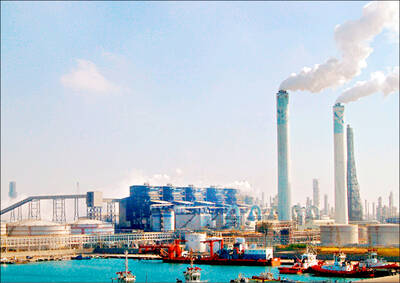
Last month, media outlets including the BBC World Service and Bloomberg reported that China’s greenhouse gas emissions are currently flat or falling, and that the economic giant appears to be on course to comfortably meet Beijing’s stated goal that total emissions will peak no later than 2030. China is by far and away the world’s biggest emitter of greenhouse gases, generating more carbon dioxide than the US and the EU combined. As the BBC pointed out in their Feb. 12 report, “what happens in China literally could change the world’s weather.” Any drop in total emissions is good news, of course. By


 RSS
RSS