


As the late afternoon sun bathes the horizon in purple and crimson, I wander slowly down the long, curving beach. Though rocks mar part of the 8km-long stretch, most of the waterfront is covered with white sand. On the southern end of the beachfront, a towering, slim golden Buddha statue peers out over the sea, and I can see small white and yellow shrines cut into the rocks of a nearby mountain fringed with low mist.
When I sit in the surf, I notice young Thai men riding black-and-white spotted horses up and down the beach, offering rides to tourists. A Thai family's dog paddle near me, luxuriating in the bath-warm water and searing sunlight. Not one Jet Ski, tour group or powerboat in sight.
There aren't many places left in Thailand where travelers can sit in the surf undisturbed. Over the past decade, it seems that clusters of hotels and condominiums have colonized nearly every strip of beach. So I was surprised, on a trip in March, to find that Hua Hin, the country's oldest beach resort, just a three-hour train ride from Bangkok, had not yet fallen to the wave of building and water sports.
PHOTO: NY TIMES NEWS SERVICE
Arriving in Hua Hin, in fact, I quickly notice the mellow atmosphere far different from the blaring beer bars and neon dance shows of other Thai beaches like Pattaya. At Hua Hin's colonial-style train station, all white-and-red columns and mahogany floors, a small group of taxi drivers sleeps in the shade of a jackfruit tree. When I try to rouse them for a ride into town, they nod "no" to my offer and then nod off again.
Friends explain to me there are several reasons for Hua Hin's slow pace of life. Because it sits so close to Bangkok, many foreign tourists skip it for other beach resorts like Phuket; Hua Hin now attracts mostly Thai families. Because Thailand's revered royal family spends much of its time in Hua Hin — in a palace of marble and teak named, aptly, Far From Worries — developers may be reluctant to overbuild, knowing that the king has made sustainable development a centerpiece of his reign.
The laid-back, small-scale life has also made Hua Hin Thailand's pioneer in boutique hotels and spas.
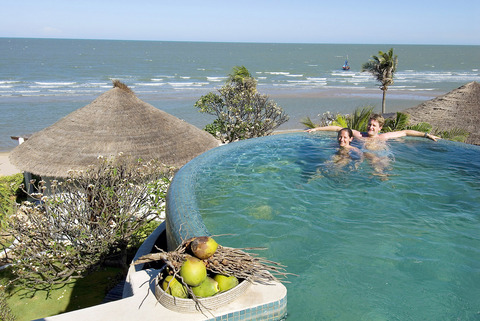
PHOTO: NY TIMES NEWS SERVICE
Thirty minutes south of Hua Hin town, I drive to Aleenta, an intimate boutique hotel in the beach village of Pranburi, made up of bungalow-style buildings with gleaming white walls and thatched roofs. Aleenta seems to attract Thai artists seeking a private but avant-garde resort — I overhear two Thai men with thin goatees and long ponytails discussing the latest films to hit Bangkok art theaters.
Aleenta's burnt sienna walls, curving outdoor staircases and crimson tiles give it the feel of a Mediterranean or Mexican beach resort. A resort at the end of nowhere: In the lap pool adjacent to a swim-up bar, I paddle around without seeing another guest. Aleenta also quickly coddles me with homey touches. My room, the size of a large New York studio and built from natural wood, thatch and smooth tile, looks out onto a lonely longtail fishing boat bobbing in the surf outside. The hotel staff has programmed an iPod in my room, and when I request coffee at bizarre, late-night hours, they laugh and bring Thai java. At the hotel's Frangipani Wing, where cooks teach Thai cuisine in an open kitchen, the chef takes time to demonstrate to me how she makes piquant Thai salads of fresh squid, basil and chopped chilies.
Aleenta has spawned a boutique hotel industry. Along the Pranburi beach road, other developers are building small bungalows and spas with Mediterranean and Moroccan themes, and Hua Hin town now features Let's Sea Hua Hin al Fresco Resort, a cheaper yet still charming 40-room boutique hotel on the water. Near the Aleenta lies the Evason Hideaway, another high-end boutique. Even the bigger hotels have gotten into the act. This spring, the Hyatt Regency Hua Hin will open its own boutique, the Barai — eight suites with their own gardens or plunge pools.
I wander up to Aleenta's spa, which advertises unique detox treatments featuring Thai herbs and tamarind juice, and massages with kaffir lime, lemongrass and jasmine flavors. On the roof of the hotel restaurant, it commands a stunning panoramic view of the sea, but I decide to head back into town, where massages will be cheaper.
In central Hua Hin, I stop for a break from the 40.5°C heat at the Sofitel Central, a renovated version of the town's classic colonial-era Railway Hotel, famed for its topiary gardens full of bushes shaped like elephants and its wide, curved balconies.
From the beginning of the 20th century until the development of other resorts like Phuket, Hua Hin was the place for wealthy Thais to escape Bangkok's heat. The Sofitel's coffee bar, which still serves high tea each afternoon, features aging photographs of that older era, a time when the king and queen were host to royal parties at the hotel, and people gathered around the radio to hear the latest jazz coming from America.
From the Sofitel, I can walk right onto the beach. Children play on the boulders jutting out of the water in low tide, and on one end of the beach, families clamber up small hills covered in thick forests with clusters of small monkeys.
I stroll into the quiet town, just a grid of small interlocking alleys. No one grabs my arm or tries to sell me anything, as often happens in Phuket. I stop in the central market, where vendors sell piles of stinky dried shrimp, fresh fish on ice and luscious mangoes topped with coconut custard, to be eaten with glutinous, sweet sticky rice.
I peek into Hua Hin Thai Massage, a small shop near a beach market selling towels and trinkets. The massage parlor truly feels like a family affair. Local women sit in circles massaging one another's feet and gossiping about their clients. When I interrupt them to ask for a foot rubdown, one reluctantly pulls herself away to bathe my feet in warm water and then prod and poke them for an hour, all for only US$10.
For many Thai tourists, the greatest attraction of Hua Hin is neither the kilometers of beach nor the multitude of spa treatments. With fishing boats pulling into Hua Hin pier every day, packed with bass, giant prawns, lobster and other delicacies, the town has built a reputation as one of the finest places to try Thai seafood dishes.
On recommendations from friends, I stop at Ketsirin restaurant on Naresdamri Road. The back of the dining room sits on a pier moored over the ocean, and crowds of Thais dig into whole steamed fish flavored with chili and lime juice. I order geng som, sour orange soup with vegetables and shellfish. It hits my tongue hard, the fiery spices tempered with a hint of sugar, and I order a platter of giant local shrimp to go with it, the prawns charcoal-grilled over a barbecue and topped with a tangy, delicious garlic-and-lemon sauce.
When dessert arrives — a plate piled with fresh papaya, guava and watermelon — I can barely finish half of it. I sit at Ketsirin for another hour, digesting my feast and watching fishing boats bobbing in the water, their lighted-up masts gleaming in the dark sky like light sabers.

In late October of 1873 the government of Japan decided against sending a military expedition to Korea to force that nation to open trade relations. Across the government supporters of the expedition resigned immediately. The spectacle of revolt by disaffected samurai began to loom over Japanese politics. In January of 1874 disaffected samurai attacked a senior minister in Tokyo. A month later, a group of pro-Korea expedition and anti-foreign elements from Saga prefecture in Kyushu revolted, driven in part by high food prices stemming from poor harvests. Their leader, according to Edward Drea’s classic Japan’s Imperial Army, was a samurai

The following three paragraphs are just some of what the local Chinese-language press is reporting on breathlessly and following every twist and turn with the eagerness of a soap opera fan. For many English-language readers, it probably comes across as incomprehensibly opaque, so bear with me briefly dear reader: To the surprise of many, former pop singer and Democratic Progressive Party (DPP) ex-lawmaker Yu Tien (余天) of the Taiwan Normal Country Promotion Association (TNCPA) at the last minute dropped out of the running for committee chair of the DPP’s New Taipei City chapter, paving the way for DPP legislator Su
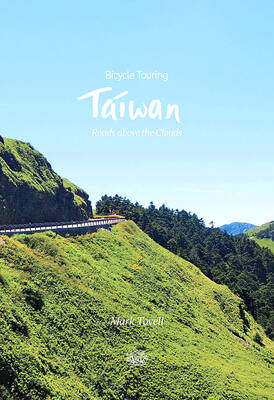
It’s hard to know where to begin with Mark Tovell’s Taiwan: Roads Above the Clouds. Having published a travelogue myself, as well as having contributed to several guidebooks, at first glance Tovell’s book appears to inhabit a middle ground — the kind of hard-to-sell nowheresville publishers detest. Leaf through the pages and you’ll find them suffuse with the purple prose best associated with travel literature: “When the sun is low on a warm, clear morning, and with the heat already rising, we stand at the riverside bike path leading south from Sanxia’s old cobble streets.” Hardly the stuff of your

Located down a sideroad in old Wanhua District (萬華區), Waley Art (水谷藝術) has an established reputation for curating some of the more provocative indie art exhibitions in Taipei. And this month is no exception. Beyond the innocuous facade of a shophouse, the full three stories of the gallery space (including the basement) have been taken over by photographs, installation videos and abstract images courtesy of two creatives who hail from the opposite ends of the earth, Taiwan’s Hsu Yi-ting (許懿婷) and Germany’s Benjamin Janzen. “In 2019, I had an art residency in Europe,” Hsu says. “I met Benjamin in the lobby


 RSS
RSS