


The Welsh Girl is a distinguished, beautifully written example of a small but enduring genre. Call it the counterwar novel. Not anti-war, exactly; it lacks the belligerence.
What it has is quieter and deeper. To adapt a Spanish saying, it tells of those who, presented with history's lined paper, write the other way. Those who thread, or are made to thread, their own lateral path through the big battalions.
Jean Renoir's great film Grand Illusion is one example, with a French prisoner and the German commandant briefly touching a common humanity. So in a way is the Japanese general in Clint Eastwood's Letters From Iwo Jima.
Setting his novel in a Welsh village during World War II, Peter Ho Davies works a trio of characters out of the fixities imposed by their time and condition. One is a British military interrogator, half-Jewish, who left Germany as a child. The second is a young villager, impregnated in a rape by a British soldier stationed near her village. The third is a German prisoner.
Davies starts each of them in mutually far-removed worlds and floats them together almost by chance. A characteristic of this writer, himself part Welsh, is to set up his characters with deeply scored identities while treating what happens to them as if they were leaves blown in the wind. Each is a castle and each is dust.
Rotheram, the interrogator, seems at first to have his own dramatic story, separate from the others. He is dispatched to talk to Rudolf Hess, Hitler's deputy, who had mysteriously flown to Britain at the start of the war. Rotheram's task is not to debrief this thoroughly and unproductively debriefed figure, but to turn up indications as to whether he is sane enough to stand trial after the Allies' approaching victory.
The Hess talks, a scintillating instance of fictional imagination applied to history, present a theatrically enigmatic figure both evading and needling his questioner. (At one stunning moment, when the two are on an escorted walk, a bull charges them. Hess produces a red handkerchief, flourishes it with the remark that he will be executed anyway, and shoves Rotheram to safety. When the bull veers off, he mutters with the sudden sardonic sanity of the mad: "An old man wasn't worth his trouble, apparently.")
Seemingly the Hess episodes are an aside from the novel's theme: personal identity versus the impersonal distortions of national identity and war. In scattered appearances, Rotheram, his name Anglicized, struggles to decide who he is: German, British or — and here Hess' malicious goading comes into play — a Jew.
Only very briefly does Rotheram cross paths with Esther Evans. (Such is the deliberately and sometimes confusingly frail structure of the story, in contrast with the vividness of characters and theme.) A shepherd's daughter, working as barmaid in the local pub, she is not so much an actor as a pulsating moral register of the currents that run through the story.
She is a peacemaker between the pub's Welsh-speaking regulars and the detested British soldiers stationed nearby. Confined in her Welsh world but loyal to it, she craves escape into something larger. For a while this is to be the soldier who courts her; when he rapes her and leaves her pregnant, her confinement has doubled. She bears it with a grace so quiet that the episodes relating her village life sometimes approach the somnolent.
It is the German prisoner who becomes the transforming spirit for Esther, Rotheram and the book's counterwar theme. Karsten has a quasi-angelic force, yet the author never makes him less than real or more than modest. We meet him first in a coastal defense bunker awaiting the Allied landings. When flamethrowers are brought in, Karsten, the only English-speaker, is sent out. "How do you do," he manages, briefly convulsing the British captors.
His fellow prisoners treat him with bitter suspicion, partly because of his English, but mostly because, effecting the surrender, he symbolizes defeat. In the camp set up in Wales, they organize a harsh military discipline, punish waverers, refuse to believe the liberation — the fall, to them — of Paris. Toward the end, after Karsten briefly escapes and lets himself be recaptured, they beat him severely.
The prisoners represent the dehumanization of war and national purpose, as do the British guards. Karsten comes, not easily, to see something beyond. His escape attempt is not military defiance but the need for freedom. And also for what he sees in Esther, who, like the other villagers, has stood by the wire to watch the prisoners.
During his brief flight he hides in her barn; she feeds him, they talk and eventually make love. For her, he too represents a release from confinement; even his name signifies a wider world. They have freed each other, and Karsten, giving himself up, realizes that freedom can come with surrender as well as escape. And when Rotheram tours the POW camps, Karsten argues him out of his own longstanding shame: that of having surrendered, in effect, by fleeing Germany.
In a long epilogue we hear more of Karsten. Released toward the war's end to work the land, he spends the winter tending the sheep on Esther's farm before returning to Germany. (Davies, who has beautifully delineated their love, avoids a romantic climax.) A villager recalls the locals' joke that caring for sheep, after all, is a kind of guard duty.
And he recalls Karsten's reply, summing up this quietly stirring book: "But he never liked that, said he'd rather be a bad shepherd than a good guard any day."
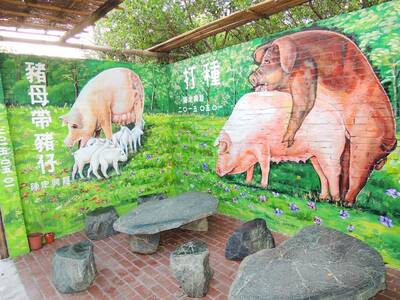
May 6 to May 12 Those who follow the Chinese-language news may have noticed the usage of the term zhuge (豬哥, literally ‘pig brother,’ a male pig raised for breeding purposes) in reports concerning the ongoing #Metoo scandal in the entertainment industry. The term’s modern connotations can range from womanizer or lecher to sexual predator, but it once referred to an important rural trade. Until the 1970s, it was a common sight to see a breeder herding a single “zhuge” down a rustic path with a bamboo whip, often traveling large distances over rugged terrain to service local families. Not only

Ahead of incoming president William Lai’s (賴清德) inauguration on May 20 there appear to be signs that he is signaling to the Chinese Communist Party (CCP) and that the Chinese side is also signaling to the Taiwan side. This raises a lot of questions, including what is the CCP up to, who are they signaling to, what are they signaling, how with the various actors in Taiwan respond and where this could ultimately go. In the last column, published on May 2, we examined the curious case of Democratic Progressive Party (DPP) heavyweight Tseng Wen-tsan (鄭文燦) — currently vice premier
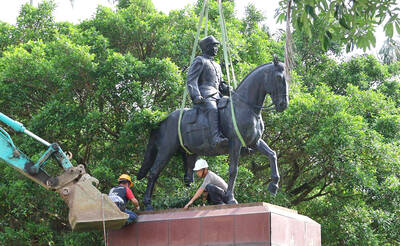
The last time Mrs Hsieh came to Cihu Park in Taoyuan was almost 50 years ago, on a school trip to the grave of Taiwan’s recently deceased dictator. Busloads of children were brought in to pay their respects to Chiang Kai-shek (蔣中正), known as Generalissimo, who had died at 87, after decades ruling Taiwan under brutal martial law. “There were a lot of buses, and there was a long queue,” Hsieh recalled. “It was a school rule. We had to bow, and then we went home.” Chiang’s body is still there, under guard in a mausoleum at the end of a path

Last week the Directorate-General of Budget, Accounting and Statistics (DGBAS) released a set of very strange numbers on Taiwan’s wealth distribution. Duly quoted in the Taipei Times, the report said that “The Gini coefficient for Taiwanese households… was 0.606 at the end of 2021, lower than Australia’s 0.611, the UK’s 0.620, Japan’s 0.678, France’s 0.676 and Germany’s 0.727, the agency said in a report.” The Gini coefficient is a measure of relative inequality, usually of wealth or income, though it can be used to evaluate other forms of inequality. However, for most nations it is a number from .25 to .50


 RSS
RSS