


Maybe it is the cobblestone byways that meander through Vilnius and appear more suited for horses than horsepower. Perhaps it is the unexpectedly historic architecture or the hulking castles that whisper of medieval derring-do. While modernity certainly intrudes — it would not be a European capital without its Prada and Ermenegildo Zegna stores, now would it? — somehow or other, this Lithuanian city, despite its many recent changes, often has the feel of an old-world diorama sprung to life.
Lithuania may seem little more than a crossword puzzle answer, one of the many nations that came back to life after the collapse of communism, but like its Baltic siblings, Latvia and Estonia, it has turned its gaze and ambitions westward, and its back to Moscow. In Vilnius, you'll find an easygoing, appealing and less expensive alternative to Paris or Prague.
Restaurants and museums proliferate in this city of 550,000, and well-established hotel chains, not to mention stylish boutique hotels, have staked their claims in recent years. Ramada and Novotel have opened in the city center, and Kempinski will soon as well. Le Meridien, a high-end hotel and conference center on the city's outskirts, even has a golf school. At many hotels, Wi-Fi and other high-tech staples are a given.
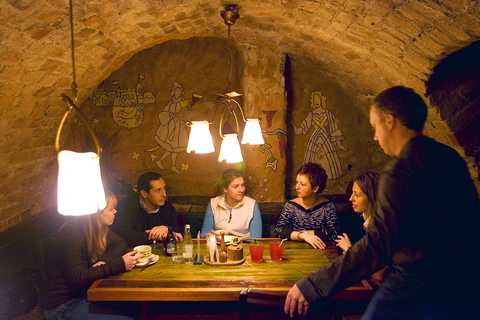
On the streets, it is readily apparent that young people, who have little if any memories of Soviet domination, have embraced Western European mores, hence all those fashion shops. English has replaced Russian as the second language of public life, after Lithuanian.
In whatever language, people are welcoming. On a recent visit, my wife, Julie Dressner, and I chatted our way from peddler to peddler on Pilies Street in the heart of the old city. Many were selling jewelry and other items made from amber. We ended up buying a handsome fruit bowl hawked by a craftsman from an outlying village who had carved it from birch.
In the Old Town, it is not difficult to get lost among the crazy-quilt streets, and you may be thankful that you do, especially when you alight at places like St. Anne's Church, as curious and enthralling a Gothic edifice as you will find. Go ahead, squint. The facade truly is made of exposed bricks of numerous shapes, even the spires, as if someone turned loose a master builder with a masonry Lego set.
All over Vilnius, night life is lively and unpretentious. At a DJ bar in the Old Town called Tipo Zoro, where a cozy section in the back is furnished with vinyl bucket seats apparently yanked from old vans, a table of Lithuanians invited Julie to join them while she waited for the bathroom. Similarly cheerful residents lingered in groups in front of many spots, and were eager to strike up conversations with foreigners.
Like the nation itself, food culture has blossomed, and you can sample everything from Greek to Chinese. In search of local fare, we ended up at Forto Dvaras, a restaurant that is a bit of a Lithuanian culinary theme park. Rustic furniture, staff in national costumes and a menu laden with blini, pancakes and giant dumplings called zeppelin (my 9-year-old daughter, Danya, has something of a sour cream addiction, and she was not disappointed). California spa cuisine, it is not. But portions were tasty and sizable, and the bill for six for lunch was only the equivalent of US$35.
The contemporary art scene has also taken off. The city recently established an avant-garde visual arts center named after the Lithuanian-American filmmaker and counterculture icon Jonas Mekas, a fellow traveler of Andy Warhol and Allen Ginsberg. The roster of private galleries seems to grow every month, taking advantage of a robust economy and a rich artistic history.
One morning, we showed up at the doorstep of a 15th-century Gothic building on town hall square that is the home of an esteemed Lithuanian painter, Kazys Varnelis. The building is also a museum, and though we didn't have an appointment, the soft-spoken, long-haired young curator, Vidas Poskus, was soon giving us a free private tour of Varnelis' sprawling, eclectic collection. It includes antique books and maps of Eastern Europe and elsewhere, Renaissance furniture, illustrations, paintings and sculpture.
Then there are Varnelis' own creations, which often use geometric patterns to create optical illusions, and are sometimes described as a modernist interpretation of Lithuanian folk art. My three children found his work — which is also in the Guggenheim in New York, the Art Institute of Chicago and other museums — transfixing.
Like some of his compatriots, Varnelis, 90, went into exile in the US after World War II and returned to Lithuania only in the 1990s. "He wanted to come back for emotional reasons — homesickness and patriotism," Poskus told us. "It was important for him to donate his collection to his people."
PHOTOS: NY TIMES NEWS SERVICE
If Varnelis symbolizes the revival here, shards of the nation's mournful past exist as well, and it is worth acknowledging them. At the National Museum, a grim current exhibit describes the exiling of Lithuanians to Siberian gulags and other repressive measures carried out by Stalin and his successors after Moscow invaded and turned independent Lithuania into a vassal Soviet republic. Not far away is the Museum of Genocide Victims, known as the KGB museum, in a former prison where the Soviet secret police once imprisoned, tortured and killed Lithuanian nationalists, dissidents and others. The cells are intact, and you can walk them.
A century ago, Julie's great-grandfather emigrated to New York from the Jewish quarter of Vilnius, at the time one of the world's most vibrant Jewish communities, later decimated by the Nazis. He recalled in unpublished memoirs that after he arrived in Vilnius on his own as a teenager to attend yeshiva, the sense of kinship among Jews was so deep that an informal network made sure he and other poor students did not go hungry. "Every night, those who could afford to invited a boy to his home," he wrote.
Before our trip, we read his memoirs, and we wondered: was anything left?
So we wandered the site of the former Jewish quarter, spotting only a few instances of Jewish stars and Hebrew writing chiseled into buildings, then feeling a little more hopeful when we reached the restored synagogue on Pylimo Street, one of the few Jewish institutions to survive the war.
After visiting the city's Holocaust museum, in a small green cottage set back from a main road, and viewing maps and photographs of the two ghettos where Jews were detained, we realized how little the footprint of the city had changed. In some places, what now look like quaint gates were once covered with barbed wire.
Relying extensively on witness testimony and original documents, the museum offers a timeline of the Jewish community's ascent and destruction in Vilnius. Larger Holocaust museums may present comparable exhibits, but to gaze upon them here, after walking those very same streets, is especially affecting.
While we tried to shield our children from some of the more graphic museum exhibits on Nazi and Soviet atrocities, plenty in Vilnius engaged them. One afternoon we hiked up a cobblestone path to the Higher Castle Museum. First constructed in the 13th century, the castle offers lovely views of the city from its open-air roof, as well as exhibits of medieval weaponry. (If you don't want to walk up the hill, you can ride a funicular.)
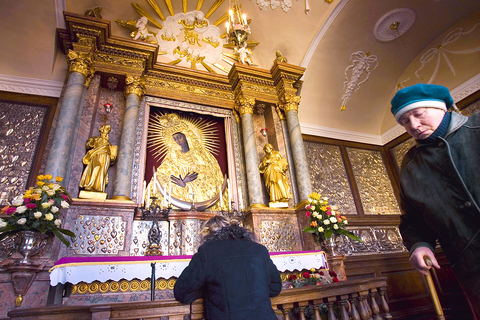
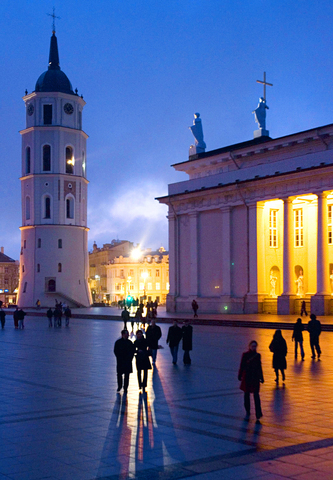
Another walk brought us to the Gates of Dawn, a bulwark that blocks a narrow road. Once part of the city's original fortifications, it was later transformed into a small chapel containing a venerated icon that has long drawn pilgrims, including Pope John Paul II. On Cathedral Square, the city's main cathedral, which has several chapels and bell towers, is another prominent attraction.
In fact, the Old Town has an alluring mishmash of architecture — from Gothic to neo-Classical and more — and locals say Vilnius has one of the world's largest assortments of Baroque buildings. Whatever the style, the place sure is nice to gaze upon, whether you are lugging around an architectural tome or, as we did, simply enjoying going astray among the narrow streets.
WHERE TO EAT and WHAT TO DO
* Forto Dvaras, 16 Pilies St, (370-5) 261-1070; www.fortodvaras.lt. Typical Lithuanian food, heavy on the quaint atmosphere and sour cream, light on the wallet. Dinner for two is about 70 litas (US$27 at 2.6 litas to the dollar).
* Kazys Varnelis House Museum, 26 Didzioji St, (370-5) 279-1644. Works painted and collected by the artist Kazys Varnelis, viewable by appointment only. Admission is free. Admission to the following museums is 8 litas or less, depending on age and student status.
* Higher Castle Museum, 5 Arsenalo St; (370-5) 261-7453. Views of the city, along with military exhibits.
* Holocaust Museum, 12 Pamenkalnio St; (370-5) 262-0730. A small, deeply affecting museum on the massacre of the nation's Jews.
* Museum of Genocide Victims, 2A Auku St; (370-5) 266-3282; http://www.genocid.lt/muziejus/en/. A history of communist oppression.
* National Museum, 1 Arsenalo St; (370-5) 262-9426; www.lnm.lt. An overview of Lithuanian culture and art.

In late October of 1873 the government of Japan decided against sending a military expedition to Korea to force that nation to open trade relations. Across the government supporters of the expedition resigned immediately. The spectacle of revolt by disaffected samurai began to loom over Japanese politics. In January of 1874 disaffected samurai attacked a senior minister in Tokyo. A month later, a group of pro-Korea expedition and anti-foreign elements from Saga prefecture in Kyushu revolted, driven in part by high food prices stemming from poor harvests. Their leader, according to Edward Drea’s classic Japan’s Imperial Army, was a samurai

The following three paragraphs are just some of what the local Chinese-language press is reporting on breathlessly and following every twist and turn with the eagerness of a soap opera fan. For many English-language readers, it probably comes across as incomprehensibly opaque, so bear with me briefly dear reader: To the surprise of many, former pop singer and Democratic Progressive Party (DPP) ex-lawmaker Yu Tien (余天) of the Taiwan Normal Country Promotion Association (TNCPA) at the last minute dropped out of the running for committee chair of the DPP’s New Taipei City chapter, paving the way for DPP legislator Su
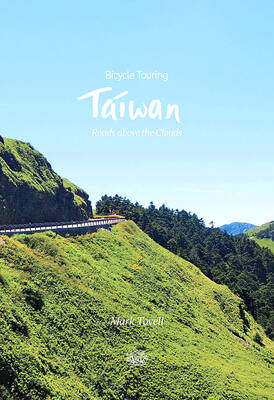
It’s hard to know where to begin with Mark Tovell’s Taiwan: Roads Above the Clouds. Having published a travelogue myself, as well as having contributed to several guidebooks, at first glance Tovell’s book appears to inhabit a middle ground — the kind of hard-to-sell nowheresville publishers detest. Leaf through the pages and you’ll find them suffuse with the purple prose best associated with travel literature: “When the sun is low on a warm, clear morning, and with the heat already rising, we stand at the riverside bike path leading south from Sanxia’s old cobble streets.” Hardly the stuff of your
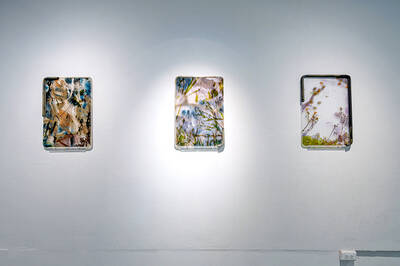
Located down a sideroad in old Wanhua District (萬華區), Waley Art (水谷藝術) has an established reputation for curating some of the more provocative indie art exhibitions in Taipei. And this month is no exception. Beyond the innocuous facade of a shophouse, the full three stories of the gallery space (including the basement) have been taken over by photographs, installation videos and abstract images courtesy of two creatives who hail from the opposite ends of the earth, Taiwan’s Hsu Yi-ting (許懿婷) and Germany’s Benjamin Janzen. “In 2019, I had an art residency in Europe,” Hsu says. “I met Benjamin in the lobby


 RSS
RSS