


"The new people were strange, violent and hard to understand. Occasionally, some were captured, and if they survived and learnt your language, they might confide something of their customs and beliefs. Mostly, though, you could only watch what they did, or try making sense of them from their tools and artifacts. You might see them coming ashore from one of their floating islands, or drinking blood. Sometimes, when you killed one of them, or if a floating island smashed against the rocks, axes of a hard, mysterious material were left behind, or thin medallions of metal you could use as jewelry. Strangest of all, was when these white, hairy, stinking people erected a piece of wood, with another set across it, and then fixed on this construction the image of a bleeding, tortured man."
This is how Daniel Richter begins his book Facing East from Indian Country, a marvelous attempt to reconstruct what early encounters between Native Americans and Europeans might have looked like from the point of view of the former. That this imaginative effort is only rarely attempted reveals a lot about the power relations that ultimately ensued from these encounters. A wide variety of early modern European reportage survives about the indigenous peoples of the Americas. But how they viewed successive European invaders, with their sailing ships, goblets of red wine, metal coins and weaponry, and their worship of a wooden cross, is very hard and usually impossible to recover. Native Americans did not write in ink on paper. Nor did they possess secure means of preserving their own carved records and drawings. And, anyway, most of these people were wiped out.
Yet unless we remember that these encounters were not just two-sided, but many-sided — that different indigenous peoples, too, must have possessed widely varying views of what was happening — it becomes easy to succumb to a kind of Eurocentric narcissism. The Europeans' gaze, however much it may be criticized, becomes the only one to be investigated.

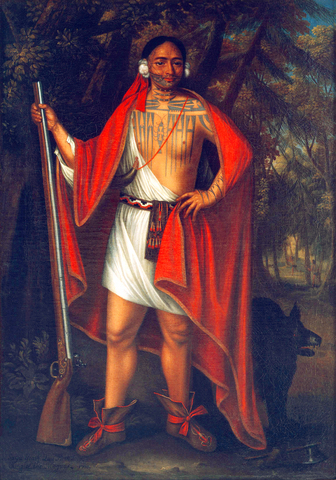
A New World: England's First View of America at the British Museum displays the watercolors of John White, the first Englishman (perhaps) to portray some of the flora, fauna and indigenous people of North America; in the National Portrait Gallery's Between Worlds: Voyagers to Britain 1700-1850, the star exhibits are the Dutch artist John Verelst's four full-length portraits of Indian Kings, on loan from Canada. These men were not in fact kings, but self-appointed envoys of the Iroquois confederacy of tribes from the borderlands between Canada and what is now upper New York state. They were painted in London in 1710 while on a visit designed to cement Iroquois military support for the British in their struggles with the French for imperial supremacy in North America.
All of these Native American images are products of imperial initiatives. John White seems to have made five voyages to the New World between 1584 and 1590. Most of his drawings and paintings of America derived from an expedition of seven ships that set out from Plymouth in April 1585. Sponsored by Walter Raleigh, its aim was to win the English a permanent colony in what was then termed "Virginia," present-day North Carolina. The time is long past when Raleigh and his kind can simply and acceptably be viewed as bluff English seadogs braving "the raging sea, and the uncertainties of many dangers."
In the early 21st century, we are more likely to be shocked by the cultural, theological and racial condescension, and the greed and violence with which some of these men treated native peoples. This shift in vision has become so pronounced that, as the historian John Elliott remarks, past European explorers and voyagers can themselves now easily end up being damningly and indistinguishably "othered": re-represented for contemporary consumption as pioneers only and unvaryingly of racism. Thus one of the scholarly contributors to the very fine catalogue accompanying this British Museum exhibition argues that the absence of European figures in White's images was intended to preserve and promote "distance between colonizers and colonized", and that this "was and would remain a characteristically English approach to their growing empire."
To the extent that the British, were overwhelmingly Protestant, this is a valid comment. Unlike their Spanish, Portuguese and French competitors, these colonizers possessed no religious orders, no substantial shock troops of professionally single males who could compile masses of information on indigenous peoples and devote themselves full-time to converting them to Christianity. And because early Protestant colonizers were far less likely than their Catholic counterparts to work at converting non-whites, they were also less likely to marry them. None the less, in White's North America, as in subsequent imperial sites, English responses to indigenous peoples seem to have varied markedly according to time, place, context, and the personalities, power and status of the individuals involved. Thus, the images that White chose to produce were determined in part by the fact that he was well educated and well connected. He was armigerous, evidently accustomed to servants, and sometimes voyaged to the New World accompanied by suits of armor and books.
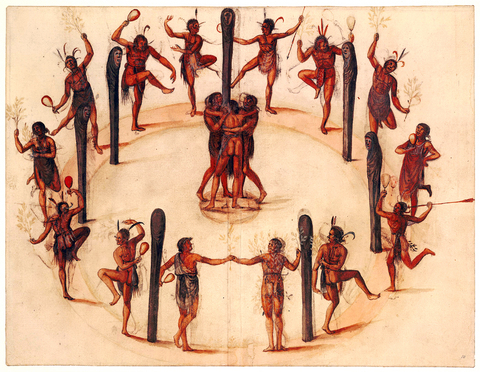
Accordingly, the Native Americans whom White drew and painted were disproportionately, as the British Museum show makes clear, Algonquian chiefs and their wives, medicine men and village elders: people of authority and rank, in other words, who seem to have signaled this — just as English elite individuals did — through the wearing of particular costumes and jewels, and through an arrogance of body. Or, at least, this is how White represents them.
As is true of all visual images of encounters in the past, there is no way of establishing how far the artist strove for accurate reportage, or how far he depicted what he or his patrons expected or wanted to see. It seems likely that he wanted, at one level, to produce positive images of the Algonquian settlements he visited, so as to encourage English investment in Raleigh's colonizing projects. White's subjects are often represented smiling, as if in welcome of strangers; and his drawings of pineapples, plantains, medicinal plants, grouper fish and crabs can be viewed as advertisements for Virginia's wholesomeness, abundance and fertility — as lures for potential settlers. But not all of his images lend themselves to being read so straightforwardly as colonialist propaganda. Consider his moving watercolor of the wife of a werowance, or chief, and her very young, chubby daughter. The latter is painted carrying an expensive doll in English costume, apparently given her by the incomers. We may interpret this detail, if we choose, as an emblem of imperialist intent. Once a colony is planted here, White may be implying, high-ranking but nearly naked girl children such as this will be duly transformed into decently dressed pseudo-Englishwomen. This may not be the only, or even a correct interpretation, however. In the painting, neither the child nor the mother looks at the doll. And they do not gaze at the artist, or out at an imagined audience. Mother and child appear instead to have their own concerns, their own points of reference, which are not necessarily those of the intruders at all. By the same token, when he painted this and other images of native women with their offspring, White may have wanted to signal that Virginia was a good place for breeding humans as well as wildlife, and therefore ripe for settlement. Conversely, White's images of Native Americans' reproductive health might have been interpreted by some as evidence that Virginia was already well populated, especially as he never produced paintings of wilderness and open spaces.
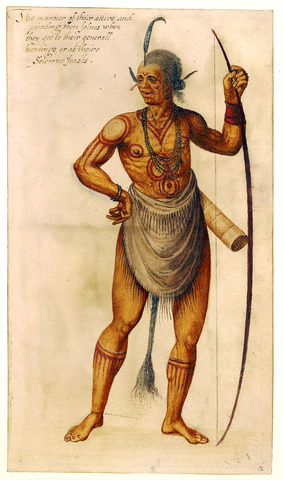
History suggests that the chubby little girl in White's painting almost certainly never got the chance to grow up. She may have died shortly after he painted her, overwhelmed by mumps, measles, flu, smallpox, or by another of the diseases the English intruders had unknowingly imported, and against which Native Americans possessed no natural immunity. Already, in the 1580s, White and his co-voyagers were aware that some of the villages they visited subsequently suffered heavy mortality, though they did not comprehend why.
It was in the 17th century, though, when large numbers of English children started arriving and being born in coastal North America, that the decimation of its indigenous population seriously got under way. Over the course of the 1600s, native communities scattered along the eastern seaboard may have suffered mortality rates of up to 90 percent. Accordingly, it is easy — and, to a degree, it is right — to be struck by the pathos of White's images. These beautiful, muscular, intricately tattooed people in their seemingly unspoilt communities are of course unaware of what we know now: that the snake has entered their Eden, and perhaps nothing will ever be the same for them again. Hindsight, though, can distort. Native communities were in reality very rarely Edenic. By no means all of the changes in indigenous experience at this time were effected by European invasions; and some Native Americans proved notably resilient and inventive in the face of the invaders. Such resilience could be assisted by rivalry among the different European powers. So long as the British, French and Spanish empires were in contention for particular tracts of land, locals could — very occasionally — seek to play them off against each other and extract various favors. The four men on show in John Verelst's striking canvases in the National Portrait Gallery were doing exactly this. They were brought to London in 1710 because the British were eager to secure Iroquois aid for a projected invasion of French Canada. While in the capital, the men were feted, twice given audience by Queen Anne, and abundantly painted and engraved. Verelst's images are the most famous. They are remarkable in part because — like White's paintings — they are so individualized.
Verelst painted his subjects as comely dignitaries and diplomats, each with different physiognomies and tattoo markings. Only in one sense are they standardized. The men are posed after the fashion that early modern European artists employed for elite males from their own continent, with one arrogant arm akimbo, one leg extended and with tokens displaying their rank. Thus the Emperor of the Six Nations is painted accompanied by a wolf, which serves as the equivalent of his heraldic beast, and with a wampum belt, a sign of communication and statecraft. In reality, only one of these men seems to have possessed real claims to be a sachem, a chief. The British were seeking to make use of the Iroquois. But there was a sense in which these young men on the make were also using their British hosts. Moreover, just as Raleigh's attempts to found "Virginia" in the 1580s failed, so London's plans in 1710 to invade French Canada proved a total disaster. This is perhaps the final, piquant challenge posed by these exhibitions. The Native American images on show are records not simply of English and British imperial power. They are, rather, relics of some of the many setbacks and failures that this empire experienced, especially in its early stages. In regard to these particular paintings, it is not only the natives who will know defeat.
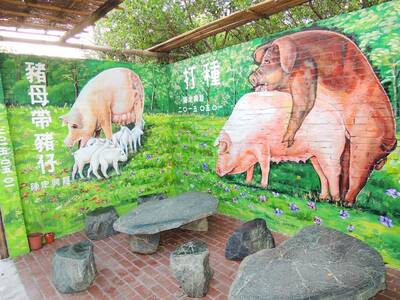
May 6 to May 12 Those who follow the Chinese-language news may have noticed the usage of the term zhuge (豬哥, literally ‘pig brother,’ a male pig raised for breeding purposes) in reports concerning the ongoing #Metoo scandal in the entertainment industry. The term’s modern connotations can range from womanizer or lecher to sexual predator, but it once referred to an important rural trade. Until the 1970s, it was a common sight to see a breeder herding a single “zhuge” down a rustic path with a bamboo whip, often traveling large distances over rugged terrain to service local families. Not only

Ahead of incoming president William Lai’s (賴清德) inauguration on May 20 there appear to be signs that he is signaling to the Chinese Communist Party (CCP) and that the Chinese side is also signaling to the Taiwan side. This raises a lot of questions, including what is the CCP up to, who are they signaling to, what are they signaling, how with the various actors in Taiwan respond and where this could ultimately go. In the last column, published on May 2, we examined the curious case of Democratic Progressive Party (DPP) heavyweight Tseng Wen-tsan (鄭文燦) — currently vice premier
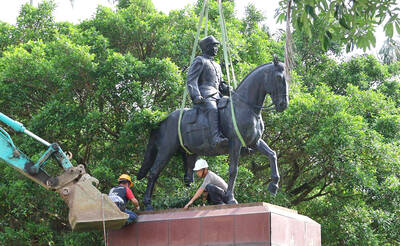
The last time Mrs Hsieh came to Cihu Park in Taoyuan was almost 50 years ago, on a school trip to the grave of Taiwan’s recently deceased dictator. Busloads of children were brought in to pay their respects to Chiang Kai-shek (蔣中正), known as Generalissimo, who had died at 87, after decades ruling Taiwan under brutal martial law. “There were a lot of buses, and there was a long queue,” Hsieh recalled. “It was a school rule. We had to bow, and then we went home.” Chiang’s body is still there, under guard in a mausoleum at the end of a path

Last week the Directorate-General of Budget, Accounting and Statistics (DGBAS) released a set of very strange numbers on Taiwan’s wealth distribution. Duly quoted in the Taipei Times, the report said that “The Gini coefficient for Taiwanese households… was 0.606 at the end of 2021, lower than Australia’s 0.611, the UK’s 0.620, Japan’s 0.678, France’s 0.676 and Germany’s 0.727, the agency said in a report.” The Gini coefficient is a measure of relative inequality, usually of wealth or income, though it can be used to evaluate other forms of inequality. However, for most nations it is a number from .25 to .50


 RSS
RSS