


The Science of Sleep, Michel Gondry's beguiling new film, is so profoundly idiosyncratic, and so confident in its oddity, that any attempt to describe it is bound to be misleading. While points of comparison are available — to Human Nature and Eternal Sunshine of the Spotless Mind, Gondry's collaborations with Charlie Kaufman; to early Surrealist artworks or the later films of Luis Bunuel — they don't do much to illuminate the puzzling, mostly delightful experience of watching The Science of Sleep unfold.
So it may be best to tack in the opposite direction, with a description that is no less accurate for seeming completely illogical. What I'm trying to say is that The Science of Sleep, for all its blithe disregard of the laws of physics, film grammar and narrative coherence, strikes me as perfectly realistic, as authentic a slice of life as I've encountered on screen in quite some time.
Some immediate qualification is called for, since the life that Gondry explores, in a spirit at once rigorous and playful, is the inner life of an eccentric, somewhat troubled fellow. Filmed in not-especially-glamorous parts of Paris, the film takes place in a zone where dreams, wishes and fears mingle with, and at times obliterate, the literal facts of everyday existence.
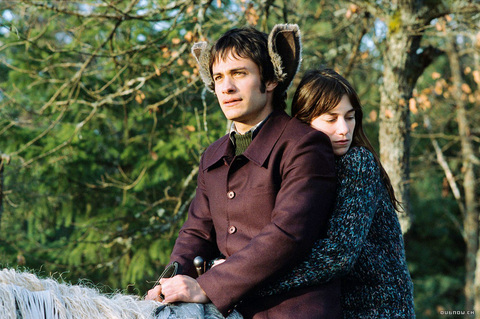
Beginning deep inside the head of its hero, an anxious young man named Stephane (Gael Garcia Bernal), The Science of Sleep creates a world of intense peculiarity, where time seems to move in loops and curlicues, and where the basic axiom that a thing and its opposite can't both be true seems not to apply.
Plot summary, therefore, is both irrelevant and impossible. Which is not to say that the movie lacks a story, only that, like a dream, the narrative moves sideways as well as forward, revising and contradicting itself as it goes along. Gondry, who would rather invent than explain, makes a plausible case that a love story (which is what The Science of Sleep is) cannot really be told any other way. Love is too bound up with memories, fantasies, projections and misperceptions to conform to a conventional, linear structure.
Arriving in Paris from Mexico to stay with his mother (Miou-Miou), Stephane stumbles into a stop-and-go romance with Stephanie (Charlotte Gainsbourg), a skittish neighbor. Actually, what happens is that her piano falls on him, a bit of cartoon slapstick that Gondry stages with insouciant matter-of-factness. Stephane's eye is first caught by Stephanie's friend Zoe (Emma de Caunes), who is more conventionally pretty but lacks Stephanie's charming strangeness. Still, the initial confusion over the two women is not so easily dispelled, and even before it begins, Stephanie and Stephane's relationship is shadowed by doubt, jealousy and confusion.
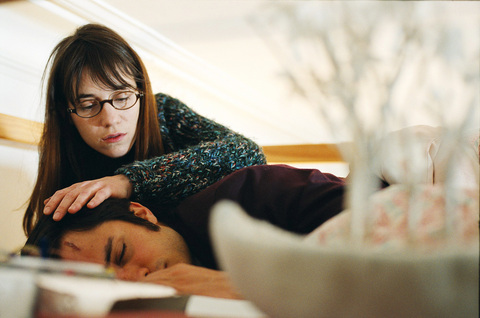
Bernal and Gainsbourg resemble a pair of fine-boned, exotic birds, exchanging tentative mating calls in their differently accented English (his tinged with Spanish, hers an eerily perfect echo of her mother, the British actress Jane Birkin).
Their awkward flirtation is also an artistic collaboration. Stephane, an aspiring illustrator (whose mother has found him a job working for a calendar company), also tinkers with improbable gadgets, like a one-second time machine made from a rewired old toy. For her part, Stephanie fashions dioramas out of felt and old stuffed animals.
And Gondry, who sharpened his eye making commercials and music videos, is a kindred spirit. He forgoes computerized special effects in favor of stop-motion animation and papier-mache, finding magical possibilities in homely materials and ordinary situations. Stephane's job, for instance, is a familiar nightmare of daily drudgery with annoying colleagues (including the spectacularly obnoxious Guy, played by Alain Chabat), but also a source of perpetual surprise and, for the audience, comic enchantment.
Gondry's debt to Surrealism lies in his embrace of the notion that the unconscious is a kingdom governed by its own perverse logic, beyond the control of reason. His vision of the unconscious, however, is remarkably benign. The dream world of The Science of Sleep is not haunted by primal sexual terror or constructed for purposes of social criticism, the way Bunuel's landscapes were. It has, instead, a wide-eyed, picture-book quality, an air of almost aggressive innocence.
After a while, the spell wears off. Not because the film's inventiveness wanes, but because its mood changes, slowly but noticeably, from eager enthrallment to desperation. The gray of daylight seeps in around the edges, and Stephane's dreams become less an escape from the frustrations of ordinary life than another potential source of disappointment. His childlike behavior, especially around Stephanie, begins to seem intemperate and regressive, a petulant refusal to wake up into the rational, adult world.
And so you leave this buoyant, impish movie feeling a little blue: sorry that it had to end and also wishing, perhaps, that it amounted to more. But its fugitive, ephemeral quality is part of its point: dreams, after all, are hard to remember, and perhaps don't hold the meanings they seem to. Without them, though, our minds would be emptier and our lives much smaller. So while The Science of Sleep may not, in the end, be terribly deep, it is undoubtedly — and deeply — refreshing.

In late October of 1873 the government of Japan decided against sending a military expedition to Korea to force that nation to open trade relations. Across the government supporters of the expedition resigned immediately. The spectacle of revolt by disaffected samurai began to loom over Japanese politics. In January of 1874 disaffected samurai attacked a senior minister in Tokyo. A month later, a group of pro-Korea expedition and anti-foreign elements from Saga prefecture in Kyushu revolted, driven in part by high food prices stemming from poor harvests. Their leader, according to Edward Drea’s classic Japan’s Imperial Army, was a samurai

The following three paragraphs are just some of what the local Chinese-language press is reporting on breathlessly and following every twist and turn with the eagerness of a soap opera fan. For many English-language readers, it probably comes across as incomprehensibly opaque, so bear with me briefly dear reader: To the surprise of many, former pop singer and Democratic Progressive Party (DPP) ex-lawmaker Yu Tien (余天) of the Taiwan Normal Country Promotion Association (TNCPA) at the last minute dropped out of the running for committee chair of the DPP’s New Taipei City chapter, paving the way for DPP legislator Su
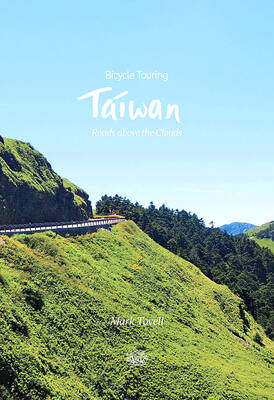
It’s hard to know where to begin with Mark Tovell’s Taiwan: Roads Above the Clouds. Having published a travelogue myself, as well as having contributed to several guidebooks, at first glance Tovell’s book appears to inhabit a middle ground — the kind of hard-to-sell nowheresville publishers detest. Leaf through the pages and you’ll find them suffuse with the purple prose best associated with travel literature: “When the sun is low on a warm, clear morning, and with the heat already rising, we stand at the riverside bike path leading south from Sanxia’s old cobble streets.” Hardly the stuff of your
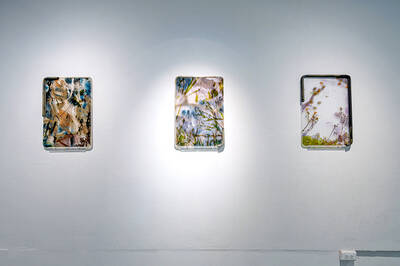
Located down a sideroad in old Wanhua District (萬華區), Waley Art (水谷藝術) has an established reputation for curating some of the more provocative indie art exhibitions in Taipei. And this month is no exception. Beyond the innocuous facade of a shophouse, the full three stories of the gallery space (including the basement) have been taken over by photographs, installation videos and abstract images courtesy of two creatives who hail from the opposite ends of the earth, Taiwan’s Hsu Yi-ting (許懿婷) and Germany’s Benjamin Janzen. “In 2019, I had an art residency in Europe,” Hsu says. “I met Benjamin in the lobby


 RSS
RSS