


With stunning swiftness, China's surging ranks of classical musicians have found a home in Western concert halls, conservatories and opera houses, jolting a musical tradition born in the courts and churches of Europe.
Large solo fees, plush orchestra jobs, an established audience and the presence of teachers steeped in the tradition have lured them to US and European cities. The phenomenon, which has been building for at least a decade, has gathered steam in the last few years, injecting new vitality into the US classical music scene after historic influxes of Italians, Germans and Russians, and more recently Japanese, Taiwanese and Koreans.
"I honestly think that in some real sense the future of classical music depends on developments in China in the next 20 years," said Robert Sirota, the president of the Manhattan School of Music. "They represent a vast new audience as well as a classical-music-performing population that is much larger than anything we've had so far. You're looking at a time when, maybe 20 to 40 years from now, Shanghai and Beijing are really going to be considered centers of world art music."
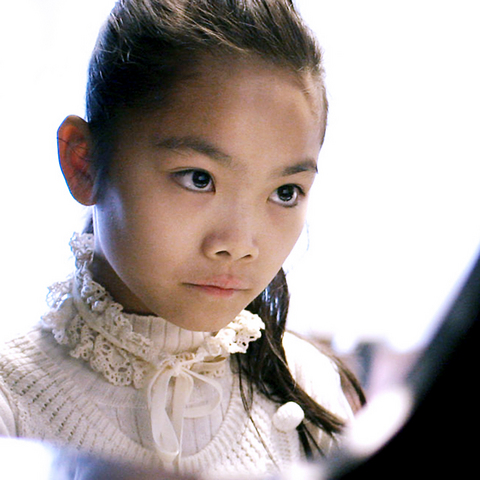
PHOTO: NY TIMES NEWS SERVICE
Cultural generalizations are always perilous. But many Western musicians and educators interviewed cited similar qualities in Chinese virtuosos: passion and refinement, expressiveness and brilliance. Chinese players seem less bound by the culture of conformity sometimes found in Asia, those Westerners said.
"Mainland China has a tremendous sense of going for it," said Paavo Jarvi, music director of the Cincinnati Symphony Orchestra. "There is something open. They are reaching out rather than holding back." And they have arrived.
Consider that the hottest artist on the classical music planet may well be the Chinese pianist Lang Lang (郎朗), 24, the darling of fans worldwide. The biggest event in the opera world last year was a Metropolitan Opera premiere by Tan Dun (譚盾), The First Emperor, which the Met hopes to take on tour to China next year.
In 2005, at the most recent Van Cliburn piano competition, a deeply Texan tradition in Fort Worth, eight of the 35 participants were Chinese, up from three in 2001 and one in 1991. One of the six finalists, Huang Chufang (黃初方), went on to win the Cleveland International Piano Competition in 2005. Chinese violinists and pianists now regularly win prizes in the world's other major competitions as well.
Along with Lang and another highly praised Chinese pianist, Li Yundi (李雲迪), also 24, a new crop of stars in their teens or barely out of them are on the way up. They include Wang Yuja (王羽佳), 20, a pianist studying at the Curtis Institute of Music in Philadelphia, already under major artists' management, and Chen Sa (陳薩), 17, another 2005 Cliburn finalist.
For several decades, Japanese and Korean musicians have formed a major presence in the West. In particular, they have long populated the string sections of professional orchestras. Chinese musicians have joined them in force and are winning high-profile positions. Ni Haiye (倪海葉), who was born in Shanghai in 1972, was appointed principal cellist of the Philadelphia Orchestra last fall. The Chicago and Pittsburgh symphony orchestras have assistant concertmasters born in China.
And not only string players: Wang Liang (王梁), 26, was recently named principal oboist of the New York Philharmonic, one of the most prestigious chairs in orchestral music.
Chinese talent has entered almost every area of the classical music world. A diverse group of composers like Tan, Bright Sheng (盛宗亮), Chen Yi (陳怡), and Zhou Long (周龍) have opened up a new sound world of Chinese-inflected rhythms, melodies, and harmonies for younger US and European composers. Chinese singers, whose culture has its own rich opera tradition, round out casts in major opera houses around the US.
Chinese conductors have in the last five years made the leap to prominent podiums, shaping orchestras and opera companies in music's most prominent role. Their arrival is felt especially in Europe, but the rising star Xian Zhang (張弦), 33, was recently named associate conductor of the New York Philharmonic.
It is in the elite Western conservatories that the presence of Chinese is perhaps most significant for the future. Talented Chinese have become a bonanza for music schools, where they are raising the technical bar and joining the already robust ranks of Koreans, Japanese, and Taiwanese. The wellspring is China's almost limitless pool of young musicians, a mounting number driven by increasing prosperity and nurtured by Chinese society's desire to compete with the West.
Music schools are sending administrators on recruitment trips to China or holding auditions there. Online applications from China to the New England Conservatory of Music in Boston have doubled in the last three years. The Eastman School of Music in Rochester, New York, sent its admissions director on a scouting mission in October, and the school has about 100 Chinese applicants for next year, twice what it had a decade ago.
Lin Yaoji, a prominent violin teacher at the Central Conservatory of Music in Beijing, makes every effort to have his brightest students study abroad at the earliest opportunity, he said, and he has placed many at top schools in Germany and the US. "It is not our own music, so we cannot make them feel it is their own," he added. "For that, they have to go abroad."
So, at Curtis, seven of the 20 piano students are China-born. Graffman, the former president, who still teaches there, said that four of his five current students are Chinese, including Wang Yuja, who performs with major orchestras around the world. Another, Hao Chen Zhang, 16, learned the 10 Rachmaninoff Op. 23 preludes over Christmas break.
"That's no joke," said Gary Graffman, the former president of the Curtis Institute and a member of the generation of piano virtuosos who came of age in the 1950s, like Eugene Istomin, Byron Janis, and Leon Fleisher. "These kids learn, frankly, in one week what it took me and my colleagues three months."
One of the brightest young lights in the demanding precollege division at the Juilliard School in New York is a 16-year-old clarinetist from Guangzhou, Wang Weixiong, an 11th-grader at the Professional Children's School in New York.
Wang picked up the clarinet at 10, studied at a local conservatory and, at a clarinet festival in Shanghai, met a Juilliard clarinet teacher, who invited him to study in New York, at 13. Like many young Chinese students, he came with his mother and lives with her in a two-bedroom apartment in the borough of Queens.
Wang's current teacher, Alan R. Kay, called him a "tremendous talent" and one of the five best students he has had in 20 years of teaching. "It's rare to find somebody that hot at his age," Kay said.
"My challenge is to calm him down," Kay added later. "He's a big showoff. I'm trying to teach him some dignity."
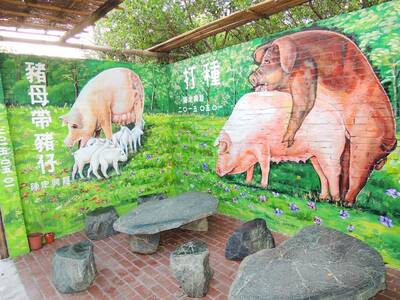
May 6 to May 12 Those who follow the Chinese-language news may have noticed the usage of the term zhuge (豬哥, literally ‘pig brother,’ a male pig raised for breeding purposes) in reports concerning the ongoing #Metoo scandal in the entertainment industry. The term’s modern connotations can range from womanizer or lecher to sexual predator, but it once referred to an important rural trade. Until the 1970s, it was a common sight to see a breeder herding a single “zhuge” down a rustic path with a bamboo whip, often traveling large distances over rugged terrain to service local families. Not only
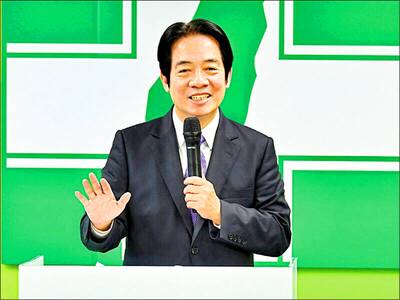
Ahead of incoming president William Lai’s (賴清德) inauguration on May 20 there appear to be signs that he is signaling to the Chinese Communist Party (CCP) and that the Chinese side is also signaling to the Taiwan side. This raises a lot of questions, including what is the CCP up to, who are they signaling to, what are they signaling, how with the various actors in Taiwan respond and where this could ultimately go. In the last column, published on May 2, we examined the curious case of Democratic Progressive Party (DPP) heavyweight Tseng Wen-tsan (鄭文燦) — currently vice premier

The last time Mrs Hsieh came to Cihu Park in Taoyuan was almost 50 years ago, on a school trip to the grave of Taiwan’s recently deceased dictator. Busloads of children were brought in to pay their respects to Chiang Kai-shek (蔣中正), known as Generalissimo, who had died at 87, after decades ruling Taiwan under brutal martial law. “There were a lot of buses, and there was a long queue,” Hsieh recalled. “It was a school rule. We had to bow, and then we went home.” Chiang’s body is still there, under guard in a mausoleum at the end of a path

Last week the Directorate-General of Budget, Accounting and Statistics (DGBAS) released a set of very strange numbers on Taiwan’s wealth distribution. Duly quoted in the Taipei Times, the report said that “The Gini coefficient for Taiwanese households… was 0.606 at the end of 2021, lower than Australia’s 0.611, the UK’s 0.620, Japan’s 0.678, France’s 0.676 and Germany’s 0.727, the agency said in a report.” The Gini coefficient is a measure of relative inequality, usually of wealth or income, though it can be used to evaluate other forms of inequality. However, for most nations it is a number from .25 to .50


 RSS
RSS